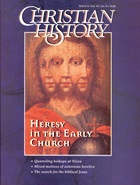
Heresy in the Early Church: Recommended Resources


The Big Picture
The Encyclopedia of Early Christianity, edited by Everett Ferguson (Garland, 1995), covers the bases (and often more) on all the items in this issue. One general work of special value is Stuart G. Hall’s Doctrine and Practice in the Early Church (Eerdmans, 1992).
Crystalline clarity marks Maurice Wiles’s The Christian Fathers (Oxford, 1982). He shows the influence of Greek philosophy on Christian theology.
Pride of place among textbooks goes to J.N.D. Kelly’s Early Christian Doctrines (Harper San Francisco, 1978). Its balance, lucidity, and helpful organization have put countless students in his debt. Jaroslav Pelikan’s The Emergence of the Catholic Tradition (100–600) (University of Chicago, 1971) is more impressionistic and written less with beginners in mind. But it is stronger than Kelly in long perspectives and illuminating insights.
The Big Issue
Central to Christian faith is the person of Christ himself. Volume 1 of Christ in Christian Tradition: From the Apostolic Age to Chalcedon (A.D. 451) by Aloys Grillmeier (John Knox, 1975) is massive, and massively learned, but inescapable for those who want to delve deeper.
Church historians continue to dispute Arius’s teaching, especially in respect to its intellectual roots and central concerns. Rowan Williams’s Arius: Heresy and Tradition (Darton, Longman, and Todd, 1987) is not easy going but remains at center stage. A fine introduction to the mind of the Arians’ greatest opponent is available in Alvyn Petterson’s Athanasius (Geoffrey Chapman, 1995).
The Big Debate
No book has created waves like Walter Bauer’s Orthodoxy and Heresy in Earliest Christianity. Its German original (1934) was finally translated into English in 1971 (Fortress). In an age inimical to tradition and authority, it fed the fashion of rehabilitating heresies and heretics by its (strictly historical) thesis. Bauer argued that teachings later condemned (in the later second century onward) were, in fact, dominant in the earliest decades of the church.
The full-scale response by H. E. W. Turner, The Pattern of Christian Truth (Mowbray, 1954), has not enjoyed the attention it deserves. Subtitled A Study in the Relations between Orthodoxy and Heresy in the Early Church, it represents a learned and sophisticated restatement of the traditional view: what became official orthodoxy was taught early on by the majority of church teachers, albeit not in fully developed form.
David Wright is senior lecturer in ecclesiastical history at the University of Edinburgh, Scotland. He is an editorial adviser for CHRISTIAN HISTORY.
Copyright © 1996 by the author or Christianity Today/Christian History magazine.
Click here for reprint information on Christian History.

Support Our Work
Subscribe to CT for less than $4.25/month