Hudson Taylor & Missions to China: Did You Know?


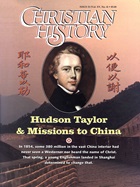
Hudson Taylor popularized—in the face of severe criticism at first—the now commonplace idea that missionaries should live and dress like the people they seek to evangelize.
When Taylor arrived in China in 1854, many Protestant missionaries were content to minister in the coastal cities. Taylor's example of pushing into the vast interior was one reason other missionaries began doing so as well.
Taylor—contrary to the mission conventions of his day—believed that single women were fully capable of managing distant mission outposts without the help of male missionaries.
Taylor's China Inland Mission was founded in 1865 on the premise that it would never solicit funds from donors but simply trust God to supply its needs. Today, 131 years later, though the organization has changed its name (to Overseas Missionary Fellowship [International]), it has not changed this policy.
Taylor battled severe depression all his life, both from the way he drove himself and because of the immensity of the task. Even after thousands of conversions, there were still some 400 million Chinese to reach. At one point late in life, he sank towards black despair, and "the awful temptation," as an unpublished note in the Taylor papers runs, "even to end his own life."
A heretic by the name of Olepen was the first missionary to China in 635. Olepen was a follower of Nestorian Christianity (See "Trickle-Down Evangelism," in this issue).
Travel to China took immense patience and courage for European and Middle Eastern missionaries. A trip from Rome to London was considered long in its day: about 1,000 miles. From Persia, the base of the Nestorians, to Chang-An, the Tang dynasty capital (now Xi'an), the trip covered 5,000 miles. Taylor's first trip to China, by sea, took half a year.
Franciscan missionary John of Monte Corvino gained many converts by buying young boys from their non-Christian parents, baptizing them, and then training them for ministry. Starting in 1294, he worked for 11 years in China and baptized more than 6,000 persons.
In the early 1800s, evangelism and printing Christian literature were capital offenses in China. It was even forbidden for foreigners to learn Chinese. Robert Morrison, the first Protestant missionary to China (who arrived in 1807), paid exorbitant fees to study Chinese. His two tutors lived in fear of torture by the Chinese officials. They carried poison so that if in danger, they could end their lives in Morrison's home rather than in a Chinese prison.
Whereas many Protestant missionaries of the 19th and 20th centuries worked with the lower classes, early Catholic missions focused on converting the elite. Jesuit Matteo Ricci, for example, who arrived in Peking in 1601, made inroads with the Chinese literati by demonstrating his fluency in classical and spoken Chinese, fixing watches, and making maps.
Because early Protestant missionaries were fluent in Chinese, they played key roles in international diplomacy. William A. P. Martin, a Presbyterian missionary, was responsible for the clause in the Treaty of Tientsin (Tianjin) (1858) that allowed missionaries to enter the interior of China to propagate the Christian religion. This treaty opened the way for Hudson Taylor's China Inland Mission.
In the 1860s, missionaries began opening schools for Chinese girls. This was a radical break with tradition: education for women was unheard of in China.
The largest massacre ever of Protestant missionaries took place in China in 1900. During the Boxer Rebellion, 188 Protestant adults and children were martyred.
China was the largest Protestant mission field in the world between 1830 and 1949. At its height, before the Chinese civil war of 1925-27, the number of missionaries topped 8,000.
In spite of the fact that missionaries were expelled in the early 1950s and Christians endured severe persecution in the mid-1960s, the number of Christians in China grew slowly to around 5 to 7 million by 1980. Many Christians simply went underground and worshipped in family churches.
The official, government-licensed church in China is called the Three-Self Church (which stands for self-government, self-support, and self-propagation); it repudiates foreign, missionary control of the Chinese church. The Three-Self idea, however, was not the invention of the early anti-foreign communist officials but was first employed by Presbyterian missionary John L. Nevius (1829-1893), who used it to evangelize and then plant indigenous churches in China.
Since the lifting of repression in the mid-1980s, the number of house churches has grown to over 200,000 today, and the number of Christians to nearly 50 million (though the Chinese government puts the figure at about 20 million).
Samuel Chao is assistant professor of Asian studies at Pepperdine University.
Copyright © 1996 by the author or Christianity Today/Christian History magazine.
Click here for reprint information on Christian History.

Support Our Work
Subscribe to CT for less than $4.25/month