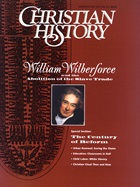
The "Shrimp" Who Stopped Slavery


Today one of his full portraits hangs in a pub. Another in the same town, Cambridge, hangs in a hotel. Another still, in his old college, St. John's. In each he peers at the world quizzically through small, bright eyes over a long, upturned nose. He was said to be "the wittiest man in England, and the most religious" (Madame de Stael), and one who possessed "the greatest natural eloquence of all the men I ever met" (William Pitt). When he spoke, another quipped, "The shrimp became a whale" (James Boswell). Historian G. M. Trevelyan called this "shrimp" the primary human agent for "one of the turning events in the history of the world."
It's hard to imagine that this man, with the gentle grin and the small, twisted body could move the world in a new direction. Yet William Wilberforce did.
Born on August 24, 1759, the third child of Robert and Elizabeth Wilberforce grew up surrounded by wealth. The Wilberforces had settled in Hull, England, at the beginning of the 1700s and made their wealth in the booming Baltic trade. When William was 9, his father died. The boy was sent to stay with his childless aunt and uncle, who were "great friends of Mr. [George] Whitefield." They exposed their young charge to the evangelical preaching of John Newton, the ex-slave trader. Years later Wilberforce spoke of "reverencing him as a parent when I was a child." Newton's immediate influence, however, was short lived.
Fearing her son might be infected by the "poison" of Methodism, his mother brought him back to Hull and enrolled him at his grandfather's old school at Pockington near York. His education as a gentleman continued among the commercial "aristocracy." He learned to play cards and sing and developed his gift of witty repartee.
He later wrote, "I was naturally a high-spirited boy and fiery. They [his friends] pushed me forward and made me talk a great deal and made me very vain." His grandfather's death in November 1774 left him richer still and more susceptible to the temptations of plenty.
In October 1776, Wilberforce entered St. John's College, Cambridge. His three years there were pleasant but unproductive. He had "unlimited command of money" and little academic pressure from his tutor.
"As much pains were taken to make me idle as were ever taken to make anyone studious," he later complained. His intellectual aspirations were no match for his passion for socializing. His neighbor, Thomas Gisborne, later recalled, "When he [Wilberforce] returned late in the evening to his rooms, he would summon me to join him. … He was so winning and amusing that I often sat up half the night with him, much to the detriment of my attendance at lectures the next day."
Wilberforce graduated the same year as the hard-working William Pitt (future prime minister). Their friendship grew throughout 1779. Together they watched Parliament from the gallery and dreamed of political careers.
In the summer of 1780, the ambitious Wilberforce stood for election as a Member of Parliament (MP) for Hull. He was only 21, and one of his opponents had powerful supporters. His chances of winning were slim.
In the campaign, Wilberforce relied on his charm, energy, tact, and powers of persuasion, and in the end, he secured as many votes as his opponents combined. He was to remain an MP, for various constituencies, for another 45 years.
"The first years I was in Parliament," he later wrote, "I did nothing-nothing that is to any purpose. My own distinction was my darling object." He frequented the exclusive clubs of St. James and acquired a reputation as a songster and wit who was professionally "careless and inaccurate in method." His fertile mind flitted from topic to topic. His early speeches, though eloquent, lacked focus and passion.
Starting in 1784, however, all that changed.
Birth of a Christian politician
In 1784, after his election as the mp for Yorkshire (one of the most coveted seats in the House of Commons), Wilberforce accompanied his sister Sally, his mother, and two of his cousins to the French Riviera (for the sake of Sally's health). He had also invited Isaac Milner, tutor at Queens' College, Cambridge, an acquaintance. Though friends counted "Wilber" both religious and moral, had he known that Milner's huge frame housed both a fine mathematical brain and a strong "methodistical" [evangelical] faith, it is unlikely he would have invited him. The combination was unimaginable in an English gentleman!
Milner's clear thought and winsome manner were effective advertisements for "serious" Christianity. Wilberforce had the quicker tongue, Milner the sharper mind. As they journeyed, they debated the evangelicalism of Wilberforce's youth.
Over the next months, Wilberforce read Philip Doddridge's The Rise and Progress of Religion in the Soul (1745) beside an open Bible. His reading and conversations with Milner convinced him of wealth's emptiness, Christianity's truth, and his own failure to embrace its radical demands. Outwardly he looked ever confident, but inwardly he agonized. "I was filled with sorrow," he wrote. "I am sure that no human creature could suffer more than I did for some months."
He considered withdrawing from public life for the sake of his faith. He confided in his friend Pitt, now prime minister. Pitt told him not to withdraw. With "ten thousand doubts," he approached John Newton. The aging saint advised him, "It is hoped and believed that the Lord has raised you up for the good of his church and for the good of the nation."
Wilberforce's unnatural gloom finally lifted on Easter 1786, "amidst the general chorus with which all nature seems on such a morning to be swelling the song of praise and thanksgiving." He believed his new life had begun.
His sense of vocation began growing within. "My walk is a public one," he wrote in his diary. "My business is in the world, and I must mix in the assemblies of men or quit the post which Providence seems to have assigned me." He also increasingly felt the burden of his calling: "A man who acts from the principles I profess," he later wrote, "reflects that he is to give an account of his political conduct at the judgment seat of Christ."
Finding his purpose
His diary for the summer of 1786 charts his painful search for greater discipline and a clearer vocation. He flitted between humanitarian and local causes, between parliamentary and national reform. He studied to correct his Cambridge indolence. He practiced abstinence from alcohol and rigorous self-examination as befit, he believed, a "serious" Christian.
After one dinner with Pitt, he wrote in his diary about the "temptations of the table," meaning the endless stream of dinner parties filled with vain and useless conversation. "[They] disqualify me for every useful purpose in life, waste my time, impair my health, fill my mind with thoughts of resistance before and self-condemnation afterwards."
In early 1786, Wilberforce had been tentatively approached by friends who were committed abolitionists. They asked him to lead the parliamentary campaign for their cause. Even Pitt prodded him in this direction: "Wilberforce, why don't you give notice of a motion on the subject of the slave trade?" But Wilberforce hesitated.
The slave trade in the late 1700s involved thousands of slaves, hundreds of ships, and millions of pounds; upon it depended the economies of Britain and much of Europe. Few were aware of the horrors of the so-called "Middle Passage" across the Atlantic, where an estimated one out of four slaves died.
Some Englishmen, including John Wesley and Thomas Clarkson, had taken steps to mitigate the evil. Yet few in England shared the abolitionists' sense that slavery was a great social evil. Some presumed that slaves were a justifiable necessity or that they deserved their plight.
For Wilberforce light began to dawn slowly during his 27th year. His diary for Sunday, October 28, 1787, shows with extraordinary clarity the fruit of prolonged study, prayer, and conversation. He realized the need for "some reformer of the nation's morals, who should raise his voice in the high places of the land and do within the church and nearer the throne what Wesley has accomplished in the meeting and among the multitude."
He also summed up what became his life mission: "God Almighty has set before me two great objects, the suppression of the slave trade and the reformation of manners" (i.e., morality).
Later he reflected on his decision about slavery: "So enormous, so dreadful, so irremediable did the trade's wickedness appear that my own mind was completely made up for abolition. Let the consequences be what they would; I from this time determined that I would never rest until I had effected its abolition."
Enormous foes
Wilberforce was initially optimistic, naively so, and expressed "no doubt of our success." He sought to stem the flow of slaves from Africa by international accord. The strength of his feelings and the support of prominent politicians like Pitt, Edmund Burke, and Charles Fox blinded him to the enormity of his task.
From his deathbed, John Wesley wrote him, "I see not how you can go through your glorious enterprise in opposing that execrable villainy, which is the scandal of religion, of England, and of human nature. Unless God has raised you up for this very thing, you will be worn out by the opposition of men and devils. But if God be for you, who can be against you?"
In May 1788, Wilberforce had recovered from another of his periodic bouts of illness to introduce a 12-point motion to Parliament indicting the trade. He and Thomas Clarkson (whom Wilberforce praised as central to the cause's success) had thoroughly researched and now publicized the trade's physical atrocities. But Parliament wanted to maintain the status quo, and the motion was defeated.
The campaign and opposition intensified. Planters, businessmen, ship owners, traditionalists, and even the Crown opposed the movement. Many feared personal financial ruin and nationwide recession if the trade ceased. Wilberforce was vilified. Admiral Horatio Nelson castigated "the damnable doctrine of Wilberforce and his hypocritical allies." One of Wilberforce's friends wrote fearing he would one day read of Wilberforce being "carbonadoed [broiled] by West Indian planters, barbecued by African merchants, and eaten by Guinea captains."
Wilberforce's spirit was indomitable, his enthusiasm palpable. As the slave owners' agent in Jamaica wrote, "It is necessary to watch him, as he is blessed with a very sufficient quantity of that enthusiastic spirit, which is so far from yielding that it grows more vigorous from blows."
The pathway to abolition was fraught with difficulty. Vested interest, parliamentary filibustering, entrenched bigotry, international politics, slave unrest, personal sickness, and political fear-all combined to frustrate the movement. It would take years before Wilberforce would see success.
Prime minister of philanthropy
The cause of the slaves was not Wilberforce's only concern. The second "great object" of Wilberforce's life was the reformation of the nation's morals. Early in 1787, he conceived of a society that would work, as a royal proclamation put it, "for the encouragement of piety and virtue; and for the preventing of vice, profaneness, and immorality." It eventually became known as the Society for the Suppression of Vice. Enlisting support from leading figures in church and state-and King George III-Wilberforce made private morality a matter of public concern.
Laws restricting drinking, swearing, and gaming on Sundays were enforced. "All loose and licentious prints, books, and publications" were suppressed, including Thomas Paine's The Age of Reason. Wilberforce was criticized for his "priggish" concerns, yet John Pollock, a recent biographer, wrote, "The reformation of manners grew into Victorian virtues and Wilberforce touched the world when he made goodness fashionable."
It has been estimated that Wilberforce-dubbed "the prime minister of a cabinet of philanthropists"-was at one time active in support of 69 philanthropic causes. He gave away a fourth of his annual income to the poor. He also gave an annuity to Charles Wesley's widow from 1792 until her death in 1822. He fought the cause of "climbing boys" (chimney sweeps) and single mothers. He sought the welfare of soldiers, sailors, and animals, and established Sunday schools and orphanages for "criminal poor children." His homes were havens for the marginalized and dispossessed.
Targeting the powerful as the agents of change, Wilberforce made common cause with Hannah More, the evangelical playwright, whose Thoughts on the Manners of the Greatappeared in 1787. "To expect to reform the poor while the opulent are corrupt," she wrote, "is to throw odors [perfume] on the stream while the springs are poisoned."
Clapham, a leafy village south of London, became a base for a number of these influential people, who became known as the "Clapham Sect." These bankers and diplomats, legislators, and businessmen shared a commitment to a godly life in public service. Their "vital" and "practical" Christianity expressed Wilberforce's vision of an integrated evangelicalism committed to a spiritual and a social gospel. The group's reputation for philanthropy and evangelical fervor spread. Warned one politician, "I would counsel my lords and bishops to keep their eyes upon that holy village."
Wilberforce's public struggles and success must be set against the background of his private joys and pains.
The public man's private side
Wilberforce's health was blighted by weak and painful eyes, a stomach prone to colitis, and a body that for many years had to be held upright by a crude metal frame. In his late 20s, he already wrote from his sickbed, "[I] am still a close prisoner, wholly unequal even to such a little business as I am now engaged in: add to which my eyes are so bad that I can scarce see to how to direct my pen."
His gloomy doctor reported, "That little fellow, with his calico guts, cannot possibly survive a twelve-month."
He did, though in the process he became dependent on small doses of opium, the nearest thing to an effective pain killer and treatment for colitis known at the time. Wilberforce was aware of opium's dangers and was not easily persuaded to take it. After taking it for some time, he noticed that omitting his nighttime dose caused sickness, sweating, and sneezing in the morning. Opium's hallucinatory powers terrified him, and the depressions it caused virtually crippled him at times.
His notebooks contain anguished prayers: "I fly to thee for succor and support, O Lord, let it come speedily. … I am in great troubles insurmountable by me. … Look upon me, O Lord, with compassion and mercy, and restore me to rest, quietness, and comfort in the world, or in another by removing me hence into a state of happiness." In his later years, he showed the long-term effects of opium use, particularly listlessness and amnesia.
His marriage to Barbara Spooner, in 1797, brought him much joy. On the other hand, the financial ineptitude of his oldest son in 1830 (reducing his parents to a peripatetic existence in their children's homes) and the death of his second daughter in 1832 caused his final years to be overshadowed by grief and poverty. (In time three of his four sons became Roman Catholics, one an adversary of Lord Shaftesbury, Wilberforce's successor in many ways).
Wilberforce's life was not without criticism. Some see in his sons' five-volume Lifemuted praise of both his evangelicalism and his parenting. Opponents of abolition bitterly denounced both his character and his cause. A Wimbledon man, Anthony Fearon, attempted blackmail (causing Wilberforce to write, "At all events, he must not be permitted to publish"), but the precise grounds are not known.
Through all this, Wilberforce drew spiritual and intellectual strength from the Bible and the Puritans (such as Richard Baxter, John Owen, and Jonathan Edwards), and built his evangelical faith on a mildly Calvinist foundation.
Philip Doddridge's Rise and Progress of Religion in the Soul continued to shape his spirituality: daily self-examination, and extended times of prayer, regular Communions and fasting, morning and evening devotions, and times of solitude. He also paid careful attention to God's providential provision in his life, the needs of others, and his own mortality.
For all of Wilberforce's appeal to "real" and "vital" Christianity, especially in his best-selling A Practical View of the Prevailing Religious System … Contrasted with Real Christianity (1797), he did not embrace a dull, joyless legalism. His personality alone was too lively for that. As he once wrote to a relative, "My grand objection to the religious system still held by many who declare themselves orthodox churchmen … is that it tends to render Christianity so much a system of prohibitions rather than of privilege and hopes … and religion is made to wear a forbidding and gloomy air."
Vocal until death
It is hard to comprehend the extent of Wilberforce's labors and scope of his achievement.
He contributed to the Christianization of British India by securing chaplains to the East India Company and missionaries to India. He worked with Charles Simeon and others to secure parishes for evangelical clergy, thus shaping the future of the Church of England. He helped form a variety of "parachurch" groups: the Society for Bettering the Cause of the Poor (1796), the Church Missionary Society (1799), the British and Foreign Bible Society (1806), the Africa Institution (1807), and the Anti-Slavery Society (1823).
But his greatest legacy remains his fight against the slave trade, which frustrated him for years. As early as 1789, he achieved some success in having 12 resolutions against the trade passed-only to be outmaneuvered on fine legal points. Another bill to abolish the trade was defeated in 1791 (by 163 to 88) because a slave uprising in Santo Domingo made MPs nervous about granting freedom to slaves. Further defeats followed in 1792, 1793, 1797, 1798, 1799, 1804, and 1805.
But Wilberforce persisted, and finally, on February 23, 1807, a political ruse by Lord Grenville's more liberal administration (pointing out that the trade assisted Britain's enemies) secured its abolition by 283 votes to 16. The House cheered. Wilberforce wept with joy.
Wilberforce became a national hero overnight, and his opponents sharpened their knives. Lord Milton Lascelles spent no less than £200,000 to fight (unsuccessfully) against Wilberforce in the election in 1807.
The next issue was ensuring that the abolition of the slave trade was enforced and that eventually slavery was abolished. This last goal took another 26 years, and Wilberforce's health prevented him from continuing to the end. At age 62, he turned over parliamentary leadership of emancipation to Thomas Foxwell Buxton.
But Wilberforce continued to play a role. In 1823 he published An Appeal to the Religion, Justice and Humanity of the Inhabitants of the British Empire on Behalf of the Negro Slaves in the West Indies. Three months before his death he was found "going out to war again," campaigning for abolitionist petitions to Parliament. He declared publicly, "I had never thought to appear in public again, but it shall never be said that William Wilberforce is silent while the slaves require his help."
On July 26, 1833, the final passage of the emancipation bill was insured when a committee of the House of Commons worked out key details. Three days later, Wilberforce died. Parliament continued working out details of the measure, and later Buxton wrote, "On the very night on which we were successfully engaged in the House of Commons in passing the clause of the Act of Emancipation … the spirit of our friend left the world. The day which was the termination of his labors was the termination of his life."
Parliament overruled family preference and designated Westminster Abbey as the place for both his funeral and memorial. Parliamentary business was suspended. One MP recalled, "The attendance was very great. The funeral itself, with the exception of the choir, was perfectly plain. The noblest and most fitting testimony to the estimation of the man."
It is right that Wilberforce is remembered in a church; he was a churchman through and through. But the places where his portrait hangs in Cambridge are in their own ways also fitting. His walk was indeed in the world, though not of it.
Christopher Hancock is vicar of Holy Trinity Church in Cambridge, England, and associate professor of systematic theology at Virginia Theological Seminary.

Support Our Work
Subscribe to CT for less than $4.25/month