The Monkey Trial


The court will come to order," said the Honorable John T. Raulston. "The Reverend Cartwright will please open the court with prayer."
It was Friday, July 10, 1925, 9 A.M., in Dayton, Tennessee, a small mountain community of about 2,000. It was the State of Tennessee versus John Thomas Scopes, the first American trial to be nationally broadcast on radio.
It should have been an open-and-shut case: did a high school mathematics-turned-biology teacher teach evolution in class? If yes, Scopes was guilty of violating a new Tennessee law.
But the case ballooned into one of the great media events of the twentieth century. Like the O. J. Simpson trial in our day, the case itself set no significant precedents, but it revealed a widening chasm in America, and in American Christianity.
Media circus
In January, about six months prior to the "monkey trial" (as it came to be known), the lower house of the Tennessee legislature passed the Butler bill:
"It shall be unlawful for any teacher in any of the universities, normals, and all other public schools of the State … to teach any theory that denies the story of the Divine Creation of man as taught in the Bible, and to teach instead that man has descended from a lower order of animals." Any teacher found guilty of the misdemeanor would be fined between $100 and $500.
The bill created a national buzz, and immediately the American Civil Liberties Union (ACLU) advertised to pay the costs to test the statute in court. A mining engineer in Dayton, Tennessee, George W. Rappelyea, convinced John Scopes to admit to violating the statute to become a test case.
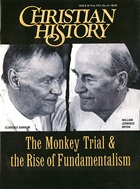
When nationally known Clarence Darrow joined the defense team and William Jennings Bryan, the prosecution, the made-for-radio trial was set.
Both men were in the twilight of their careers. Almost 70 years old, Darrow had just come off a highly publicized trial in Chicago, in which he saved two admitted murderers (Nathan Leopold and Richard Loeb) from capital punishment with an insanity defense. Darrow was widely known as a defender of "radicals" and an outspoken agnostic.
Bryan had been a three-time presidential candidate and secretary of state under Woodrow Wilson. Though he had not practiced law in more than 30 years, he was the author of a syndicated weekly column on the Bible and was recognized as a leading spokesman for emerging fundamentalism.
When the trial began, more than 100 journalists—including sardonic H. L. Mencken—descended on tiny Dayton. The press had its angle from the outset. To them Darrow symbolized objectivity, tolerance, and forward thinking—clear-headed modernity at its finest. Bryan symbolized narrowmindedness, tribalism, and social backwardness —tendentious Christianity at its worst.
Also from the beginning, the prosecution and defense understood the media circus being created, and each side choreographed its part, playing not only to a jury but to a nation at attention.
Did Scopes break the law?
On day one of the trial, as many as a thousand people crammed into the 700-seat courtroom. After a new indictment was returned (to ensure no mistrial), the selection of the jury began.
An early exchange revealed the partisan nature of the trial. Defense attorney Darrow, wearing purple suspenders, a white shirt, and a white string necktie, was examining a prospective juror, an itinerant preacher. Darrow asked, "What is your business?"
"I am a minister," J. P. Massingill replied.
"Ever preach on evolution?"
"I don't think so, definitely," the minister said, "that is, on evolution alone."
"Now, you wouldn't want to sit on this jury unless you were fair, would you?"
"Certainly, I would want to be fair; yes, sir," the minister replied.
Darrow asked him again whether he had preached on evolution, and the minister said he was strictly for the Bible.
Darrow pressed, "I'm talking about evolution. I am not talking about the Bible. Did you preach for or against evolution?"
When the minister said, "I preached against it, of course!" the courtroom erupted into applause.
"Let's have order," the judge barked, and eventually excused the minister from jury duty.
After the jury was selected, it was dismissed for two days as prosecution and defense argued whether the indictment was legitimate (the defense argued that the Butler Bill violated the Tennessee constitution in denying freedom of speech). In the end, the judge ruled the indictment was legitimate, and the defense entered a plea for Scopes: Not guilty.
On day four, each side made an opening statement. The defense argued the trial represented not a conflict between secular humanists and Christians, but between tolerant, educated Christians and intolerant, obscurantist Christians. Defense attorney Dudley Malone said, "We believe there is no conflict between evolution and Christianity. There may be a conflict between evolution and the peculiar ideas of Christianity which are held by Mr. Bryan as the evangelical leader of the prosecution, but we deny that the evangelical leader of the prosecution is an authorized spokesman for the Christians of the United States. … We maintain and we shall prove that Christianity is bound up with no scientific theory."
The state, on the other hand, said the trial was about the immediate facts: did Scopes in fact violate the Tennessee statute?(right)
The state began its case in the afternoon, calling as its first witness Walter White, county superintendent of public instruction. White testified that Scopes had admitted to him that he had taught from the textbook Civic Biology, that Scopes confessed he "could not teach that book without teaching evolution," and that "the statute was unconstitutional."
In Darrow's cross-examination, White admitted he had no complaint about Scopes's work as a teacher.
The next state's witness was 14-year-old Howard Morgan. He testified that his teacher, John Scopes, taught him about evolution, that "the earth was once a hot molten mass, too hot for plant or animal life to exist upon it."
Prosecuting attorney Stewart asked Morgan, "How did he [Scopes] classify man with reference to other animals; what did he say about them?"
"Well, the book and he," replied Morgan, "both classified man along with cats and dogs, cows, horses, monkeys, lions, horses, and all that."
During his cross-examination, Darrow asked Morgan, "He [Scopes] didn't say a cat was the same as a man?"
"No sir," replied Morgan. "He said man had a reasoning power, that these animals did not."
Darrow quipped, "There is some doubt about that, but that is what he said, is it?" and the courtroom guffawed.
Darrow then asked Morgan, "What he [Scopes] taught you … has not hurt you any, has it?"
Morgan replied, "No, sir," and the courtroom once more broke into laughter.
Two more state's witnesses testified that afternoon, and with that, Stewart said, "The state rests." The prosecution had made its case in only a couple of hours.
Man among the primates
The defense wanted to show that evolution was a universally held view among scientists, and that it was not a contradiction for Christians to subscribe to the theory. So the defense brought in from world-class universities experts who, in many cases, were also Christians.
Late in the afternoon on day four, for example, the defense called Maynard Metcalf, a zoologist from Baltimore, to the stand. Under questioning, Metcalf said he had been a department chairman at Oberlin College, had conducted research at Johns Hopkins University and other institutions, and had received a government research appointment under President Wilson.
Darrow asked him, "Are you a member of any church organizations?"
"I am now a member of the United Church in Oberlin," Metcalf replied. He said he had led an adult Bible class for three years as well as a Bible class for college students.
When Darrow began asking Metcalf about how widespread the teaching of evolution was, the state objected that this would be hearsay evidence. The defense wanted the judge at least to hear the evidence before making a ruling, so the judge allowed the examination to continue but dismissed the jury.
Darrow then asked Metcalf, "Is evolution taught in all the leading colleges of the world?"
Metcalf discussed the difference between evolution and theories of evolution. He concluded, "We are in possession of scientific knowledge to answer directly and fully the question: Has evolution occurred?"
Darrow asked, "Will you tell what it means—the fact of evolution?"
"I think it means the change of an organism from one character into a different character," Metcalf replied. "The term in general means the whole series of such changes which have taken place during hundreds of millions of years, which have produced from lowly beginnings, the nature of which is not by any means fully understood, the organism."
"Now in the classification of scientists, zoologists," asked Darrow, "where does man come?"
"He is classed," said Metcalf, "among the primates."
Bryan speaks out
On day five, the prosecution challenged the defense's scientific testimony, asking the judge not to admit it. The state argued that expert testimony was not pertinent.
Darrow rebutted, "We expect to show by men of science and learning—both scientists and real scholars—men who know what they are talking about—who made some investigation … that any interpretation of the Bible that intelligent men could possibly make is not in conflict with any story of creation . …There isn't a human being on earth [who] believes it literally."
After more debate, William Jennings Bryan rose to his feet for the first time in the trial. One Bryan biographer noted that for the first four days of the trial he had "sat in a stifling courthouse in his shirtsleeves waving a large fan." This first speech was also his last major speech of the trial.
Bryan began slowly, "The principal attorney [Darrow] has often suggested that I am the arch conspirator and that I am responsible for the presence of this case, and I have almost been credited with leadership of the ignorance and bigotry which he thinks could alone inspire a case like this."
Bryan mocked evolution, reading from the biology textbook Scopes had used, pointing out the "evolutionary tree" diagram. "He [Scopes] tells children to copy this diagram," Bryan jibed, "and take it home in their notebooks, to show their parents that you cannot find man! That is the great game to put in the public schools, to find man among animals, if you can.
"Tell me that the parents of this day have not any right to declare that children are not to be taught this doctrine."
After citing Darwin's Descent of Man, Bryan thundered, "Never have they traced one single species to any other, and that is why it was that this so-called expert stated while the fact of evolution, they think, is established, that … every theory [of how it came about] has failed . …
"I suppose this distinguished scholar [the defense's first witness] who came here shamed them all by his number of degrees. He did not shame me, for I have more than he has, but I can understand how my friends felt when he unrolled degree after degree."
Bryan pointed out that "more of the jurors are experts on what the Bible is than any Bible expert who does not subscribe to the true spiritual influences or spiritual discernments of what our Bible says."
"Amen," shouted voices in the audience.
"The facts are simple," Bryan concluded, "the case is plain, and if those gentlemen want to enter upon a larger field of educational work on the subject of evolution, let us get through with this case and then convene a mock court, for it will deserve the title "mock court" if its purpose is to banish from the hearts of the people the Word of God as revealed."
The courtroom swayed with applause.
After more wrangling, the judge conceded to allow expert testimony but in written affidavits only. Such testimony would be read into the court record, but the jury would never see or hear it. The judge, defense, and prosecution all knew the affidavits might come into play in the inevitable appeal.
Surprise move
So the defense read some comments Governor Peay had made as he signed into law the Butler bill: "It will be seen that this bill does not require any particular theory of interpretation of the Bible regarding man's creation to be taught in the public schools . …The widest latitude of interpretation will remain as to the time and manner of God's processes in his creation of man."
The defense showed that the new Tennessee biology textbook (which had just replaced Civic Biology) also made use of Darwinism, and concluded that biology couldn't be taught without mentioning evolution.
Then the defense read a statement into the record from Walter C. Whitaker, rector of St. John's Episcopal Church in Knoxville, Tennessee: "As one who for 30 years has preached Jesus Christ as the Son of God and as 'the express image of the Father,' I am unable to see any contradiction between evolution and Christianity."
The defense added similar statements to the record from Dr. Shailer Mathews, dean of the Divinity School of the University of Chicago, as an expert on the Bible, as well as from scientists at Harvard University, Rutgers University, and the University of Chicago.
Then, in what proved to be the most effective strategy of the trial for the defense, defense attorney Arthur Hays called William Jennings Bryan to the stand.
Hays's move was highly unusual since Bryan was an attorney for the prosecution. Bryan's testimony about Scopes would not, in fact, be valuable. But Hays had a deeper strategy: he wanted to weaken the prosecution's case by making its star attorney look foolish.
Over the objections of his own team members, Bryan took the stand: "[The defense] came here to try revealed religion. I am here to defend it, and they can ask me any questions they please."
Thus began the much-hoped-for confrontation between Darrow and Bryan, the modernist and the biblicist. It was a heated, two-hour exchange that, in the end, did not affect the case as much as it did the nation.
Bryan takes his stand
Wearing a blue shirt and blue suspenders, Darrow opened by asking, "You have given considerable study to the Bible, haven't you, Mr. Bryan?"
"Yes, sir, I have tried to."
"Do you claim that everything in the Bible should be literally interpreted?"
"I believe everything in the Bible should be accepted as it is given there," Bryan said. "Some of the Bible is given illustratively. For instance, 'Ye are the salt of the earth.' I would not insist that man was actually salt, or that he had flesh of salt."
Darrow questioned Bryan on the story of Jonah, and then moved to the story in the Book of Joshua, in which God is said to have made the earth stand still.
"Mr. Bryan, have you ever pondered what would have happened to the earth if it had stood still?"
"No."
"You have not?"
"No," Bryan replied. "The God I believe in could have taken care of that, Mr. Darrow."
"I see. Have you ever pondered what would naturally happen to the earth if it stood still suddenly?"
"No."
"Don't you know it would have been converted into a molten mass of matter?"
Bryan snapped, "You testify to that when you get on the stand. I will give you the chance."
Darrow then pressed Bryan on the date of the Flood. "What do you think that the Bible, itself, says?" asked Darrow.
"I never made a calculation."
"What do you think?" pressed Darrow.
"I do not think about things I don't think about," quipped Bryan.
"Do you think about things you do think about?" snapped Darrow.
"Well, sometimes."
The court rippled with laughter.
After a bit, Darrow asked, "Mr. Bryan, don't you know that there are many other religions that describe the Flood?"
"No, I don't know," Bryan replied.
"You have never examined any other religions?"
"Yes, sir."
"Have you read anything about the origins of religions?"
"Not a great deal," replied Bryan.
After Bryan mentioned he had studied Confucianism, Darrow asked, "Do you know how old the Confucian religion is?"
"I can't give you an exact date."
Darrow persisted. "Do you know how old the religion of Zoroaster is?"
"No, sir,"
"Do you know they are both more ancient than the Christian religion?"
Bryan replied, "I am not willing to take the opinion of people who are trying to find excuses for rejecting the Christian religion."
Darrow jumped on Bryan: "You don't care how old the earth is, how old man is, and how long the animals have been there?"
"I am not so much interested in that," replied Bryan.
Darrow's interrogation kept cycling back to the age of the earth.
"Mr. Bryan," Darrow asked, "could you tell me how old the earth is?"
"No, sir, I couldn't."
"Could you come anywhere near it?"
"I wouldn't attempt to," Bryan said. "I could possibly come as near as the scientists do, but I had rather be more accurate before I give a guess."
When at one point prosecuting attorney Stewart complained, "What is the purpose of this examination?" Bryan interrupted, "The purpose is to cast ridicule on everybody who believes in the Bible, and I am perfectly willing that the world shall know that these gentlemen have no other purpose than ridiculing every Christian who believes in the Bible."
Darrow snapped, "We have the purpose of preventing bigots and ignoramuses from controlling the education of the United States and you know it, that is all."
Bryan replied, "I am simply trying to protect the Word of God against the greatest atheist or agnostic in the United States," and the crowd applauded.
Darrow barked, "I wish I could get a picture of these clackers."
Morning without the sun
A little later, Darrow and Bryan went at it again, "Mr. Bryan, do you believe the first woman was Eve?"
"Yes."
"Do you believe she was literally made out of Adam's rib?"
"I do."
"Did you ever discover where Cain got his wife?" Darrow asked.
"No, sir," snapped Bryan. "I leave the agnostics to hunt for her."
"Does the statement 'The morning and the evening were the first day,' and
'The morning and the evening were the second day' mean anything to you?"
"I do not think it necessarily means a 24-hour day," said Bryan.
Darrow kept pressing Bryan to admit the days were literal, 24-hour days, but Bryan only replied, "My impression is that they were periods."
"Have you any idea of the length of the periods?" asked Darrow.
"No, I don't."
"Do you think the sun was made on the fourth day?" asked Darrow.
"Yes."
"And they had evening and morning without the sun?"
"I am simply saying it is a period."
Darrow ragged on, "They had evening and morning for four periods without the sun, do you think?"
"I believe in creation as there told," replied Bryan, "and if I am not able to explain it, I will accept it. Then you can explain it to suit yourself."
"Mr. Bryan, what I want to know is, do you believe the sun was made on the fourth day?"
"I believe just as it says there."
"Do you believe the sun was made on the fourth day?"
"Read it!" snapped Bryan and then turned to the judge. "Your Honor, I think I can shorten this testimony. The only purpose Mr. Darrow has is to slur at the Bible."
"I object to that," replied Darrow. "I am examining you on your fool ideas that no intelligent Christian on earth believes!"
The judge had heard enough, and he adjourned the trial for the day. The next morning, he refused to let the questioning of Bryan continue because he believed Bryan's testimony would "shed no light" on the trial.
But to many Americans, the exchange shed all too much light on the fundamentalists, whom they felt Bryan represented. The Christian Century put it most graciously, that though there was a convincing argument for the "conservative position," "Mr. Bryan is manifestly unable to make this argument, for he has neither the mind nor the temper for the task."
The Nation put it more sarcastically: "Among fundamentalist rank and file, profundity of intellect is not too prevalent."
The verdict
Knowing the trial was a lost cause, Darrow, on the final day of the trial, asked the judge: "I think to save time we will ask the Court to … instruct the jury to find the defendant guilty."
After only eight minutes of deliberation, the jury returned a verdict: Scopes was guilty of violating the Tennessee statute. The judge fined Scopes $100.
The fundamentalists convinced the jury but not the larger American public. At best, the trial revealed that even among American Christians in the 1920s, there were two competing standards for determining truth, one "biblical," the other, "scientific," and it was difficult to see how they could be reconciled.
David Goetz is senior associate editor of Leadership journal.
Copyright © 1997 by the author or Christianity Today/Christian History magazine.
Click here for reprint information on Christian History.

Support Our Work
Subscribe to CT for less than $4.25/month