Fundamentalist Internet



Fundamentalism was a broad movement that arose from and sustained itself in a variety of sub-movements in conservative Christianity.
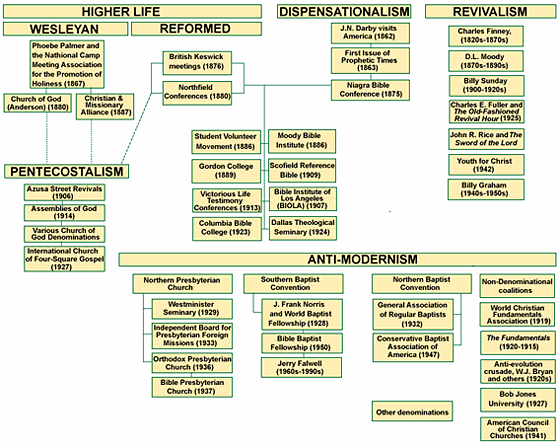
This chart suggests some of the relationships and "families" within fundamentalism. Naturally the relationships were much more complicated in history than can be expressed in a simple chart, so, see notes on the next page for explanations.
—Bob Jones IV
Bob Jones IV is a graduate student at the University of Notre Dame.
Fundamentalist Internet Notes
Higher Life Movement
Arose out of pre-Civil War revivalism and stressed a deeper work of the Holy Spirit beyond conversion. It took two forms.
Wesleyan
National Camp Meeting Association for the Promotion of Holiness. An outgrowth of Phoebe Palmer's New York City "Tuesday Meetings," holiness camp meetings stressed a dramatic "second blessing" that brought freedom from sin.
Church of God (Anderson). A precursor to the numerous Church of God denominations springing from the Azusa Street Revivals.
Christian & Missionary Alliance. Founded by A. B. Simpson, who left the Presbyterian Church under the influence of holiness teachings. Later Pentecostals would claim Simpson as an evangelical forebear of the tongues movement.
Reformed
Keswick meetings. Institutionalized around the time of Moody's British campaigns, Keswick holiness stressed repeated "filling with" and "surrender to" the Holy Spirit to attain victory over sin.
Northfield Conference. The Bible conference started by Moody in 1880 increasingly emphasized Spirit-filling, especially after F. B. Meyer's arrival from Britain in 1891.
Student Volunteer Movement. This mission board sent Spirit-filled young people to carry the gospel around the world.
Gordon College. Founder A. J. Gordon was diffident on dispensationalism but a vocal champion of Keswick holiness.
Victorious Life Testimony conferences. After accepting Keswick holiness teachings in 1910, Charles Trumbull, editor of the widely-circulated Sunday School Times, founded this conference, which eventually settled in Keswick Grove, New Jersey.
Columbia Bible College. Founded by Trumbull follower Robert McQuilkin in Columbia, South Carolina, to promote Keswick holiness teaching.
Pentecostalism
Azusa Street revival. Led by William Seymour, a holiness preacher, these revivals insisted that spirit baptism, as evidenced by speaking in tongues, was the universal sign of a sanctified life.
Assemblies of God. The first effort to organize the many churches founded in the wake of the Azusa Street revivals.
International Church of the Four-Square Gospel. Founded by evangelist Aimee Semple McPherson, who had earlier withdrawn her membership from the Assemblies of God.
Dispensationalism
John Nelson Darby. The British originator of the dispensational system of interpreting Scripture.
Prophetic Times. A widely-read newspaper that interpreted current events in light of dispensational understandings of prophecy.
Niagara Bible Conference. This long-running conference did for dispensationalism in America what the Northfield Conference did for teaching on the Holy Spirit.
Moody Bible Institute. The Chicago Bible school perpetualized (especially through its press) two of the evangelist's main emphases: the Spirit-filled life and dispensationalism. Also helped keep missions and evangelism central.
Scofield Reference Bible. First published in 1909, the Scofield Bible's marginal notes raised both dispensationalism and Keswick holiness teaching to a level of near-inspiration.
Bible Institute of Los Angeles. A headquarters for West Coast fundamentalism. Funded specifically to teach a dispensational hermeneutic. R. A. Torrey was first dean.
Dallas Theological Seminary. Founded by Presbyterian L. S. Chafer whose systematic dispensationalism rivaled that of Scofield.
Revivalism
Charles Finney. The converted lawyer, "Father of Modern Revivalism," taught that specific techniques could encourage conversion.
D. L. Moody. The first major revivalist to adopt premillennialism; he was also influenced by the higher life movement.
Billy Sunday. He headquartered at the influential Winona Lake Bible Conference (founded 1895).
Charles E. Fuller and The Old Fashioned Revival Hour. By the 1940s, this dispensationalist had one of the most popular programs on all of radio.
John R. Rice and The Sword of the Lord. Through this widely-circulated magazine, Rice became one of the most influential fundamentalist leaders.
Youth for Christ International. Following the model of evangelists Jack Wyrtzen and Percy Crawford, YFC generated a new wave of revivalism and launched Billy Graham's career.
Billy Graham. Until 1957, Graham was embraced by fundamentalists.
Anti-Modernism
Northern Presbyterian Church. The Presbyterian Church in the U. S. A. split over modernism in the 1920s without the influence of either dispensationalism or higher life teachings.
Westminster Seminary. After the Princeton Seminary board was restructured to lessen the influence of conservatives, J. Gresham Machen left to form this institution.
Independent Board for Presbyterian Foreign Missions. This mission board was founded to combat the modernism that Machen perceived on the foreign field.
Orthodox Presbyterian Church. After being disciplined by the Presbyterian Church in the U. S. A., Machen and his allies formed the OPC.
Bible Presbyterian Church. Carl McIntire and a handful of other Machen lieutenants split from the opc over Machen's steadfast refusal to ally the denomination with dispensationalists.
Southern Baptist Convention
The denomination as a whole remained so conservative that it avoided splits in the 1920s.
J. Frank Norris and World Baptist Fellowship. Norris, a fiery preacher, was the principal in founding a number of organizations among dissident fundamentalists in the South.
Bible Baptist Fellowship. Started by a group who resented Norris's control of World Baptist Fellowship. The new fellowship founded Baptist Bible College.
Jerry Falwell. Converted by the radio ministry of Charles Fuller and educated at Bible Baptist College, Falwell traces his heritage to Norris.
Northern Baptist Convention
Split in the 1920s by conservatives heavily influenced by both higher life and dispensationalism.
General Association of Regular Baptists. Conservatives who had operated within the Convention since 1923 under the name Baptist Bible Union withdrew to form the garb.
Conservative Baptist Association of America. Formed by conservatives frustrated with NBC's missions policies.
Non-Denominational Coalitions
World's Christian Fundamentals Association. Founded by William Bell Riley, the WCFA acted as an umbrella organization for fundamentalists.
The Fundamentals. These volumes opposed modernism and advocated both dispensationalism and Keswick holiness teachings.
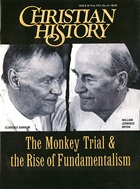
Anti-evolution crusade. The major political expression of fundamentalism was led by William Jennings Bryan. Succeeded in banning the teaching of evolution in the schools of many states.
Bob Jones University. Named after the evangelist who founded it in 1927, BJU saw its mission as countering the erosion of faith experienced by students exposed to modernist professors at state colleges.
American Council of Christian Churches. Machen lieutenant Carl McIntire founded the accc to oppose the Federal Council of Churches and to provide a network for churches and denominations that had decided in favor of separation.
Other denominations.
Fundamentalists fought modernism in many denominations: Methodist, Congregational, Mennonite, among others.
Copyright © 1997 by the author or Christianity Today/Christian History magazine.
Click here for reprint information on Christian History.

Support Our Work
Subscribe to CT for less than $4.25/month