









Enraptured with Order



Clarence Larkin believed the biblical interpreter "cannot intelligently do his work without a plan. He must have drawings and specifications." To that end, the mechanical-engineer-turned-preacher wrote and illustrated Dispensational Truth, or God's Plan and Purpose in the Ages (1919), a 180-page book that contains 90 charts.
These charts, he wrote, must be tested against the Bible itself, yet to properly interpret and understand the Bible, "The charts are indispensable." The above, according to Larkin, is "the main chart" of his book.
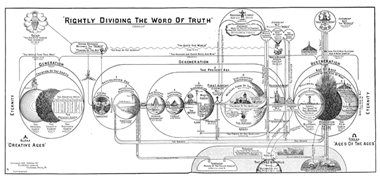
Diagramming Bible books and salvation history is characteristic of dispensationalism—a method of interpreting the Bible that divides history into different "dispensations" or spiritual eras. In each dispensation, God reveals a new aspect of his will, and according to C. I. Scofield, each dispensation is "a new test of the natural man, and each ends in judgment—marking his utter failure in every dispensation."
Though others have divided history into spiritual eras, John Nelson Darby (1800-1882), an early leader of the Plymouth Brethren in England, was the first to create a full-blown dispensational system. He promoted his ideas in America during a preaching tour in the 1870s. Scofield, one of many pastors and teachers taken with his ideas, eventually published a Bible with dispensationalist notes (in 1909) that became the standard Bible for fundamentalists.
Dispensationalists are known for their premillennialism: because the world is corrupt, Christ must return before the millennial kingdom is established. This view directly challenged the postmillennialism of liberals (and evangelicals like Charles Finney), who believed human effort would eventually create the kingdom of God on earth. Interpretive disagreements (such as whether believers would be raptured by Christ before or after the Tribulation) have split dispensationalists into warring factions at times.
Copyright © 1997 by the author or Christianity Today/Christian History magazine.
Click here for reprint information on Christian History.

Support Our Work
Subscribe to CT for less than $4.25/month