Discovering David Livingstone
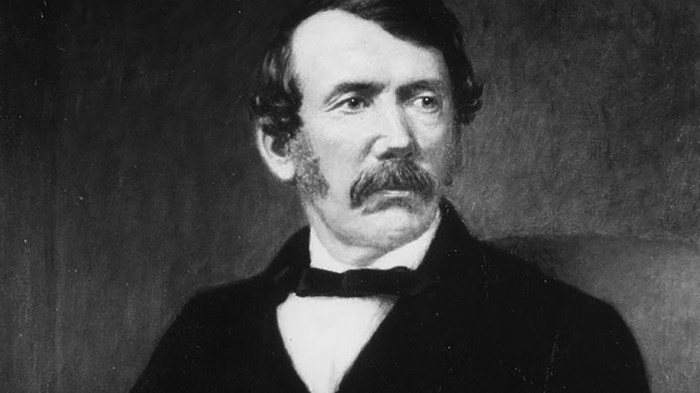


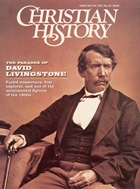
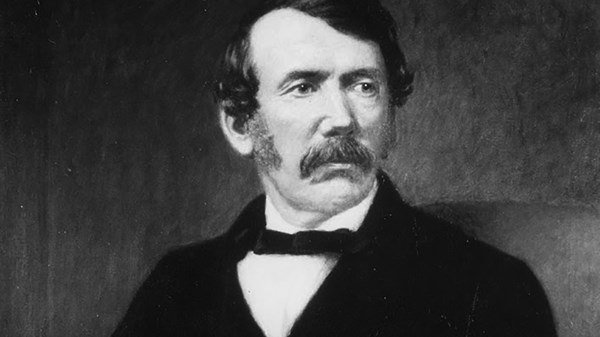
With four theatrical words, "Dr. Livingstone, I presume?", which Henry Morton Stanley rehearsed in advance, David Livingstone became immortal. Stanley stayed with Livingstone for five months and then went off to England to write his bestseller, How I Found Livingstone. Livingstone, in the meantime, got lost again—in a swamp literally up to his neck. Within a year and a half, he died in a mud hut, kneeling beside his cot in prayer.
His African friends, former slaves he had freed, buried his heart under an mpundu tree 70 miles from the shore of Lake Bangweulu. Then they carried his body back to his own people, an 11-month journey through equatorial jungle and open seas.
All Britain wept. The whole civilized world wept. They gave him a 21-gun salute and a hero's funeral among the saints in Westminster Abbey. BROUGHT BY FAITHFUL HAND OVER LAND AND SEA, his tombstone reads, DAVID LIVINGSTONE: MISSIONARY, TRAVELLER, PHILANTHROPIST. FOR THIRTY YEARS HIS LIFE WAS SPENT IN AN UNWEARIED EFFORT TO EVANGELIZE THE NATIVE RACES, TO EXPLORE THE UNDISCOVERED SECRETS AND ABOLISH THE SLAVE TRADE. He was Mother Teresa, Neil Armstrong, and Abraham Lincoln rolled into one.
In the century and a quarter since his death, no missionary/explorer has been more constructed, deconstructed, psychoanalyzed ("a congenital manic depressive," says one scholar), and turned into a stained-glass saint. There are well over 100 books about him, and African cities bear his name.
He was such an important figure that the history of southern Africa can be divided into B.L. (Before Livingstone) and A.L. (After Livingstone). When he arrived in 1841, Africa was as exotic as outer space, called the "Dark Continent" and the "White Man's Graveyard." Although the Portuguese, Dutch, and English were pushing into the interior, African maps had blank unexplored areas—no roads, no countries, no landmarks.
Livingstone helped redraw the maps, exploring what are now a dozen countries, including South Africa, Rwanda, Angola, and the Republic of the Congo (formerly Zaire). He is the stuff of legend, indeed.
But what can we presume about Livingstone today?
Latin on the run
Livingstone's birth became the foundation of the legend: he was born on March 19, 1813, in the grimy industrial town of Blantyre, eight miles from Glasgow. His family (parents Neil and Agnes, two brothers, and two sisters) lived in a one-room tenement. The central figure of his childhood was grandfather Neil (senior), who entranced the boy with stories of the olden days. (He had been a tenant farmer who had been evicted from Ulva, an island off the west coast of Scotland. Starting in the 1700s, the Anglo-Scottish gentry deliberately depopulated the countryside by evicting a million Scots, replacing them with vast sheep farms.)
When David was a child, his father started his own business as a door-to-door tea salesman, so the room was constantly fragrant with the smell of tea.
At age 10, David went to work in the cotton mill, clambering under gigantic, steam-driven machines to fix broken threads. After 14 hours of labor that exhausted most children, Livingstone attended classes for another two hours. He was so entranced with books that he spent his first pay on a Latin grammar. He propped the book on a machine, and each time he passed it, he read a line or two. In this way, he managed to learn Latin and Greek, and plowed through Virgil, Horace, and a stack of theological tomes. His father, a Calvinist Congregationalist who distributed tracts as he sold tea, disapproved of "trashy novels" (a title he bestowed on any nonreligious literature) and science books. The only escapism David was allowed were travel books like Robinson Crusoe.
Though his father condemned science as ungodly, David's life was changed by the writings of Thomas Dick, an eccentric Scottish theologian and amateur astronomer who proclaimed both science and religion revealed the complexities of God's world. After reading one book, Livingstone later wrote, "Immediately I accepted salvation by Christ and vowed to devote my life to his service."
Two years later, after reading an appeal from Karl Gützlaff (see Hudson Taylor, issue 52 of Christian History, page 35) for medical missionaries to China, Livingstone seized the opportunity. Not only could he merge scientific study and Christian service, he could also appease his father, who would not let him become a doctor unless it was for a religious purpose. At age 23, with no formal education, he registered in Anderson's College in Glasgow, where he studied medicine, theology, and science. A year later, he applied to the interdenominational London Missionary Society (LMS).
By then, however, the door to China was slammed shut by the Opium War, leaving Livingstone looking for a new mission frontier. Within six months, he met Robert Moffat, a veteran missionary of southern Africa, who enchanted him with tales of his remote station, glowing in the morning sun with "the smoke of a thousand villages where no missionary had been before."
"Animal pleasure of traveling"
The newly ordained medical doctor set out for South Africa in December 1840, little realizing he would be gone 16 years. The voyage, via Brazil, was so rough the little sailing ship was tossed like "a ship in a fit of epilepsy." Three months later, he arrived in Cape Town, the main British colony, and set out immediately in an ox cart for Robert Moffat's station in Kuruman, 600 miles north.
After 25 years of patient work, Moffat had created a miniature Zion on the edge of the Kalahari Desert. He had built a dam and planted fruit trees. With its stone church and neat rows of houses, Kuruman was reminiscent of a village in Scotland.
Unfortunately the "smoke of a thousand villages" was an exaggeration. Moffat had fewer than 40 converts, half of whom were backsliders, and the surrounding area was as unpopulated as the Scottish Highlands. Livingstone was disappointed at the prospects. Within a month, accompanied by a fellow missionary, Livingstone made his first of three exploratory tours, 500 miles northeast into southern Africa.
For ten years, Livingstone tried to be a conventional missionary. He opened a string of stations in "the regions beyond," where he settled down to station life, teaching school and superintending the garden. After four years of bachelor life, he married the boss's daughter, Mary Moffat.
From the beginning, Livingstone showed signs of restlessness. After his only convert decided to return to polygamy, Livingstone felt more called than ever to explore. "The mere animal pleasure of traveling in a wild unexplored country is very great," he wrote. "Brisk exercise imparts elasticity to the muscles, fresh and healthy blood circulates through the brain, the mind works well, the eye is clear, the step is firm."
During his first term in South Africa, Livingstone made some of the most prodigious—and most dangerous—explorations of the nineteenth century. His object was to open a "Missionary Road"—"God's Highway," he also called it—1,500 miles north into the interior. In 1849 his team became the first recorded Europeans to reach Lake Nagami, "the lake beyond the [Kalahari] desert," earning him a gold medal from the Royal Geographical Society. He was accompanied by William Cotton Oswell, a wealthy soldier and big-game hunter.
On many of these early trips he took his wife. Mary was born in Africa and was used to the hardships of pioneer missionaries—but not the sort of hardships Livingstone would put her through. Her newborn baby died after they had wandered through the Kalahari Desert for a month with limited water. In 1852, after seven years of marriage, Livingstone escorted Mary and the children to Cape Town, his first visit to "civilization" in 11 years. He put them on the boat to Britain, and did not see them again for four years. (Though often separated from her husband for years at a time, Mary gave birth to six children in their 17 years of marriage.)
On these early journeys, Livingstone's interpersonal quirks were already apparent. He had the singular inability to get along with other Westerners. He fought with missionaries, fellow explorers, assistants, and (later) his brother Charles. He held grudges for years. He had the temperament of a book-reading loner, emotionally inarticulate except when he exploded with Scottish rage. He held little patience for the attitudes of missionaries with "miserably contracted minds" who had absorbed "the colonial mentality" regarding the natives. When Livingstone spoke out against racial intolerance, white Afrikaners tried to drive him out, burning his station and stealing his animals.
Though alienated from the whites, the natives loved his common touch, his rough paternalism, and his curiosity. They also thought he might protect them or supply them with guns. More than most Europeans, Livingstone talked to them with respect, Scottish laird to African chief. Some explorers took as many as 150 porters when they traveled; Livingstone traveled with 30 or fewer.
After Livingstone sent his family to Scotland, he made an epic, three-year trip from coast to coast, reputedly the first European to do so.
On this trip, he was introduced to the 1,700-mile-long Zambezi, the twenty-sixth longest river in the world. It starts in the equatorial jungle of Angola and the Republic of the Congo, 600 miles from the Atlantic Ocean, and bisects the continent. As it cuts through the Rift Valley, it boils over falls and thunders down cauldrons deeper than the Grand Canyon until it disgorges into the Indian Ocean.
During this trip, he reached Victoria Falls, his most awe-inspiring discovery. It was like being back in the mill at Blantyre, with God's steam machines thundering and pulsating, the wild water sending off sparks like "bits of steel when burned in oxygen." The scene was "so lovely," he later wrote, that it "must have been gazed upon by angels in their flight."
River of human misery
Despite its beauty, the Zambezi was a river of human misery, the original "heart of darkness." It linked the Portuguese colonies of Angola and Mozambique, the main suppliers of slaves for Brazil, who in turn sold to Cuba and the United States. Women and children, prisoners of war, and the survivors of famine were captured in the interior and shipped to the coast. Livingstone frequently encountered parties of 50 to 100, chained and shackled, each yoked with a handle that extended behind their backs.
Livingstone had a number of motives for his vast peregrinations. For one, he was planting the British flag, extending the borders of the Empire—though the British government repeatedly told him it had no interest in creating African colonies. But in Livingstone's mind, if Britain could drive a wedge through the upper Zambezi, it would have a chain of colonies up the spine of Africa, from South Africa, through Uganda and the Anglo-Egyptian Sudan, clear up to Egypt (which was then a British protectorate).
Livingstone was always on the lookout for fertile, well-watered high land—with no tsetse flies or malaria—where he could transplant a colony of pious Scot peasants. He meticulously recorded the natural resources, coal and mineral deposits, forest and animal life, anything that might attract settlers.
Yet Livingstone's primary desire was to expose the slave trade and end it by cutting it off at the source. The strongest weapon, he believed, was Christian commercial civilization. He hoped to replace the "inefficient" slave economy with a capitalist economy: buying and selling goods, like beeswax and ivory, instead of people. The tribes were more than willing to engage in "legitimate commerce." In fact, Livingstone partially financed his trips by trading goods from one native state to another: guns for bronze, bronze for elephant tusks, tusks for slaves (whom he escorted to safety and set free), arriving at the coast with cart-loads of ivory left over.
Eventually, Livingstone believed, this mercantile economy would be transformed into a "progressive" agricultural economy of cotton, coffee, and sugar, and based on people working for wages.
The queen's cows
In December 1856, having completed his cross-continental journey, wracked by pain and malarial fever, barely able to rise from his bed, David Livingstone arrived in a dispirited England. For three years, the country had been mired in the Crimean War, a horrible nightmare that produced the tragedy of the Light Brigade ("Half a league, half a league, half a league onward, all in the valley of Death rode the six hundred . …"). England desperately needed heroes, and Livingstone fit the bill.
He was given medals and an honorary doctorate from Oxford. When he had a private audience with Queen Victoria, he delighted her with an amusing story of an African chief who asked, "If the queen of England is so rich, how many cows does she have?"
Seizing the moment, Livingstone wrote his first manifesto, a 400-page book called Missionary Travels and Researches in South Africa. It is still an important source for reconstructing the precolonial history of Africa. It was an immediate bestseller, selling 70,000 copies. As historian Timothy Holmes says in Journey to Livingstone (1993), it had something for everyone: "The Christian's faith in God is strengthened by the author's very survival of every imaginable danger. The abolitionist is inspired by the prospect of stopping the slave trade. Medical men are intrigued by Livingstone's approach to disease and the value of his treatment for fever."
Livingstone made more than 120 times his £100 annual LMS salary from the royalties, which he used for his family and his expeditions. That was just as well, for Livingstone's relations with the lms soured during his furlough. The society, though admiring his feats, felt he should take up more settled work, like his father-in-law, Moffat. He claimed his explorations were "missionary travels," and he was preparing God's Highway for those who followed.
Livingstone and the LMS finally split over his role in a new mission south of the Zambezi. The lms wanted him to shepherd the group, but Livingstone would agree only to help the missionaries cross the river.
Through the influence of his friends in the scientific and religious communities, the government appointed him leader of a "voyage of discovery upon the Zambezi," at a cost of £5,000.
In March 1858, with the cheers of England ringing in their ears, the Zambezi Expedition set sail with Livingstone, his pregnant wife, Mary, and child, his brother Charles, two sailors, an engineer, artist, geologist, and a doctor/botanist.
They were to navigate upriver in a brass-and-mahogany steamboat (as in the movie The African Queen ), from the mouth to Victoria Falls, a thousand miles inland, where they would establish a mission station of the Universities Mission to Central Africa ( UMCA). Among their tons of supplies, they carried a prefabricated iron house, which they hoped to erect there.
The Ma Robert("Robert's Mother," the Makololo's name for Mary Livingstone) was state-of-the-art technology but proved too frail for the expedition. Besides using too much wood, it leaked horribly after repeatedly running aground on sandbars.
Like Moffat's tale of smoke from a thousand villages, Livingstone stretched the truth about the Zambezi to his correspondents back home, minimizing the dangers and pushing his men beyond human endurance. When they reached a 30-foot waterfall, he waved his hand, as if to wish it away, and said, "That's not supposed to be there." Mary, who had just given birth to her sixth child, died in 1862 beside the river, only one of several lives claimed on the voyage.
Abruptly Livingstone changed his plan: the UMCAwould establish a colony of freed slaves in the cool, fertile valley of the Shire River, believed to be free of malaria. It flows into the Zambezi from Lake Nyasa (now Lake Malawi), the second largest lake in Africa. Unfortunately a tribal war was creating havoc in the area, and a severe drought and Arab slave traders from the north were depopulating the land. The Zambezi Expedition, a nightmare from the beginning, now got worse (see "The Other Livingstone," page 32). Finally in 1864, the British government, which had no interest in "forcing steamers up cataracts," recalled Livingstone.
Carried through a swamp
He reached London sick and dispirited but brought himself back into the public eye with his book Narrative of an Expedition to the Zambezi and its Tributaries.
A year later, he was on his way back to Africa again, this time leading an expedition sponsored by the Royal Geographical Society and wealthy friends.
"I would not consent to go simply as a geographer," he emphasized, but as biographer Tim Jeal wrote, "It would be hard to judge whether the search for the Nile's source or his desire to expose the slave trade was his dominant motive."
The source of the Nile was the great geographical puzzle of the day. But more important to Livingstone was the possibility of proving that the Bible was true by tracing the African roots of Judaism and Christianity. He believed ancient Egypt was a black culture connected to central Africa through the Nile and its tributaries. He drew similarities between ancient Coptic and the modern languages of South Africa. "One of my waking dreams," he wrote, "is that the legendary tales about Moses coming up into Inner Ethiopia with Merr, his foster-mother, and founding a city which he called in her honor 'Meroe' may have a substratum of fact."
With no white companions, Livingstone set out with 30 porters, Indian soldiers, boys from a government school for freed African slaves, and locally recruited men. They deserted almost immediately, leaving only a few faithful servants. Among the faithful were Chuma and Susi, whom he had freed ten years before. The deserters spread a rumor that Livingstone had been murdered, and expeditions were sent to find him.
For two years he simply disappeared, without a letter or scrap of information. He reported later that he had been so ill he could not even lift a pen, but he was able to read the Bible straight through four times. Livingstone's disappearance fascinated the public as much as Amelia Earhart's a few generations later.
When American journalist Henry Stanley found Livingstone, the news exploded in England and America. Papers carried special editions devoted to the famous meeting. In August 1872, in precarious health, Livingstone shook Stanley's hand and set out on his final journey. By October his health was failing. (He would never find the source of the Nile, missing it by some 200 miles.) In January he had to be carried through a swamp that came up to "Susi's mouth, and wetted my seat and legs. … When [my porter] sank into a deep elephant's footprint, he required two to lift him." They traveled only a mile and a half a day.
"It is not all pleasure, this exploration," he wrote. On May 1, 1873, at age 60, Livingstone, who had evaded death so many times, finally lost the battle. Chuma and Susi, preparing the body for burial, found a blood clot several inches long obstructing his small intestine and evidence that his death had been hastened by severe hemorrhoidal bleeding. They wrapped his body in calico and dried it in the sun to preserve it for the long trip back "home."
Saint of the Empire
Within ten years, the Africa Livingstone knew was gone forever. One month after his death, the British forced the Sultan of Zanzibar to close the largest slave market on the east coast of Africa. Meanwhile, near Moffat's original station of Kuruman, acres of diamonds were found—the largest gold and diamond deposits in the world. This discovery set off the "scramble for Africa," and independent African and Afrikaner states were conquered and carved into British, Portuguese, French, German, and Belgian colonies. Under empire builders like Cecil Rhodes, after whom Rhodesia was named (now Zambia and Zimbabwe), and De Boers (the diamond cartel), the British were wildly successful, creating colonies from South Africa to Egypt.
For a generation and more, Livingstone was "the Saint of the British Empire." Biographies poured forth and rarely mentioned his less congenial traits. The man and the legend inspired generations of men and women, like Alexander Mackay and Mary Slessor, to dedicated missions work throughout Africa.
During the anti-colonial 1960s, Livingstone was debunked: he made only one certified convert, who later backslid; he explored few areas not already traveled by others; he freed few slaves; he treated his colleagues horribly; he traveled with Arab slave traders; his family life was in shambles—in short, to many he embodied the "White Man's Burden" mentality.
Nonetheless, at a time when countries are being renamed and statues are being toppled, Livingstone has not fallen. Despite modern Africans' animosity toward other Europeans, such as Cecil Rhodes, Livingstone endures as a heroic legend. Rhodesia has long since purged its name, but the cities of Livingstone (Zambia) and Livingstonia (Malawi) keep the explorer's appellation with pride.
Furthermore, the capital of Malawi, Blantyre, was named for Livingstone's birthplace. And Livingstone's massive bronze statue still points to the world's largest waterfall, Victoria Falls.
In 1996, among his own people, the National Portrait Gallery in London mounted an exhibit that honored the man and the "Livingstone industry" that created this larger-than-life legend. He is the man who introduced Africa to the English-speaking world, and as much as any individual in its history, transformed it, for ill and for good.
Alvyn Austin is a writer and historian from Toronto, Canada.
Copyright © 1997 by the author or Christianity Today/Christian History magazine.
Click here for reprint information on Christian History.

Support Our Work
Subscribe to CT for less than $4.25/month