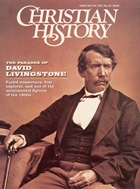
The Paradox of David Livingstone: A Gallery of Pioneers & Pallbearers


Robert and Mary Moffat
(1795-1883) (1795-1871)
Pioneer in-laws
Though Livingstone's name is most often attached with the opening of Africa for missions, in many ways, it was Robert and Mary Moffat who provided the scaffold, 50 years in the making, upon which later missionary successes were built.
Born in Ormiston, Scotland, Robert was raised in a Presbyterian home, but the faith didn't take at first. He "ran off to sea" for a time and at 14, became apprenticed to a gardener. At 19 he underwent a spiritual rebirth, and a year later heard a message by a London Missionary Society director. Soon after, he applied to the society and eventually was accepted for service. In 1816 he sailed for Cape Town.
Meanwhile he had taken up with Mary Smith, the daughter of his employer. She too wanted to be a missionary, but her parents forbade her marriage for more than three years before allowing her to travel to South Africa to wed Robert.
Disillusioned with "confused and deplorable and awful" missionaries in the Cape Colony, the Moffats moved in 1825 to the Kuruman mission station, which would later be Livingstone's first home. After several years of vainly attempting to communicate in the rudimentary trading language called Cape Dutch, Robert began what was to be his finest legacy: translating Scripture and spiritual training texts into Tswana.
Even after 29 years of effort, Robert knew his version was imperfect, especially when the natives asked why Paul had demanded to be armed with guns! In addition, there were no Tswana words for many Christian concepts. Moffat translated the word sin into cow dung, and the word for holiness he used usually meant "a nice fat ox or cow."
The paths of Livingstone and the Moffats first crossed in 1840 when Robert secured Livingstone for the work at the mission. "Perhaps," wrote Moffat biographer E.W. Smith, "Livingstone and Moffat agreed better than any two men in the field."
Livingstone's relationship with Robert's wife was not as positive, especially after he married their daughter, also named Mary. Ironically the elder Mary, whose parents had vehemently opposed her move to Africa, repeatedly chided Livingstone for risking her daughter's life by taking her further into the continent. The elder Mary lived in Africa for 50 years, then died a few months after returning to England when she and Robert retired.
"He was the father and pioneer of South African mission work" concludes one official biographer. Regarding his wife, Mary, it adds, "For fifty years [she] shared all her husband's hardships and trials," and when discussing their impact on that region, adds, "Her name must be associated with his."
Charles Livingstone
(1821-1873)
Ineffectual "General Assistant"
"I am at a loss how to treat him," wrote David Livingstone about his brother, eight years his junior. These words summarize the frustration Charles engendered among the seven men who constituted the ill-fated Zambezi Expedition.
He had worked in the same cotton factory as young David and, like his brother, used what little free time he could spare for education. Feeling a call to missions, he emigrated to America to get ministerial training.
He pastored in, coincidentally, Livingstone County, New York, and later traveled to England on a leave of absence (likely due to a nervous breakdown). Though he had not seen his brother for years, David asked Charles to join him on the Zambezi Expedition.
His official title was "General Assistant and 'moral agent,'" and his unofficial duties included photography (which he knew little about) and personal assistance to David. However, "As an assistant he has been of no value," wrote David in his journal. "Photography very unsatisfactory. … Meteorological observations not creditable, and writing the journal in arrears."
Charles returned home (the last expedition member to leave his brother) after contracting dysentery and rejoined his family in America. He eventually reconciled with his brother and returned to England to assist in the publication of Narrative of an Expedition to the Zambezi and its Tributaries. David, through his clout, solicited for Charles an appointment to a consulship on the west coast of Africa. There he died of fever.
Sechele
(c. 1815?-1892)
Livingstone's only convert
Sechele was an African chief with uncommon understanding of Livingstone. And since Livingstone was uncommonly keen on the ways of the African, it is not surprising that these two forged a fast friendship.
They first met after Livingstone arrived at Kuruman in 1841. "You startle me," said the Bakwena chief upon hearing Livingstone's first instructions in the Christian faith. "These words make all my bones to shake." But Sechele became antagonistic when Livingstone associated with a Bakwena rebel, and he dropped not-so-subtle hints about Livingstone's personal security. When the chief's only child fell ill, Livingstone successfully treated her, and the antagonism melted.
In 1846 Livingstone accepted the chief's invitation to move to his village, Chonuane, roughly 200 miles northeast of Kuruman. Sechele's intelligence impressed Livingstone. "He acquired the alphabet on the first day of my residence at Chonuane," he wrote. "He was by no means an ordinary specimen of the people, for I never went into the town but I was pressed to hear him read some chapter of the Bible. Isaiah was a great favorite with him."
As a drought pressed upon the village, Sechele, "who declared he would cleave to us wherever we went," followed Livingstone's lead and transplanted his village 40 miles west to the banks of the Kolobeng. The chief became increasingly devoted to Christianity and volunteered to construct a school and church.
"I wish to build a house for God," he said, "who is the defense of my town."
As the town built up over many months in the dry, tsetse-infested region, Sechele "continued to profess to his people his full conviction of the truth of Christianity." Livingstone, however, was not willing to allow the converted chief full church membership until he put away his "superfluous wives" and practiced monogamy. It took three hard-fought years, but Sechele relented and sent his other wives back to their families.
He was baptized in September 1848, much to the hot displeasure of his people. Work in the village stopped, women stayed at home, and a large meeting was called to discuss the problem. Sechele responded by telling the villagers, in Livingstone's words, "if they wished to kill him, to do so immediately."
In March of the following year, though, Livingstone entered this in his journal: "Symptoms of pregnancy discovered in Mokokon [one of Sechele's ex-wives]. Enquired of Sechele. Confessed he had been twice with her. … He shews much sorrow for his sin. Cut him off for a season."
He wrote to Moffat that the pain caused by Sechele's backsliding "fell on my soul like drops of aqua fortis on an ulcerated surface." It was also a catalyst for moving on, forsaking the life of a resident missionary for that of an explorer.
Sechele slowly drifted out of the doctor's life, though they stayed in touch, and at least from Sechele's view, remained good friends. In one letter's salutation the chief writes the doctor, "Friend of my heart's love and of all the confidence of my heart, I am Sechele."
John Kirk
(1832-1922)
Friend with private reservations
The governor of South Africa was considering Kirk for a post and was trying to get Livingstone to reveal some hidden deficiency in his friend. "I replied, in terms that I need not repeat," Livingstone wrote, "that I knew no defect of character." Livingstone was speaking truly about his long-time friend.
This friendship prompted Kirk to join Livingstone on the Zambezi Expedition, where Kirk served as medical officer and botanist. The entire expedition party seemed to be on great terms with Kirk, except for the hostile Charles Livingstone. "As for Dr. Kirk," wrote Bishop Mackenzie, "we are the greatest possible cronies." When Kirk's two-year term was up, in fact, Livingstone was able to cajole him into staying on. The ties between the older and younger man seemed to tighten.
Recent scholarship, however, has highlighted Kirk's secret thoughts. At various points, he became furious with Livingstone's leadership. Privately, Kirk at one point said, "I can come to no other conclusion than that Dr. L. is out of his mind." At another point, in disgust he threw a copy of Livingstone's Missionary Travels into the river.
Just prior to Kirk's departure for home, Livingstone came down with a nasty case of dysentery. Although worn out and homesick, Kirk stayed and nursed Livingstone back to health, probably saving his life. Years later Livingstone lobbied for Kirk's appointment to various government posts. Between 1866 and 1887, he served as vice-consul, assistant political agent, consul general, and political agent in Zanzibar, where he worked diligently to end the slave trade.
Charles Mackenzie
(1825-1862)
Armed bishop
Mackenzie "arrived in East Africa with a crozier [bishop's staff] in one hand and a rifle in the other." His short life (he died at age 37) is a tribute to that unsure mixture of charismatic leadership and youthful impetuosity.
Charles possessed a winsome character: at once gentle, brave, just, and compassionate. His athletic prowess, good looks, and muscular build seemed ideal for ministry in adverse conditions. But his first appointment, as priest in the Cape city of Durban, only allowed him to exercise clerical duties.
In 1859 he returned to England and attended Livingstone's famous Cambridge lecture, where the explorer cried out for missionaries to Africa's interior. The next day, the Bishop of Oxford invited Mackenzie to head the first expedition of the Universities Mission to Central Africa (UMCA). He sailed for Cape Town, and on New Year's Day 1861, he was ordained the first Church of England missionary bishop in the region.
At the mouth of the Kongone River, the bishop met Livingstone with awe. "He is an excellent fellow," Mackenzie said, "and I have no fear of any difficulty at any time arising between us." But difficulties did indeed arise, as they did among all the members of the Zambezi Expedition. They were only the beginning of the difficulties the mission soon encountered.
Unable to navigate the river due to a meager water level, the missionaries returned to the mouth, where they all came down with fever. Trying the Shire River instead, they came upon a slave caravan. The choice was made, after prayer and debate, to free the slaves, which was accomplished with almost no resistance. Mackenzie was presented with an instant congregation of some 84 liberated and grateful Manganja (among them was Livingstone's later companion Chuma).
Mackenzie and his "children" accepted the Manganja tribe's invitation to live among them, though he was soon asked to help the Manganja fight against their enemies, the Ajawa. How could he refuse and see those he loved carried away into slavery? The domino process had begun. The attack commenced and peace-talking, though attempted, could not stop the poison arrows from flying at Mackenzie and Livingstone. As the bishop threw the doctor a rifle, Livingstone fired at a human for his first time.
The missionaries routed the Ajawa, killing six. They finished the job by setting fire to the Ajawa village. The die had been cast.
Soon the missionaries felt like sitting ducks, waiting for the Ajawa retaliation. Panicky, they decided to take the initiative and made two offensive attacks. Livingstone, away at Lake Nyasa at the time, was horrified at this news.
Hearing that his sister was coming up from Cape Town, Mackenzie and a fellow-missionary went to meet them. Unfortunately the rain was incessant and their canoe overturned. Without food or medicine, feverish and hungry, they put up on an island in the river. Hoping to rendezvous with Livingstone and Mackenzie's sister, the two lived in a gloomy and damp hut offered by the local chief. Depression mounted as the rendezvous was hopelessly delayed. They passed the time translating Romans into Greek. Diarrhea worsened for both; Livingstone's steamer was nowhere to be seen. Mackenzie slowly slipped into coma and died.
James Chuma and Abdullah Susi
(1850-1882) (?-1891)
Faithful servants
As an 11-year-old boy, Chuma, along with the men, women, and children of his village, were captured by Portuguese slave-traders. Their hands were tied together as they were marched to the coast. On the way, the slave caravan ran into David Livingstone (on his Zambezi Expedition in 1861), who negotiated for their release. Chuma immediately attached himself to Bishop Mackenzie's UMCA mission.
Abdullah Susi, a native of Shupanga near the Zambezi delta, joined the Zambezi Expedition in 1863 as a woodcutter. He also later worked for the UMCA and became an integral part of Livingstone's fateful Nile expedition.
Before Henry Morton Stanley stood face-to-face with Livingstone in Ujiji, he met Chuma and Susi, Livingstone's "front men."
Pushing through the crowd, Stanley heard a polite voice in English greet him."How do you do, sir!" Stanley turned sharply and saw a man whom he described as having the blackest of faces, yet animated and joyous.
"Who the deuce are you?" Stanley asked.
"I am the servant of Dr. Livingstone," Susi replied.
Chuma and Susi worked with Livingstone until his last hour and beyond. They insisted, in spite of ridicule and doubt, that his body be taken to Britain for burial. They embalmed the body and buried his heart. Then, with a small band of followers, they dutifully bore their Bwana (master) to England. The trip from Chitambo to England took almost a year, and after their arrival, they helped reconstruct Livingstone's final days for posterity.
As a result of their faithfulness, the names of Chuma and Susi captivated the imaginations of the British as the Livingstone myth burgeoned in the late 1800s.
Steven T. Grezlak has been an editor and writer for Worldwide Challenge magazine.
Copyright © 1997 by the author or Christianity Today/Christian History magazine.
Click here for reprint information on Christian History.

Support Our Work
Subscribe to CT for less than $4.25/month