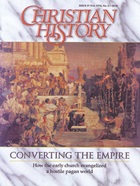
Evangelism in the Early Church: Christian History Interview - Roman Redux


The situation of the ancient and modern church seems strikingly similar: both are minorities in predominantly pagan cultures. The early church, of course, was eventually successful at converting its culture. So the natural question is, Are there any lessons we can learn to help us convert our culture?
We posed this and other questions to Robert Wilken, professor of history at the University of Virginia. He is the author of many books on the early church, including Remembering the Christian Past (1995), and he is an editorial adviser to First Things, a journal that examines religion and modern culture.
Are the worlds of ancient Rome and the modern West parallel?
In some ways, yes: this culture is no longer our culture. It still has many Christian elements in it: the calendar (with major holidays like Christmas and Easter—though even they have been denuded), church architecture, choral music (much of which is Christian), art, and the like. But with the passing of each generation, the sensibility of the culture is less Christian. The feeling of being a distinct minority was very much the experience of early Christians.
But our situations are different in one key respect: today we in the West live in a post-Christian world, in an aggressive secular culture. This culture has known Christianity, and it is bitter toward Christianity; the culture is in revolt against what existed before. Ancient paganism did not have that kind of bitterness. It was curious about Christianity, even incredulous.
But what about the persecutions?
By the time you get to Decius in the middle of the third century, some Romans believed Christianity was a formidable foe. But Porphyry, the most thoughtful critic of Christianity in that period, recognized that Jesus was an extraordinary man. He just didn't want to admit he was the Son of God. He tried to fit Jesus into the divine pantheon of the Roman Empire.
In this issue, we've examined the role of apologetics, martyrdoms, and everyday evangelism. Are there other, often overlooked, reasons the early church grew in this environment?
Two lesser-known factors come to mind. First, Christians created a tightly knit community. There was strong leadership in the role of the bishop as the priest, the teacher, and the overseer (the person who presided over the life of the community). This is a wholly unprecedented kind of office.
Jews had the rabbi, who was a teacher and a scholar, but he didn't have priestly or administrative roles. Priests, Jewish and pagan, were generally not teachers or community administrators. Furthermore, no religion had tried to organize itself across the empire. But Christian bishops of different regions worked with one another. There are no real parallels to this in the ancient world.
Second, Christians had the Bible, a rich book of historical scope and literary diversity. In the Old Testament alone you have creation stories, history, poems and prayers, proverbs, and prophecy. In the New Testament, you have stories about Christ and books of theological interpretation. In the ancient world, there was nothing like it.
But the ancient world had stories of their gods, many of which are so interesting we preserve them to this day.
Yes, but in Christian teaching, you have a person who is human and more than human, who died and rose again—and all this is grounded in history, not myth. The ancient world had stories of gods coming back to life and miraculous happenings. But to talk about such things as if they happened in history, to have a good historical record of such things, that was unparalleled.
What Christian beliefs most impressed pagans?
The resurrection of Jesus was the central Christian confession. This is what set Christ and the church apart. It was a belief Christians were willing to die for. It was a belief Christians didn't soft peddle: the New Testament makes it clear that Jesus died and was buried and rose from the grave. We're not talking about a myth; we're not talking about some new kind of understanding. We're talking about a person who actually died and rose again and showed himself to witnesses. First Corinthians 15 was a key text for early Christians.
What beliefs most troubled pagans?
The strong predestinarian language of the New Testament. Around the year 200, Origen of Alexandria listed all the biblical passages that suggest our actions are determined by God, along with those that suggest we have responsibility for our actions. He did this because critics of Christianity had read in Romans 9 about loving Jacob and hating Esau, for example, and the part about God showing mercy to whom he will show mercy. Many pagans thought that undercut moral responsibility and freedom of the will, and that was a real stumbling block.
What are some of the lessons we can learn from the early church about evangelizing our culture today? For example, should we do apologetics today as the early church did?
A lot of early apologetics was not defense but simple explanation. In his First Apology, Justin Martyr gave an account of Christian worship. He also talked about baptism. He didn't try only to establish a link to the larger culture or prove Christianity true. He also tried to tell people what Christians actually did in worship and what they believed.
Today I believe the most significant apologetic task is simply to tell people what we believe and do. We need to familiarize people with the stories in the Bible and to talk about the things that make Christianity distinctive. Many people are simply unaware of the basics of Christianity. They're rejecting something they don't know that much about.
But apologetics then and now has a limited role. We must speak what is true, but finally the appeal must be made to the heart, not the mind. We're really leading people to change their love. To love something different. Love is what draws and holds people.
What about the tightly knit early Christian community—what can we learn from that?
I think that should be a main strategy of Christians today—build strong communities. The early church didn't try to transform its culture by getting into arguments about whether the government should do this or that. As a small minority, it knew it would lose that battle; there were too many other forces at work. Instead it focused on building its own sense of community, and it let these communities be the leaven that would gradually transform culture.
How did the early church build their community?
It built a way of life. The church was not something that spoke to its culture; it was itself a culture and created a new Christian culture. There were appointed times when the community came together. There was a distinctive calendar, and each year the community rehearsed key Christian beliefs at certain times. There was church-wide charity to the surrounding community. There was clarity, and church discipline, regarding moral issues. All these things made up a wholesome community.
Did the church strive to be "user-friendly"?
Not at all—in fact, just the opposite.
One thing that made early Christian community especially strong was its stress on ritual. That there was something unique about Christian liturgy, especially the Eucharist. It was different from anything pagans had experienced.
The worship was architecturally different. The altar at a Greek temple was in front of the temple and represented that worship was a public event open to all. In Christian churches, the altar was inside. Worship was something the church gave one the right to enter into.
Furthermore, in Christian worship there was no bloody sacrifice. Prayers and hymns were taken out of the Bible, a book foreign to pagans. And then there was a sermon, an unusual feature in itself, with historically grounded talk of a dying and rising God.
Pagans entered a wholly different world than they were used to. Furthermore, it was difficult to join the early church, besides the social and cultural hurdles: the process for becoming a member took two years.
Do you think we ought to adopt this strategy today?
Yes. I think seeker-sensitive churches use a completely wrong strategy. A person who comes into a Christian church for the first time should feel out of place. He should feel this community engages in practices so important they take time to learn. The best thing we can do for "seekers" is to create an environment where newcomers feel they are missing something vital, that one has to be inculcated into this, and that it's a discipline.
Few people grasp that today. But the early church grasped it very well.
What practice of the early church do you think would most impress our secular culture today?
The early Christian devotion to a celibate life of prayer. This did not begin until the middle of the third century, but there was something about this that deeply impressed pagans. It was radical. They saw that Christians were willing to spend themselves for their beliefs.
That to me has always been the most powerful argument for the truth of Christianity. For people to give themselves wholly to a life of prayer and chaste living—well, they must have seen something or felt something real, the reality of Christ.
Copyright © 1998 by the author or Christianity Today/Christian History magazine.
Click here for reprint information on Christian History.

Support Our Work
Subscribe to CT for less than $4.25/month