


The Rise of Pentecostalism: Did You Know?


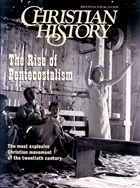
Recently Life magazine, in listing the top 100 events of the second millennium, put Pentecostalism at 68th. The Dictionary of Christianity in America says that Pentecostalism is perhaps "the single-most-significant development in twentieth-century Christianity."
Though many consider the 1906 Azusa Street Revival as the birth of modern Pentecostalism, speaking in tongues took place at two earlier Holiness gatherings, one in Topeka, Kansas, in 1901, and another in Cherokee County, North Carolina, in 1896.
It is hard to say which is the oldest Pentecostal denomination. The United Holy Church and the Church of God (Cleveland, Tenn.) point to pre-Pentecostal roots as far back as 1886. The Pentecostal Holiness Church, with pre-Pentecostal roots as far back as 1879, was the first to adopt a clear Pentecostal statement of faith in 1908.
Early Pentecostals claimed the gift of tongues was not primarily the speaking of a heavenly language (glossalalia) but other human languages (xenolalia). The purpose? Early leader Charles Parham said, "I had felt for years that any missionary going to the foreign field should preach in the language of the natives, and that if God ever equipped his ministers in that way [by xenolalia], he could do it today." Though many anecdotes of xenolalia exist, none have been confirmed.
Many early Pentecostals were pacifists. At the outbreak of World War I, some Pentecostals called for a "great peace council" at which they could state their opposition to warfare. Every major Pentecostal denomination has at some point adopted a pacifist resolution.
Pentecostals have often been as stern as fundamentalists about social behavior. In addition to banning traditional vices like alcohol, tobacco, and the movies, they have targeted chewing gum, short-sleeved dresses, soft drinks, and neckties.
Though most early Pentecostals came out of the blue-collar working class, the movement thrived among the poor and marginalized of society. Early Pentecostals taught a "theology of the poor," interpreting their remarkable growth as God's special favor upon the poor.
Racial harmony marked the earliest stage of the movement; the Azusa Street Revival was led by a black, William Seymour, and blacks and whites worshipped and shared leadership in the church. As one Pentecostal historian of the day remarked, "The color line was washed away in the blood."
On the other hand, some white critics noted that since the movement "started with a black man" and began "like a simoon from the African desert … , [it is] better adapted to tropical climates where there is plenty of water to immerse the victims of this hellish power."
Pentecostals found occasion to argue about most any subject, from prohibitions on pork to the correct doctrine of the Trinity. The result: today, worldwide, there are 11,000 Pentecostal or charismatic denominations.
There were many women preachers and pastors in the early years of the movement, and the most well-known Pentecostal of the twentieth century was evangelist Aimee Semple McPherson. Another early preacher of fame was Maria Woodworth-Etter, who once argued, "It is high time for women to let their lights shine; to bring out their talents that have been hidden away rusting, and use them for the glory of God."
For most Pentecostals, tongues and healings have been a means to a greater end. As one modern Pentecostal leader put it, "In spite of charges to the contrary, Pentecostals do not spend all their time talking about tongues. They have instead consistently sought to bring people to Christ."
The largest church in the world is a Pentecostal church in Korea: the Yoido Full Gospel Church pastored by David Yongii Cho. 240,000 attend weekly worship. Two Pentecostal churches in Buenos Aires attract together 150,000 each week.
Pentecostalism has become the fastest growing family of world Christianity. It is growing at a rate of 13 million a year, or 35,000 a day. With nearly a half billion adherents, it is, after Roman Catholicism, the largest Christian tradition.
Copyright © 1998 by the author or Christianity Today/Christian History magazine.
Click here for reprint information on Christian History.

Support Our Work
Subscribe to CT for less than $4.25/month