Loose the Women
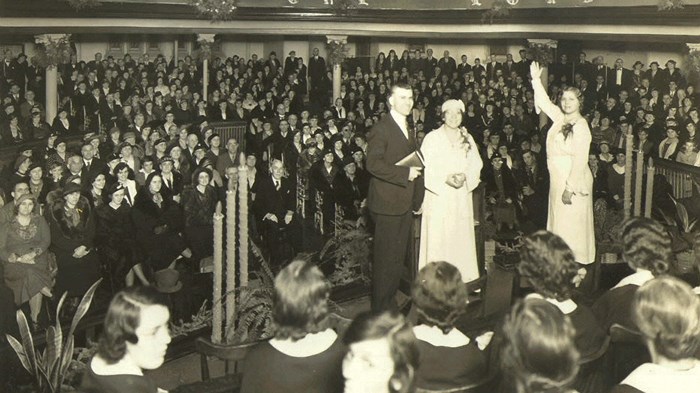


In 1916 Maria B. Woodworth-Etter declared, "God is calling the Marys and the Marthas today all over our land to work in various places in the vineyard of the Lord; God grant that they may respond and say, 'Lord, here am I. Send me.' … My dear sister in Christ, as you hear these words may the Spirit of God come upon you, and make you willing to do the work the Lord has assigned to you."
Following the example of their Holiness predecessors like Phoebe Palmer, and the Salvation Army's Catherine Booth, women ministered prominently at the beginning of Pentecostalism.
"Fit men and women"
Charles Fox Parham established Bethel Bible College in 1900 in Topeka, Kansas, to "fit men and women to go to the ends of the earth to preach." Agnes Ozman, the first to experience Spirit baptism, was an evangelist training for the mission field at Parham's school. Parham ordained women and commissioned them to ministry, and these women assisted Parham in his evangelistic campaigns. He often left women in charge when he moved on to the next meeting.
Women also participated at the Azusa Street Mission in Los Angeles. The Apostolic Faith featured testimonies, articles, and reports of women evangelizing, pastoring, and going out as missionaries. At one point, at least six of Azusa's twelve-member credentials committee were women.
In addition to approving and supporting numerous independent ministries, Pentecostal denominations issued ministerial credentials to women. The Church of God (Cleveland, Tennessee) began in 1909 to acknowledge "women who engage in the ministry of the Word" by granting them evangelists' licenses. By 1913, 12 percent of its ministers were women, with the percentage peaking at 18 percent around 1950. The Assemblies of God (AG) received ordained women into fellowship at its first General Council in 1914, and by 1936, there was one ordained woman for every four ordained men.
Women also founded Pentecostal denominations. Florence Crawford founded the Apostolic Faith Mission in Portland, Oregon, and Aimee Semple McPherson founded the International Church of the Foursquare Gospel (ICFG). The ICFG early on boasted that 37 percent of its ministers were female.
In black Pentecostalism, Madgalena Tate founded the Church of the Living God, Pillar and Ground of Truth, while Ida Robinson founded the Mount Sinai Holy Church after hearing God say in a dream, "Come out on Mount Sinai and loose the women." Both denominations allowed women to be not only pastors (allowed in a few other black Pentecostal denominations) but also bishops.
Preacher, yes; elder, no
While most denominations allowed women's Spirit-inspired preaching, few gave them authority to hold church offices. Although women often did pastor, this was viewed as expedient only because of the urgency of the "last days." Women started congregations in their homes as Bible studies or prayer groups and continued as pastors when no male was available to lead. So the anointing of the Holy Spirit on an individual woman outweighed denominational non-recognition.
The Church of God licensed women to preach, but would not ordain them. General Overseer A. J. Tomlinson wrote, "Let the good sisters feel at perfect liberty to preach the gospel, pray for the sick or well, testify, exhort, etc., but humbly hold themselves aloof from taking charge of the governmental affairs."
In 1914 the Assemblies of God agreed that women could be ordained as evangelists and missionaries but not as elders. E. N. Bell, the first ag general chairman, defended this view by stating the apostle Paul "meant what he said. … The squabbles in the church, the disputing and disorder—men should handle it."
After World War II, Pentecostals increasingly aligned themselves with evangelicalism, which emphasized male leadership. In the 1950s, Pentecostals, like other Americans, aspired to the middle class and were anxious about the possible collapse of the home, so the stay-at-home mom became a powerful symbol. The result is that today the female preacher or pastor is the rare exception in Pentecostal circles.
David G. Roebuck is director of the Hal Bernard Dixon, Jr. Pentecostal Research Center in Cleveland, Tennessee.
Go Now
A forerunner of Pentecostalism argues with God.
Maria Woodworth-Etter preached the Pentecostal message as early as 1885, and by 1912 she was one of Pentecostalism's most popular evangelists. In this excerpt from A Diary of Signs and Wonders, she describes her call to ministry.
The dear Savior stood by me one night in a vision and talked face to face with me, and asked what I was doing on earth. I felt condemned, and said, "Lord, I am going to work in thy vineyard."
The Lord said, "When?"
I answered, "When I get prepared for the work."
Then the Lord said to me, "Don't you know that while you are getting ready souls are perishing? Go now, and I will be with you." …
I told him that I could not talk to the people; I did not know what to say, and they would not listen to me.
Jesus said, "You can tell the people what the Lord has done for your soul; tell of the glory of God and the love of Jesus; tell sinners to repent and prepare for death and the judgment, and I will be with you."
Still I made one excuse after another, and Jesus would answer, "Go, and I will be with you."
I told him I wanted to study the Bible; that I did not understand it well enough. Then there appeared upon the wall a large open Bible, and the verses stood out in raised letters. The glory of God shone around and upon the book. I looked, and I could understand it all.
Then Jesus said again, "Go, and I will be with you."
I cried, "Lord, I will go. Where shall I go?"
And Jesus said, "Go here, go there, wherever souls are perishing."
Praise the Lord for his wonderful goodness in revealing his word and will in such a wonderful way, to such a poor weak worm of the dust. … I was to be God's mouth-piece. I must trust God to speak through me to the people the words of eternal life.
Copyright © 1998 by the author or Christianity Today/Christian History magazine.
Click here for reprint information on Christian History.

Support Our Work
Subscribe to CT for less than $4.25/month