Pentecostal Millennialism: The Second Comers



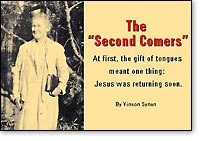
The Second Comers
On the very first day of the twentieth century, a group of Kansas Bible school students laid hands on Agnes Ozman, praying that she would be baptized in the Holy Spirit with the expected sign of speaking in tongues. In what was later called "the touch felt around the world," the 30-year-old, while "a halo surrounded her head and face," began to "speak the Chinese language."
With that, the Pentecostal movement, which now numbers over a half-billion adherents, was born. But despite the movement's association with tongues ever since that centennial prayer meeting, early Pentecostalism was less a tongues movement and more a Jesus-is-coming movement.
Topeka's missionary tongues
The Topeka Pentecost occurred in an atmosphere of millennial expectations. After Ozman spoke in tongues, her teacher, Charles Fox Parham, and most of the other students also experienced tongues. In short order, Parham formulated the doctrine that tongues was the "Bible evidence" of baptism in the Holy Spirit. He also believed tongues were known earthly languages any missionary could instantly use to reap the final harvest of souls before the imminent, premillennial rapture of the church.
"I had felt for years that any missionary going to the foreign field should preach in the language of the natives," he wrote. "Anyone today ought to be able to speak any language of the world if they had horse sense enough to let God use their tongue and throat."
Parham was not the first to identify tongues as the sign of Spirit baptism. As early as 1830, Scottish Presbyterian minister Edward Irving and a group of English evangelicals had predicted the restoration of tongues (as well as the other gifts of the Spirit) as signs of the end of the age.
Agnes Ozman is said to miraculously speak in Chinese.
On April 20, 1830, in the first recorded instance in modern times, James McDonald spoke in tongues, and his twin, George, interpreted: "Behold He cometh—Jesus cometh— a weeping Jesus." In fact, almost all the subsequent interpretations in England centered on the theme "the Lord is coming soon; get ready to meet him."
John Nelson Darby, who developed the dispensational eschatology emphasizing the Rapture, was Irving's friend, and his ideas were ardently supported by many Holiness leaders. "Every fully-developed Pentecostal experience includes this Pentecostal expecting of the coming of the King," said one.
It was not long before Parham's followers prepared to use their xenoglossolalia in the mission fields. "We have several missionaries in the field who have the gift of tongues, who not only speak the language and understand the natives, but can use the language intelligently," Parham claimed. "It has become a gift to them."
Enraptured Azusa Street
In 1906 the center of the Pentecostal revival shifted from Parham to one of his students, William J. Seymour, a black Holiness preacher from Texas who came to Los Angeles to spread the Pentecostal fire. In a rundown mission on Azusa Street, manifestations of tongues and healing drew thousands of visitors from around the world. As in Topeka, the understanding was that Jesus was soon to return and that tongues was a harbinger of his coming.
The manifestations of tongues and interpretations at Azusa Street were unanimous in their emphasis concerning the Rapture. In September 1906, for example, Anna Hall prophesied, "I have come to tell you that Jesus is coming. Go forward in my name. … My people have only time to get on the beautiful garments and prepare for the wedding supper in the heavens."
Seymour himself joined the eschatological excitement, writing in his Apostolic Faith paper in January 1907, "We are listening now for the sound of his chariot wheels. … We are now living in the eventide of this dispensation, when the Holy Spirit is leading us, Christ's Bride, to meet him in the clouds."
Rapture's entry ticket
In these early days, Pentecostals commonly believed tongues was evidence of the "sealing" of the Holy Spirit, qualifying believers for the "bridehood saints." Many appeals were made to the parable of the wise and foolish virgins in the Matthew 25 parable. For decades Pentecostal preachers warned their congregations of the perils of not speaking in tongues—the necessary experience to go up in the Rapture.
One of these preachers was George Floyd Taylor, who wrote in his 1907 book, The Spirit and the Bride, that the "sealed ones" would be the "triumphant missionaries of humanity's last generation."
In his closing appeal, Taylor criticized "scholarly clergymen and high steeple officials with tall plug hats, sleek coats, toothpick shoes, and golden-headed canes, with long faces and lugubrious countenances and deep sighs, consulting with one another, 'How to reach the masses?' … They are nineteen centuries behind the times. That problem was solved at Pentecost."
After a few missionary fiascoes, fewer claims were made for missionary tongues. But many were still reached, and around the world the message shouted from the housetops was "Jesus is coming." Listeners were warned to be sure they were among the bridehood saints who were sanctified and filled with the Holy Spirit.
After 1910, when it became increasingly clear that, in fact, missionaries weren't miraculously given abilities in new earthly tongues, Pentecostals began to increasingly see tongues more as "evidence" of the baptism in the Holy Spirit and as a devotional "prayer language."
Vinson Synan is dean of the School of Divinity at Regent University in Virginia Beach, Virginia, and author of The Holiness-Pentecostal Tradition (Eerdmans, 1997).
Copyright © 1999 by the author or Christianity Today/Christian History magazine.
Click here for reprint information on Christian History.

Support Our Work
Subscribe to CT for less than $4.25/month