Evangelicalism: Billy Graham
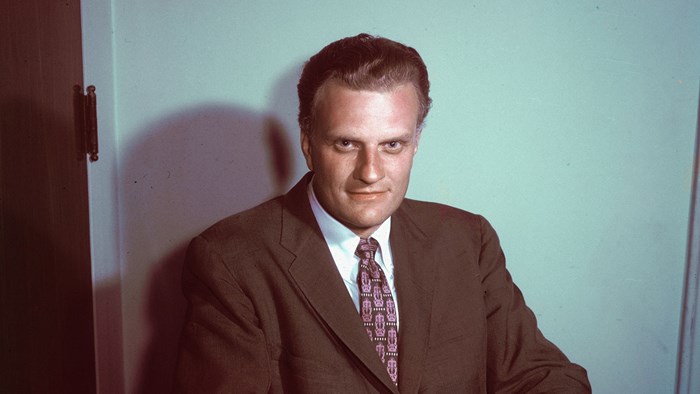


The litany of accomplishments is familiar. Billy Graham has preached the gospel of Christ in person to more than 80 million people and to countless millions more over the airwaves and in films. Nearly 3 million have responded to the invitation he offers at the end of his sermons.
He was the first Christian, eastern or western, to preach in public behind the Iron Curtain after World War II, culminating in giant gatherings in Budapest (1989) and Moscow (1992) and complemented by unprecedented invitations to Pyongyang, North Korea (1992) and Beijing (1993).
He has been a friend to the pope, the queen, several prime ministers, and every president from Dwight Eisenhower to Bill Clinton. When America needs a chaplain or pastor to help inaugurate or bury a president or to bring comfort in times of terrible tragedy, it turns, more often than not, to him.
For virtually every year since the 1950s, he has been a fixture on lists of the ten most admired people in America or the world. He has received both the Presidential Medal of Freedom (1983) and the Congressional Gold Medal (1996), the highest honors these two branches of government can bestow upon a civilian. Thus, it is hardly surprising that a Ladies Home Journal survey once ranked the famed evangelist second only to God in the category, "achievements in religion."
Born near Charlotte, North Carolina, in 1918, Billy Graham first attended Bob Jones College, but he found both the climate and Dr. Bob's strict rule intolerable. He then followed a friend to Florida Bible Institute, where he began preaching and changed his denominational affiliation from Associate Reformed Presbyterian to Southern Baptist. To round out his intensive but academically narrow education, he moved north to Wheaton College, where he met and married Ruth Bell, the daughter of a medical missionary, and undertook his first and only stint as a local pastor.
In 1945 Graham became the field representative of a dynamic evangelistic movement known as Youth for Christ International. In this role, he toured the United States and much of Great Britain and Europe, teaching local church leaders how to organize youth rallies. He also forged friendships with scores of Christian leaders who would later join his organization or provide critical assistance to his crusades when he visited their cities throughout the world.
God may choose a country boy
… and I pray that he would!"
—Billy Graham
Graham gained further exposure and stature through nationally publicized crusades in Los Angeles, Boston, Washington, and other major cities from 1949 to 1952, and through his Hour of Decision radio program, begun in 1950. Stunningly successful months-long revivals in London (1954) and New York (1957), triumphant tours of the Continent and the Far East, the founding of Christianity Today magazine (1956), the launching of nationwide television broadcasts on ABC (1957), and a public friendship with President Dwight Eisenhower and Vice-President Richard Nixon firmly established him as the acknowledged standard-bearer for evangelical Christianity.
As Graham's prestige and influence grew, particularly among "mainline" (non-evangelical) Christians, he drew criticism from fundamentalists who felt his cooperation with churches affiliated with the National and World Council of Churches signaled a compromise with the corrupting forces of modernism. Bob Jones accused him of peddling a "discount type of religion" and "sacrificing the cause of evangelism on the altar of temporary convenience." The enduring break with hard-line fundamentalism came in 1957, when, after accepting an invitation from the Protestant Council of New York to hold a crusade in Madison Square Garden, Graham announced, "I intend to go anywhere, sponsored by anybody, to preach the gospel of Christ, if there are no strings attached to my message. … The one badge of Christian discipleship is not orthodoxy but love. Christians are not limited to any church. The only question is: are you committed to Christ?"
The New York Crusade marked another significant development in Graham's ministry. At a time when sit-ins and boycotts were stirring racial tensions in the South, Graham invited Dr. Martin Luther King, Jr., to discuss the racial situation with him and his colleagues and to lead the Garden congregation in prayer. The implication was unmistakable: Graham was letting both whites and blacks know that he was willing to be identified with the civil rights movement and its foremost leader, and King was telling blacks that Billy Graham was their ally. Graham would never feel comfortable with King's confrontational tactics; still, his voice was important in declaring that a Christian racist was an oxymoron.
During the decade that spanned the presidencies of Lyndon Johnson and Richard Nixon, to whom he had close and frequent access, Graham often drew fire from critics who felt he ought to be bolder in supporting the civil rights movement and, later, in opposing the war in Vietnam. The normally complimentary Charlotte Observer noted in 1971 that even some of Graham's fellow Southern Baptists felt he was "too close to the powerful and too fond of the things of the world, [and] have likened him to the prophets of old who told the kings of Israel what they wanted to hear."
The evangelist enjoyed his association with presidents and the prestige it conferred on his ministry. At the same time, presidents and other political luminaries clearly regarded their friendship with Graham as a valuable political asset. During his re-election campaign, for example, Nixon instructed his chief of staff, H. R. Haldeman, to call Graham about once every two weeks, "so that he doesn't feel that we are not interested in the support of his group in those key states where they can be helpful." After the Watergate scandal, Graham drew back a bit and began to warn against the temptations and pitfalls that lie in wait for religious leaders who enter the political arena.
When the movement known as the Religious Right surfaced in the late 1970s, he declined to participate in it, warning fellow Christian leaders to "be wary of exercising political influence" lest they lose their spiritual impact.
As Graham came to sense the breadth of his influence, he grew ever more determined not only to help evangelicalism become increasingly dynamic and self-confident, but also to shape the direction of contemporary Christianity. That determination manifested itself in several major international conferences sponsored or largely underwritten by the Billy Graham Evangelistic Association (BGEA).
In particular, the 1966 World Congress on Evangelism in Berlin, attended by 1,200 evangelical leaders from 104 nations, and the 1974 International Congress on World Evangelization in Lausanne, Switzerland, attended by 2,400 delegates from 150 countries, helped evangelicals to see themselves as a worldwide Christian force, alongside Vatican II and the World Council of Churches, an international movement capable of accomplishing more than its constituents had dreamed possible.
Few, if any, developments in Billy Graham's ministry have been more surprising or controversial than his success in penetrating the Iron Curtain. Beginning in 1978, virtually every Soviet-controlled country progressively gave him privileges that no other churchman, including the most prominent and politically docile native religious leaders, had ever received. Graham used these visits to preach, to encourage Christian believers, and to explain to Communist leaders that their restriction of religious freedom was counterproductive, hampering diplomatic relations with America.
A story from Graham's 1982 visit to Moscow highlights the impact of his diplomatic influence. A group of six Siberian Pentecostals, claiming to be victims of religions persecution, had been living in asylum in the basement of the U. S. Embassy since 1978. A vexing source of tension between the Soviet and U. S. governments, the Siberian Six demanded that Graham meet with them during his trip—with full media coverage. Not wanting to exacerbate an already perilous situation, Graham agreed to the meeting but vehemently refused any media presence. He also refused to meet the group's demands that he publicly call for their release and decry communism, which enraged the Pentecostals and led them to tell the American press, "He was like all the other religious figures who have visited us, nothing special."
However, Graham and his adviser Alexander Haraszti were working behind the scenes for the group's release, seeking, through all of their diplomatic contacts, a promise of safe passage out of the country. This Haraszti received when a Soviet deputy told him, "The Soviet Union will not lie to Billy Graham." Graham sent a letter to the Pentecostals in 1983, outlining the steps he felt they should take. Not long afterward, the two families, together with several relatives who had not been with them in the embassy, were allowed to emigrate. Asked in 1989 to assess his role in the incident, Graham said, "I think [the Soviets] eventually did what we asked them to. I have no way of knowing whether [what we did] was a factor or not. But I think it was."
Graham's proudest achievements may be two BGEA-sponsored conferences in Amsterdam in 1983 and 1986, with a third scheduled for the year 2000. These gatherings, attended by a total of 13,000 on-the-job itinerant evangelists from 174 countries, provided basic instruction in such matters as sermon composition, fundraising, and effective use of films and videotapes. As a sign of Billy Graham's change-embracing spirit, approximately 500 attendees at the 1986 meeting were women, and Pentecostals outnumbered non-Pentecostals. Subsequent smaller gatherings throughout the world have afforded similar training to additional thousands of evangelists.
Indeed, it is plausible that the answer to the oft-asked question, "Who will be the next Billy Graham?" is no single man or woman, but this mighty army of anonymous individuals whose spirits have been thrilled by Billy Graham's example, their hands and minds prepared with his organization's assistance, and their hearts set on fire by his ringing exhortation at the Amsterdam meetings: "Do the work of an evangelist!"
Age and Parkinson's Disease have taken their toll, but they have not quenched Billy Graham's spirit. "My mind tells me I ought to get out there and go," he said, as he was beginning to feel the effects of his disease, "but I just can't do it. But I'll preach until there is no breath left in my body. I was called by God, and until God tells me to retire, I cannot. Whatever strength I have, whatever time God lets me have, is going to be dedicated to doing the work of an evangelist, as long as I live."
William Martin is a professor of sociology at Rice University and author of Prophet with Honor: The Billy Graham Story (Morrow, 1991).
Timeline
1918 William Franklin Graham, Jr., born near Charlotte, North Carolina
1925 Scopes "Monkey" Trial forces fundamentalism into a retreat
1934 Charles E. Fuller begins an evangelistic radio show that will come to be called The Old Fashioned Revival Hour
1937 Graham transfers to Florida Bible Institute; preaches his first sermon
1940 Enrolls at Wheaton College, meets Ruth (they marry in 1943)
1943 National Association of Evangelicals founded
1944 Graham's first attempt at mass evangelism, at the inaugural rally for Chicagoland Youth for Christ, prompts 42 people to come forward
1947 Carl F.H. Henry publishes The Uneasy Conscience of Modern Fundamentalism; Fuller Theological Seminary founded
1949 An eight-week crusade in Los Angeles catapults Graham into the national spotlight
1951 Bill Bright founds Campus Crusade for Christ; later writes the pamphlet "The Four Spiritual Laws"
1954 Graham's wildly successful crusade at London's Harringay Arena
1956 Christianity Today publishes its first issue
1957 Graham's crusade at Madison Square Garden forces break with fundamentalists
1962 D. James Kennedy creates an outreach program called "Evangelism Explosion"
1963 Pat Robertson begins the 700 Club
1974 Graham assembles 2,400 Protestant leaders from 150 countries at Lausanne, Switzerland, for the International Congress on World Evangelization
1982 Visits the Soviet Union
1986 "Amsterdam '86" draws 10,000 itinerant evangelists
1987-88 Televangelists Jim Bakker and Jimmy Swaggart involved in scandals
1995 Graham reaches 185 countries simultaneously through 3,000 downlinks in his "Global Mission" satellite crusade
You Are There
How two journalists reported on Billy Graham's landmark 1949 crusade in Los Angeles:
That old time religion has gone as modern as an atomic bomb in the thunderous revival meetings that Rev. Billy Graham conducts nightly in a giant tent at Washington Boulevard and Hill Street.
But its modernity is in externals. Nothing detracts from the traditional fury and power of an old-fashioned gospel gathering. That's what his listeners, many of whom remember with pleasure the late Billy Sunday, want. And that's what they get.
In a mighty and skilled voice, Billy Graham selects the words of today, in 1949, as he hammers out this slogan:
"Christ in this crisis."
The crisis is the worldwide crisis of fear, of atomic warfare, of economic, social and political problems. And of moral degeneration in this country.
Billy Graham, only 30 years old, is a tall handsome man with intense blue eyes and a whip-like vitality. As president of a Baptist college in Minneapolis, he disclaims that he is a professional evangelist, but he is noted for addressing large congregations.
— Richard Reynolds, Los Angeles Daily News, September 30, 1949
Old-time religion is sweeping Los Angeles. In six weeks, 200-thousand people have filed into a circus tent on the outskirts. And they're still pouring in at the rate of 10-thousand every night.
They come to hear a handsome young college president, Billy Graham. And churchmen say he's started the greatest religious revival in the history of southern California.
Thousands have hit the sawdust trail [and] announced their return to Christ. One sportsman said he's selling his racing stable.
He mixes sermons with stories of salvation from misery, misfortune, and sorrow for those who repented their sins.
He tells such stories as this:
An irreligious business man lost his family, his self-respect and his standing in his community. He was a beaten, discouraged man.
Then he repented. He was led to a small tent. An attendant said, "We will have someone assist you in prayer."
That someone was his wife, whom he had not seen since their divorce 10 years before. They plan to remarry soon.
— Associated Press news release, November 1949
Billy Graham's Success: Two Views
The Billy Graham campaign will spin along to its own kind of triumph because canny experienced engineers of human decision have laid the tracks, contracted for the passengers, and will now direct the traffic which arrives on schedule. … Anticipation has been adroitly created and built up by old hands at the business, and an audience gladly captive to its own sensations is straining for the grand entrance . …[The "Graham procedure"] does its mechanical best to "succeed" whether or not the Holy Spirit is in attendance.
—The Christian Century, 1957, criticizing the extensive preparations for Graham's New York crusade
What is most captivating about Billy is his sincerity. There isn't an iota of hypocrisy in the man. He is real. I sat in Harringay [Arena, London, site of a 12-week crusade in 1954] night after night asking over and over, 'What is the reason [for his success]?' I finally decided that this was the first time most of these people had heard a transparently honest evangelist who was speaking from his heart and who meant and believed what he was saying. There is something captivating about that."
—Anglican priest and popular author John Stott in 1986
For more information on this topic, see:
billygraham.org—The Billy Graham Evangelistic Association
http://www.billygraham.org
Billy Graham Center Home Page
http://www.wheaton.edu/bgc/bgc.html
The Billy Graham Training Center at The Cove
http://www.thecove.org
TIME 100: Heroes & Icons - Billy Graham
http://www.pathfinder.com/time/time100/heroes/profile/graham01.html
Copyright © 2000 by the author or Christianity Today/Christian History magazine.
Click here for reprint information on Christian History.

Support Our Work
Subscribe to CT for less than $4.25/month