

Roman Catholic Reform: John XXIII
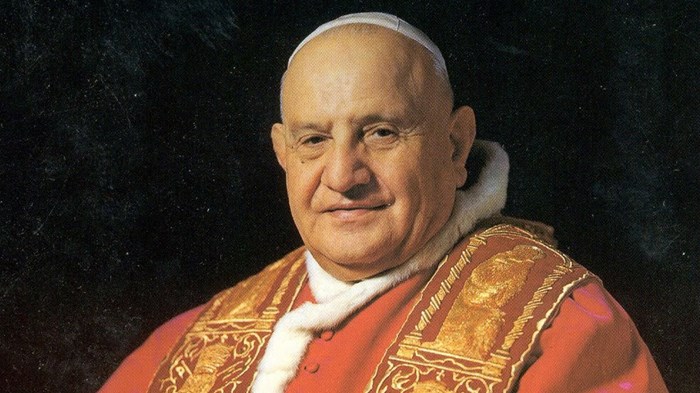


Angelo Guiseppe Roncalli began his life in 1881 as the son of farmers so poor they shared the first floor of their house in Bergamo, near Milan, with six cows. After entering seminary at age 11, he pursued a thoroughly Catholic education, then spent most of his life in the papal diplomatic service. He served mainly in obscure places, which helped him make a lot of friends without collecting any enemies. He was known for being lovable and kind, if a bit unconventional—hardly qualities that would automatically propel him toward the papacy.
However, when Pope Pius XII died in 1958, the office was plagued by allegations of autocratic abuses, anti-Semitism, and complicity with Adolf Hitler. No one wanted continued controversy, so the cardinals looked around for a milder successor. They spotted the pious and aged Roncalli, whom they believed would manage a brief and uneventful administration.
Much to the cardinals' surprise, the new pope had no intention of merely "warming the throne of Peter" until his death. He wrote in his journal in 1961, "When … the cardinals of the Holy Roman Church chose me … everyone was convinced that I would be a provisional and transitional pope. Yet here I am, already on the eve of the fourth year of my pontificate, with an immense program of work in front of me to be carried out before the eyes of the whole world, which is watching and waiting."
He was referring to the program he had announced just months after his election, the calling of a great church council, Vatican II. No such council had been summoned since 1879, and John attributed the unexpected call to an inspiration from the Holy Spirit. He was frustrated by the "prophets of doom" among his advisors who believed "our era, in comparison with past eras, is getting worse," whereas "at the time of the former councils, everything was a triumph for the Christian idea and way of life and for proper religious liberty."
The pope, a keen student of history, lacked these illusions about the past, and he was convinced that with a few major reforms, the church could have at least as great an impact on the twentieth century as it had on any other. Specifically, he sought reconciliation with non-Catholics (whom he called "separated brethren"), greater efficiency within church administration, and increased relevance to contemporary culture. Vatican II was successful on all three counts.
John included journalists and non-Catholic religious leaders as observers and also invited prelates from around the world, ensuring that the council's efforts would reach far beyond Rome and ushering in an unprecedented spirit of ecumenism. The church became more vigorous as authority was decentralized and hierarchy relaxed. Most significantly for the average Mass-attending Catholic, the liturgy was switched from Latin to the language the congregation could understand. This led W. M. Abbott, Jesuit editor of a 1965 book on ecumenism, to predict: "[B]y 1990 our Catholic people will be much closer to Holy Scripture—and, thanks to the vernacular, so will our priests."
John XXIII didn't live to see the impact of the council or even its second session. But his successor, Pope Paul VI, announced at his election that the council would continue, and by the time it closed in 1965, it was hailed as possibly the most significant event in church history since the Reformation.
Elesha Coffman is assistant editor of Christian History.
Timeline
1881 Angelo Giuseppe Roncalli born near Milan
1892 Enters minor seminary of Bergamo
1907 Pope Pius X issues encyclical condemning modernism
1946 Mother Frances X. Cabrini becomes first American to be canonized as a saint
1950 Pope Pius XII proclaims the dogma of the Assumption of the Virgin Mary
1958 Roncalli elected Pope John XXIII
1962 Vatican II opens
1963 John XXIII dies; Pope Paul VI continues the council
1965 Vatican II closes its fourth and final session; Pope Paul VI and Ecumenical Patriarch Athenagoras nullify anathemas in force since the Great Schism
You Are There
To anyone who had the good fortune to be standing in front of the bronze doors leading into the papal palace, on the side of St. Peter's Square, at eight o'clock on the morning of Thursday, October 11, 1962, there was suddenly revealed a dazzling spectacle. At that moment, two papal gendarmes, resplendent in parade uniform of white trousers and black topboots, coats, and busbies, slowing swung the great door open, exposing to a portion of the crowd row upon row of bishops, clad in flowing white damask copes and mitres, descending Bernini's majestic scala regia from the papal apartments. As brilliant television floodlights were switched on along the stairway, the intense light brought to mind Henry Vaughan's lines: "I saw Eternity the other night, Like a great ring of pure and endless light."
In rows of sixes, an apparently inexhaustible phalanx of prelates filed out of the Vatican palace, swung to their right across St. Peter's Square, then wheeled right again, to mount the ramplike steps leading into the basilica. Every now and then, this white mass was dotted with the black cassock, full beard, and round headdress of an oriental bishop, and with the bulbous gold crown and crossed pectoral reliquaries of a bishop of the Byzantine rite. Toward the end came the scarlet ranks of the Sacred College of Cardinals. Finally, the pope appeared, carried, in deference to the wishes of his entourage, on the sedia gestatoria, and looking rather timid, perhaps even frightened—as he always does when first mounting this oriental contraption—but gradually warming to the mild acclamation of the overawed crowd, and gently smiling and quietly weeping as he was carried undulantly forward, blessing the onlookers.
—"Xavier Rynne" (pseudonym), an observer at the opening of Vatican II, in Letters from Vatican City
For more information on this topic, see:
The Writings of Pope John XXIII
http://listserv.american.edu/catholic/church/papal/john.xxiii/john.xxiii.html
Popes Through the Ages: Pope John XXIII
http://www.newadvent.org/Popes/ppjo23.htm
1962 Man of the Year: Pope John XXIII
http://www.pathfinder.com/time/special/moy/1962.html
CIN - Vatican II Documents
http://www.cin.org/vatiidoc.html
Copyright © 2000 by the author or Christianity Today/Christian History magazine.
Click here for reprint information on Christian History.

Support Our Work
Subscribe to CT for less than $4.25/month