Globalism: John Paul II
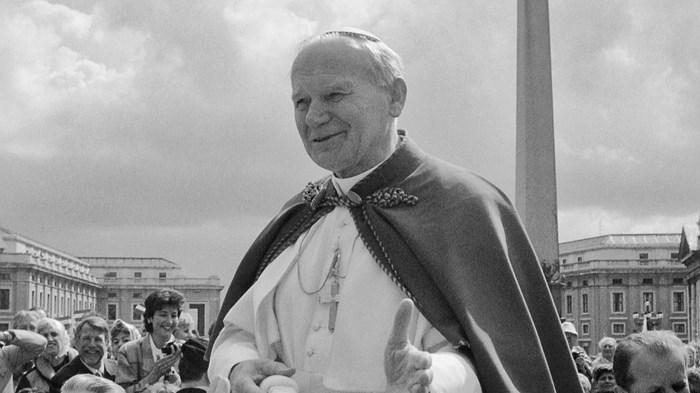


In October, 1978, Karol Wojtyla, the Cardinal Archbishop of Krakow, Poland, was elected the first Slav pope in history and the first non-Italian since the sixteenth century. He took the name John Paul II, and many observers believe he will be known in history as "John Paul the Great," much as Christians refer to the fifth and sixth century popes, Leo the Great and Gregory the Great.
Secular writers tend to see his greatness chiefly in the part he played in the end of the empire of Soviet communism. During World War II, when Joseph Stalin was cautioned against incurring the displeasure of Pope Pius XII, Stalin dismissively asked, "How many divisions does the pope have?" John Paul marshaled divisions of the human spirit in Poland and throughout Eastern Europe, encouraging millions of people to declare their determination to "live in the truth." It was in 1980, one year after he visited Poland, that the Solidarity movement became a force—a connection Solidarity leader Lech Walesa commemorated by signing the agreement legalizing the movement with a souvenir pen bearing the pope's picture.
Wojtyla's Slavic heritage is not the only unique element of his background. During the Nazi occupation of Poland, he worked in a quarry and a chemical factory. But by night, he studied philosophy, published poetry, and wrote and performed plays as part of a clandestine cultural resistance organization. It wasn't until after his father's death in 1941 that he began to consider the priesthood as yet another way to resist the degradation and brutality of totalitarian rule.
He entered seminary in 1942, though the political climate made this a risky choice; many of his professors had already been arrested and lost forever to concentration camps. He conducted his studies in secret until Poland was "liberated" by the Russian army and the Krakow seminary could be public once more. Following his ordination, he began to travel throughout Europe, and he also continued his literary pursuits, always making every effort to assert a vision of life different from what the ruling communists sought to impose. His ideas and activism attracted the attention of church leaders, and when the cardinals met to choose a new pope after John Paul I's sudden death in 1978, Wojtyla garnered nearly all of the votes.
While his influence in world affairs has been enormous, John Paul is not primarily a political figure. He sees himself first as a priest, philosopher, theologian, bishop, and teacher. Among his titles is Servus servorum Dei (Servant of the servants of God), and as such he sees himself as servant to the more than one billion Roman Catholics in the world, and indeed to the entire human family, all of whom are called to be servants of God and of one another. "Believers have a duty to treat all men and women as brothers and sisters in the one human family," he said in a 1995 address to the ambassador of Great Britain. "Prejudice and enmity have no place in true religion and can never be justified on religious grounds."
The theme of his first sermon as pope was "Be not afraid!" and that theme has been repeated thousands of times throughout the 20 years of his pontificate. The message is that, despite all the perils facing humanity, the human project itself cannot fail because God has become one of us in Jesus Christ, and Christ has already overcome sin, evil, and every threat to human existence. That message is aptly described as "prophetic humanism," a radically Christ-centered word to the world offering both God's judgment and promise of redemption. "The Redeemer of Man, Jesus Christ, is the center of the universe and of history," he wrote in his first encyclical.
John Paul's focus on future redemption, as well as his deep hostility to communism, place him in opposition to liberation theology, which gained popularity in the 1960s and 1970s. He saw too much of a Marxist agenda in this school of thought. However, he also criticized Western capitalism on the grounds of the "fundamental defect, or rather a series of defects, indeed a defective machinery" that allows some to prosper while others starve. The pope's other stances that have created controversy include vehement opposition to abortion and birth control, a refusal to even discuss women's ordination, and forceful support for theological orthodoxy, even to the point of intervening in the affairs of Catholic educators and the Society of Jesus.
In more than 90 pastoral visits around the world, in World Youth Day events that have rallied millions of young people, and in thousands of homilies, speeches, and official documents, the role of John Paul has been chiefly that of teacher. His is possibly the most energetic teaching pontificate in 2,000 years of Christian History. Especially influential are the 13 encyclical letters to date, five of which deserve special attention:
- Centesimus Annus (The Hundredth Year, 1991) set out the biblical and moral basis of a free and just social order.
- Veritatis Splendor (The Splendor of Truth, 1993) contends for the objectivity of moral truth, in opposition to all forms of relativism and nihilism.
- Evangelium Vitae (The Gospel of Life, 1995) explains why protecting unborn children and other imperiled human lives is necessary for the defense of human dignity against "the culture of death."
- Ut Unum Sint (That They May Be One, 1995) echoed the prayer of Christ in John 17, calling for unity among Christians, especially reconciliation with Eastern Orthodoxy and the healing of the sixteenth-century breach between Rome and the Reformation.
- Fides et Ratio (Faith and Reason, 1998) explains that all truth is God's truth and therefore all truth is one, which requires a renewed conversation between science, philosophy, and revelation.
Christians of all communions will for many years into the future, I am confident, be studying the teaching and pastoral initiatives of the one who will be known, I am also confident, as John Paul the Great. As George Weigel, in his Witness to Hope: The Biography of John Paul II, noted, John Paul II, for the first time in centuries, has effectively placed the papacy in the service of the entire Christian community and its mission to the world.
Richard John Neuhaus is editor of First Things: A Monthly Journal of Religion and Public Life.
Timeline
1920 Karol Wojtyla is born in Poland
1938 Begins studies at Jagiellonian University
1939 Germany invades Poland
1942 Wojtyla begins studying for the priesthood at an underground seminary
1945 Russia assumes control of Poland
1948 Wojytla obtains doctorate in mystical theology; serves as parish priest
1956 Becomes professor of ethics at Krakow Seminary
1960 Publishes the influential book Love and Responsibility
1962-65 Actively participates in Vatican II
1963 Becomes archbishop of Krakow
1978 Elected pope, as John Paul II
1979 Journeys to Mexico and Poland
1981 Shot and seriously wounded
1983 Visits his would-be assassin in prison and extends forgiveness
1985 Addresses 80,000 young Muslims in Casablanca
1986 Inaugurates World Youth Day to celebrate the faith of young Catholics
1989 Solidarity sweeps semi-free elections in Poland; John Paul meets with Mikhail Gorbachev at the Vatican
1994 Attempts to influence the debate on family planning prior to UN Conference on Population and Development
1996 Makes pilgrimage to unified Germany
You Are There
When John Paul made a pilgrimage to Poland in 1979, fully one-third of the nation turned out to see him, welcoming him with displays like this one in Krakow:
John Paul II drove into his city in an open car, past the exultant faces of men, women, and children he had baptized, confirmed, and counseled, past couples whose marriages he had blessed and whose parents he had buried. … [F]or the next three nights, the streets surrounding the archbishop's residence and the roofs of nearby houses were thronged with young people—high school and university students and workers, celebrating a kind of papal street festival, clearly to the discomfort of the authorities. The first night, John Paul came out on a balcony and began a dialogue with the crowd, asking, "Who's making all this noise? I haven't heard so much noise since Mexico, where they cried, 'El Papa, El Papa.'" The youngsters took the cue and began the rhythmic chant, "El Papa, Sto lat, El Papa, Sto lat! [May you live a hundred years!]" They called for a speech, but the pope explained there wouldn't be any; he had a sore throat. So they sang together, as they would for the next three nights. … Finally, at midnight, John Paul called off the songfest with the last word: "You are asking for a word or two, so here they are—Good night!"
—George Weigel in Witness to Hope: The Biography of John Paul II
For more information on this topic, see:
The Holy See - The Holy Father - John Paul II
http://www.vatican.va/holy_father/john_paul_ii
TIME 100: Leaders & Revolutionaries - Pope John Paul II
http://www.pathfinder.com/time/time100/leaders/profile/popejohn.html
CNN - Biography - Pope John Paul II
http://www.cnn.com/SPECIALS/1999/pope
Catholic Information Network: John Paul II
http://www.cin.org/pope.html
Copyright © 2000 by the author or Christianity Today/Christian History magazine.
Click here for reprint information on Christian History.

Support Our Work
Subscribe to CT for less than $4.25/month