




Preparing a Way in the Wilderness


In 1890 William D. Bloys, a Presbyterian Army chaplain at Fort Davis, Texas, began a regular outdoor service in a pasture 19 miles from the fort. Officially the "Bloys Camp Meeting," his motley gathering of cowboys and ranchers became known as the "Spiritual Hitchin' Post of West Texas." Bloys never tried to force a man to accept a faith he didn't feel he needed, but many men in that wild country did accept—and cleaned up their lives. One observer remarked, "No boy raised up at Bloys ever ended in the Jeff Davis County Jail."
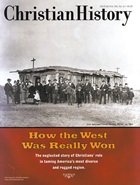
Though such signs of spiritual life appeared all over the western landscape, they are completely absent from most people's visions of the nineteenth-century American frontier. Names like Buffalo Bill, Sitting Bull, Annie Oakley, Calamity Jane, Billy the Kid, and Wyatt Earp are almost synonymous with the West, while names like William D. Bloys, Daniel S. Tuttle, Charles Sheldon, Sheldon Jackson, and Brother Van Orsdel ring few bells. Yet if one looks at actual accomplishments, the situation might well be reversed. Most western communities owe far more to these unheralded clerics than they do to the high-profile outlaws or icons.
From about 1840 to the end of the century, these largely anonymous ministers shaped the contours of western life in three major ways. They formed the first churches and Sunday schools, which promoted social stability while reining in local violence; they developed a distinctly western style of Christianity that emphasized a non-denominational message of salvation and personal ethics; and they helped lay the institutional foundations—orphanages, hospitals, and schools—for scores of western communities.
Into the fray
The American West of the Civil War era was full of violence. In 1859, for example, an observer noted that the only need El Paso, Texas, had for a minister was to bury the dead. Presbyterian minister Alexander T. Rankin described Denver of 1860 as a town of no laws, jails, or courts, and thus a land with "no restraint on human passion." The bodies of six recently hanged horse thieves greeted Episcopal rector John Cornell when he first stepped off the train in Laramie, Wyoming, in 1866. Even in the 1880s, Baptist James Spencer noted that he could postmark his letters from Butte, Montana, as sent "from Hell."
The clergy naturally hoped that by organizing fledgling churches they could stem this tide. Thus their initial response was to scour their area for enough people to found a "First" (Presbyterian, Methodist, Baptist, etc.) church. The mobility of both pastors and parishioners, however, meant that these "First" churches remained small for years.
Frontier clerics discovered that it was often easier to organize a Union (multi-denominational) Sunday school instead. Really a Bible class for adults, these Sunday schools often developed into genuine churches. In 1914 the Presbyterians estimated that about 80 percent of their new churches in western areas had originally begun as Sunday schools.
Modest though they might have been, these churches and Sunday schools served as bulwarks of social stability. Not only did they provide venues for regular services, their rooms held a variety of social gatherings as well, thus functioning as training grounds for political democracy. The numerous church meetings introduced people to such basic democratic principles as how to conduct public meetings via accepted rules of order, how to speak to the issue at hand, and (usually) respect for majority rule. Thus, the church and political gatherings of the era overlapped and reinforced each other.
On rare occasions, the pioneer clergy actually brought order out of chaos. Famed Methodist itinerant John "Father" Dyer reportedly staved off an 1880 anti-Chinese riot in the mining town of Breckenridge, Colorado. When an angry mob began to shout, "The Chinese must go," Dyer mounted the nearest steps and began to sing "All Hail the Power of Jesus' Name." He paused after several verses to launch into an extemporaneous sermon, preaching that God's love was intended for all humanity and that all men were brothers. Eventually the mob dispersed.
Although there were exceptions, most western communities treated their ministers with respect. The more educated clergy were frequently called upon to deliver graduation addressees, preside at civic functions, and serve on local school boards. Realtors and civic boosters touted the presence of ministers and churches as a mark of a community's "maturity."
A gospel with grit
The major Protestant denominations moved West at approximately the same time, but none could claim dominance in any one region. Instead, a rough-hewn ecumenism emerged as both clergy and parishioners found themselves in a decidedly minority position. Consequently, many western clerics modified their gospel presentations, giving frontier Christianity a character distinct from its eastern incarnation.
Slighting denominational concerns, these western ministers generally sought out universal themes. Methodist William B. Goode, for example, resolved never to use his sermons to condemn but always to look for the good that he could find in a frontier situation. Congregationalist James Walker tried to temper the prevailing Colorado ethos of "self-made men" by noting that both success and failure were played out against a background of Divine Providence. Arizona Baptist Romulus A. Windes confessed that whenever he delivered a sermon, he simply tried "to get people to do better."
Improving behavior was often as lofty a goal as preachers dared aim for—and they weren't afraid to use an emotional appeal to reach it. When popular Montana Methodist minister William Wesley Van Orsdel ("Brother Van") preached to a tough crowd of miners or cowboys, he would often begin with the song "Where Is My Wandering Boy Tonight," which contained these lyrics:
O where is my wandering boy tonight,
The boy of my tenderest care,
The boy who owes me my joy and light,
The child of my love and prayer?
At the end of his sermon, Brother Van would remind his listeners, "Now don't forget your Ma and Pa. There is a light shining in their window for you. At least write and tell them what you are doing. Do it before you pull off your boots tonight."
Many a western cleric proved quite creative in shaping his message to the circumstances at hand. When Reverend Melton Jones preached in a Clifton, Arizona, saloon in 1899, he compared the religious figures of the past to the images on a deck of cards. (Another version of this theme—the Ace, one God; the deuce, Adam and Eve; the trey, the three wise men; the four, the four evangelists, etc.—was later turned into a popular song.) A Southern Methodist preaching in Phoenix in August 1898 compared that desert climate with what sinners might expect in the next world.
The original WWJD
Perhaps the best example democratizing the western gospel message is the career of the Congregational minister Charles Sheldon, who first arrived in Topeka, Kansas, in 1888. To bolster his sagging Sunday evening services, Sheldon began reading to his congregation from a novel he had underway, and, like a movie serial, left his audience hanging in suspense when he broke off his narrative for the night.
In October 1896, he began reading from his seventh and most recent work, a study titled In His Steps. The book opens with the arrival of a poor wanderer, who is clearly not an ordinary tramp—"not more than 30 or 33 years old, I should say." The man collapses and dies before the astounded congregation of the fictional Reverend Henry Maxwell. The man's death so unnerves people, they vow for one year to ask themselves, "What would Jesus do?" before acting. The book revolves around how a newspaper editor, businessman, singer, college president, and clergyman use their talents in this new light.
The book sold incredibly well. Due to a technical error by the publisher, In His Steps entered the public domain, where it is still in print in numerous editions. Sales estimates range from 6 to 23 million, and in common parlance, it became known as "the second best seller to the Bible alone." By condensing personal ethics into a single phrase, Sheldon's book serves as the ultimate embodiment of the western ecumenical experience.
Body and soul
Throughout the region, western clergy also helped lay the institutional infrastructure for their communities. Except for the territorial and state governments and the saloons—which received near-universal condemnation—the West lacked permanent institutions of any sort. Thus the ministers found themselves called upon to fill a genuine need by founding orphanages, hospitals, and schools.
Virtually all the early western hospitals (those of the U. S. Army excepted) had some sort of denominational affiliation. The makeshift hospital in the Catholic mining town of Price, Utah, drew its funds from a compulsory donation from every miner. The nursing nuns left only when the ores played out. The Protestant Episcopal Church established a small hospital in Indian territory to aid "Natives," miners, and railroad men, and also set up a larger facility on the Navajo Reservation in Arizona. Brother Van led the Methodists in establishing at least nine hospitals in Montana.
Since these church-run hospitals in the rural and mining areas functioned on a modest scale, most of them eventually disappeared. But the clergy in the urban centers could draw on both a wider financial base and a larger number of patients. Many of these church-run health care institutions remain vital yet today: St. Anthony's hospital in Amarillo (Catholic); St. Luke's in Boise (Episcopal), and so on.
The fin-de-siecle concern over tuberculosis (TB) drew many western clerics into health care. Episcopal Bishop Leigh Richmond Brewer founded St. Peter's Hospital in Helena in 1884, and his Idaho counterpart, James B. Funsten, founded St. Luke's in Boise 18 years later. Baptists established TB hospitals in El Paso and Tucson, while the Methodists set up Good Samaritan in Phoenix, and the Episcopalians, St. Luke's in the Desert in Tucson. (Other religious leaders became involved in this work, too: the crowning accomplishment of Denver's leading Reform rabbi, Joseph Friedman, was the creation of the National Jewish Hospital, which provided free care for TB sufferers.)
The Reverend Hugh A. Cooper, who arrived in Albuquerque with TB, opened a five-room cottage for indigent health seekers, which later grew into the extensive Presbyterian Hospital system of New Mexico.
Though founding hospitals is hardly reflected in many popular accounts of how America "won" the West, nineteenth-century westerners took note. As Episcopal Bishop Daniel Tuttle remarked in his Reminiscences, "When the church takes the lead in beneficent activities for human welfare, sneering at or capricious criticism of her is never heard."
"Send us a teacher"
This same pattern can be seen in education. Ministers who arrived in the West were virtually expected, by believers and religious skeptics alike, to become involved with some form of education. In Cottage Grove, Oregon, a group of militant freethinkers encouraged Cumberland Presbyterian Will V. McGee to establish a school, reluctantly concluding that a church education was preferable to no education at all.
In areas with established public schools, ministers were encouraged to sit on local school boards or serve as superintendents. The first three territorial superintendents of public instruction in Nevada—a territory that insisted on no sectarian teaching in any public school—were all Protestant clergymen. Church leaders were instrumental in establishing school systems all across the West, from El Paso to Alaska. The motto of the Congregational Church in Dakota Territory reflected this emphasis: "Evangelism and education."
Because of limited budgets, many western local governments were unable to establish comprehensive public school systems until the early twentieth century. Thus, the educational network of the West from 1840 to 1900 remained a patchwork of public, Roman Catholic, and Protestant parochial education.
Western parochial schools, naturally, varied from place to place, but in two areas, New Mexico and Utah, the Protestant clergy turned education into a central feature of their mission. Congregational, Baptist, Methodist, Episcopal, and especially Presbyterian clerics and laywomen erected entire school systems. They did so to instruct the "exceptional populations," as they politely termed the Hispanic Catholics and Latter-day Saints, in the manners and mores of mainstream America. By 1883, for example, the Presbyterian school system taught about 2,000 Utah children and perhaps a thousand New Mexicans.
Churches had already discovered that neither Hispanic Catholics nor Mormons would listen to traveling Protestant ministers. So while male ministers often supervised educational operations, middle- and upper-class women almost always taught the classes. As Presbyterian Sheldon Jackson (see "Out There on the Edge of Things," page 30) once observed, "They won't come hear preachers; send us a teacher." Another writer, expressing the biases of his time, penned, "Christ's command, 'Go preach,' is not more obligatory on man than his command 'Go teach' is on women."
The Protestant concern for education culminated in the establishment of numerous small denominational colleges all through the West. The Presbyterians founded Hastings College (Nebraska), Austin (Texas), and Occidental (California), while the Disciples of Christ established Pepperdine (California) and Texas Christian University. The Methodists founded Southern Methodist University in Dallas, Nebraska Wesleyan in Lincoln (for years known as "Northern Methodist"), and the University of Southern California in Los Angeles. The USC athletic teams were proudly called the "Methodists" until 1912, when a local sports reporter noted that the football team fought "like Trojans," and they assumed their current name.
These denominational colleges were especially important in the historically under-churched Pacific Northwest. At a time when the state schools, such as the University of Washington, Washington State, University of Oregon, and Oregon State, remained small, denominational colleges educated many a young northwesterner: Gonzaga (Catholic), McMinnville (Baptist), Whitworth (Presbyterian), Linfield (Baptist), Whitman (Congregational), Pacific Lutheran, and so on.
The Episcopal Church played a special role in the western Protestant educational crusade. Unlike the Congregationalists and Presbyterians, which established a range of primary schools, middle schools, academies (high schools), and colleges, the Episcopal bishops concentrated mostly on erecting academies, often directed toward educating young women. From 1870 to 1918, western missionary bishops established about 20 such academies throughout the region. Over time, most of these academies disappeared as nearby colleges flourished and people became more suspicious of schools with religious ties.
In the early 1900s, Idaho Episcopal bishop James B. Funsten found himself on the defensive. Critics began to question the need for church involvement in western health care and education. But Funsten vigorously defended the Episcopal institutions. As he saw it, the overall mission of the church was to treat the whole person, mind, body, and soul. In a sense, the schools, hospitals, and churches combined to do just that.
From the 1860s to about 1900, then, western Protestant ministers helped lay the institutional foundations for their regions. In truth, the various denominations were the only organizations that had the funds and personnel to do so. As a Denver observer noted in 1902, "If a new hospital is wanted or a new college is wanted, it is the church people of the locality who are called upon to meet the expense of it." This had been the case in the American West for almost half a century.
Ferenc M. Szasz is professor of history at the University of New Mexico and author of the forthcoming book Religion in the Twentieth-Century West.
Related Links:
Start your search for academic information on the American West here: www.academicinfo.net/amwest.html
Find articles on Charles Sheldon (In His Steps) from the Topeka Capital-Journal at: http://cjonline.com/sheldon/.
Copyright © 2000 by the author or Christianity Today/Christian History magazine.
Click here for reprint information on Christian History.

Support Our Work
Subscribe to CT for less than $4.25/month