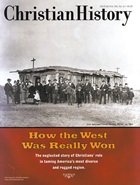
How the West Was Really Won: A Gallery of Local Heroes


Brother Van (William Wesley Van Orsdel)
1848-1919After stepping off the steamboat at Fort Benton, Montana, on a June Sunday in 1872, this penniless, sandy-haired, Methodist "evangelist-at-large" was ready to preach. When his impromptu Sabbath service at the Four Deuces saloon came to an end, listeners didn't want to let him go. They asked his name, but since it was a mouthful, they dubbed him "Brother Van." Practically everyone in Montana would know that name before long.
William Wesley Van Orsdel's parents died before he turned 13. An aunt raised "Willie" and his siblings on a small Pennsylvania Dutch farm near Gettysburg. At 15 Van Orsdel was soundly converted at the little Methodist prayer meeting the family attended.
Sometime in the next few years, he was roused by "a mighty vision." He later recalled, "I could see the miners, stage drivers, freighters, cowboys, and here and there among them a copper-colored native, beckoning and calling. To me these were Macedonian cries, and with the all-impelling word 'go' locked up like fire in my bones, I felt like Paul—'woe be unto me if I go not.'"
At 22 he retired the plow, packed up his Bible and carpetbag, bid Pennsylvania farewell, and headed for Montana.
In his 47 years of ministry there, he helped convert Indians, miners, farmers, drunkards, brothel keepers, and saloon owners. He was once shot at by Indians and another time mistaken for a horse thief and nearly hanged. He gained a reputation for caring about his listeners, so that even when he preached uncompromisingly to hardened "sinners," he often managed to win them over.
From 1892 to 1918, as superintendent of the Methodists' North Montana Mission, he built 100 churches, 50 parsonages, six hospitals, a school for orphans, and Montana Wesleyan college. He never married, and upon "retirement" at age 68, he continued to preach every Sunday and speak at missionary conferences across the country.
At 71 he suffered a paralytic stroke and lay in a coma. A few days later, he suddenly awoke and began to sing and converse with old friends long dead. Near the end, he said, "I haven't an enemy. Only friends. Tell the people of Montana that I love them all."
DOCTOR TO NEW MEXICO OUTLAWS AND INDIANSTaylor Filmore Ealy
1848-????On April 1, 1878, the sheriff of Lincoln, New Mexico, was shot dead in the street. The man who dashed out to pick up the sheriff's gun and turn it on the assassins was shot, too, but he managed to get himself over to Dr. Taylor Ealy's house. Ealy wrote:
"The report was that he shot him through the bowels, but it was a mistake. … The ball passed through his left thigh. I drew a silk handerchief through the wound, bound it up and he was taken charge of by [a friend]."
Though Ealy never mentioned his patient's name, the only man reported wounded in the gunfight was Henry McCarty, alias William Antrim, alias William Bonney, alias Billy the Kid.
Ealy, a Presbyterian educated at both seminary and medical school, had arrived in Lincoln with his family at the onset of the infamous Lincoln County War. The man who'd requested a Presbyterian presence in town, lawyer Alexander McSween, led the faction that included Billy the Kid. The Ealys ministered as best they could in the bullet-ridden town until McSween was murdered. The lawyer's enemies then targeted the preacher, who barely escaped with his life.
In the fall of 1879, the Ealys took an assignment from Sheldon Jackson to start a school among the Indians at Zuni Pueblo. But after two grueling, frustrating years, Taylor was discouraged. A son had been born and died there, and the Indians were so deeply entrenched in their cultural and spiritual traditions that they wanted little to do with the white man's school or his religion.
In the end, the West proved to be poor match for the Ealys, and in June 1881, they returned to their native Pennsylvania, where Taylor lived out the rest of his life as a country doctor.
"Father's work may appear to many unimportant," said Ealy's daughter Ruth after his death. "He was always, though, a fighter for the cause of righteousness. Wherever he went, in the West, on the mission field, in his home in Schellsburg [Pennsylvania], he worked faithfully to advance the cause of the great Master, under whom he enlisted."
TOMBSTONE'S REFEREEEndicott Peabody
1857-1944The story is told that when the Reverend Endicott Peabody was raising funds for his new church in Tombstone, Arizona, he entered one of the town's saloons and walked up to the table at which sheriff Wyatt Earp was playing poker. Earp had been winning, and a pile of chips lay before him. When Peabody asked for a donation, Earp pushed a stack of chips his way. "Here's my contribution, Mr. Peabody." Then Earp turned to the other players and announced, "Now each of you has to give the same." Peabody's St. Paul's Church stands in Tombstone today.
"Cotty" Peabody was born into a wealthy, aristocratic family in Salem, Massachusetts. He was educated in England, excelled in academic and religious studies, and was so taken with athletics, it was said that Peabody "made a sacrament of exercise."
Upon returning to America, he enrolled in the Episcopal Theological School in Cambridge, Massachusetts. While still a student, he accepted a pastoral call to the now famous silver-mining town of Tombstone.
"I bought a little horse," he said, "and with a broad brimmed white felt hat, a grey flannel shirt, riding breeches with yellow gaiters, and blankets strapped on behind and a gun hung on the pommel of the saddle, you would have taken me for the worst kind of a western rough instead of a quiet man of peace."
His arrival in Tombstone on January 29, 1882, came a few relatively peaceful months after the infamous shootout at the O. K. Corral. He wrote home that "the ordinary citizen is unmolested and the only danger is from a stray shot from [the feuders] or some incensed gambler … but in my circumstances … there is little cause for anxiety and I feel … it is best to leave it all to him for whom I am trying to work."
Peabody stayed in Tombstone only six months, but he made a favorable and lasting impression upon the community—from the mining magnates and city officials to the miners, muckers, saloon keepers, and gamblers. His candor and his love of sports won him the role of referee in all outdoor games played by Tombstone's young men. He loved a good horse race, attended the gymnasium religiously, and never refused a challenge to strap on boxing gloves.
And the church he built (debt-free) was the territory's first Protestant church.
He returned to Massachusetts to complete seminary, after which he founded, in 1883, a boy's prep school in Groton dedicated to cultivating "manly, Christian character, having regard to moral and physical as well as intellectual development." Groton's most illustrious graduate was Franklin D. Roosevelt.
WYOMING'S KINGDOM CRUSADERJosiah Strong
1847-1916On a cold night in 1873, the town of Cheyenne, Wyoming, was set afire. The arsonists were the town's former brothel-keepers, who had been forced out of business by Pastor Josiah Strong's call for a moral cleanup. The flames did nothing to melt Strong's resolve.
Strong had been just a greenhorn graduate of Cincinnati's Lane Theological Seminary when he married Alice Bisbee on August 29, 1871. Ten days later, the newlyweds were setting up house in Cheyenne, where Strong was ordained and installed as pastor of a Congregational church. He stayed long enough to lead the anti-prostitution crusade (and suffer the consequences mentioned above), but he soon headed back east to take a chaplaincy at Western Reserve College in Ohio.
As the years passed, Strong's passion for societal reform grew. In 1885 he published his most famous and influential book, Our Country. By 1916 it had sold over 125,000 copies. The book drew heavily on his western experience but also recalled the ideals of his Puritan ancestors. He challenged the nation and the church to transform society with biblical principles and thereby establish the Kingdom of God on earth.
"Free institutions are safe only when the great majority of the people have that reverence for law which can spring only from reverence for God," he wrote. "The most striking defect of young America is the lack of reverence." To remedy this, he exhorted the church to roll up its sleeves, work hard, pray always, and seize the day for Jesus Christ.
After the initial success of Our Country, Strong dedicated himself fully to biblical social reform, first in America and then in Britain and in South America. His efforts gave birth to the "Safety First" movement, the American Institute for Social Service (and its British counterpart), and the Federal Council of Churches in America.
Mark Ammerman is author of The Rain From God, The Ransom, and The Longshot (all Horizon Books), a historical fiction series set in seventeenth- and eighteenth-century New England.
Related Links:
For an interesting history of Christian missionaries in the West, see:
www.insiders.com/yellowstone/main-worship2.htm
Copyright © 2000 by the author or Christianity Today/Christian History magazine.
Click here for reprint information on Christian History.

Support Our Work
Subscribe to CT for less than $4.25/month