Yesterday's Christian Woman


When Nutter and Nancy Murphy and their family came to Shawnee, Kansas, in October 1859, the first thing they did after finding temporary lodging for the night was to hold family devotions. Daughter Lydia later remembered, "That night the family Bible rested in the center of the room. We gathered around the table, seated on boxes and improvised chairs while the usual evening family prayers were held after the reading of a chapter of Scriptures. During the 50 years of his Kansas citizenship, this morning and evening Scripture reading and prayer was not once omitted in my father's house."
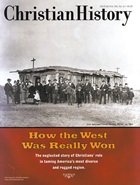
For many pioneer families, Christian faith was an integral part of life. It formed the backbone of their values and sustained them through numerous hardships. When John Klein, who grew up on a Texas farm at the end of the 1800s, thought about all his mother Ida (see "Religion—Sunday and Every Day," below) did in a day to care for the family and help run the farm, he recognized, "Special strength provided by the Almighty must have made it possible for her to do all this."
Frontier farms were family farms, and the family was an economic as well as a social unit. Though most pioneers believed the woman's sphere was within the home, the shortage of manpower meant many women (and children) helped with the farm. They helped dig cellars, build cabins, plow, plant, and harvest, as well as tend to their "domestic" activities, such as cleaning, cooking, sewing, and caring for the children. To understand the lives of frontier Christian women, then, we must take a look at the toil that filled their days.
Clara Hildebrand, looking back on her own pioneer experience, described the woman's role:
"The pioneer Kansas woman shared her husband's work and interest in the garden, the orchard, the crops and animals of the farm; she worked in the garden and gathered its products. She knew just how each vineyard or tree in the young orchard was coming in. She shared in the hope for a beautiful crop as the field things sprouted and grew green and tall. Did a horse, dog or other farm animal get badly gored, cut or wounded, hers was the task to cleanse the wound and take the stitches that drew the torn edges together."
Besides outdoor responsibilities, a pioneer wife spent a lot of time in the kitchen. Sarah Hammond White explained the basics of fireplace cooking:
"We used kettles suspended from a wire across the fireplace and boiled most of our food; baking was done in an iron kettle about four inches deep and two and a half from the ground, supported by three iron legs. This baker, as it was called, was covered with an iron lid upon which coals of fire were placed, and the baker was placed on coals of fire too, and I want to say no malleable stores ever baked better biscuits."
One central Texas mother with an especially large family recalled that "breadmaking was much trouble and took so long. … We had only three [dutch ovens], each one just large enough for one loaf at a time, and there had to be 20 loaves every day because there were so many of us."
Men and boys helped gather fuel for the fire and keep the wood box filled. On the treeless plains they collected dried buffalo chips in sacks and kept them for use as fuel for cooking as well as for warm fires in winter.
Cornbread and corn mush were standard fare in the beginning, but food usually became abundant as the family farm thrived. Gardens and orchards produced vegetables and fruits that women canned or dried for use in the winter. Several times a week, women baked bread. If the family had a good cow, butter was made every other day, both for family use and to be sold in town for extra money.
With flour and sugar often being scarce, the enterprising pioneer woman learned to make do. One woman wrote, "I came here willingly believing it to be for the best and am determined to try with the assistance of Providence to make the best of it."
Special occasions called for heightened creativity. Bessie Wilson remembered when a neighbor was returning to Kansas with a new bride in 1875:
"Mother was asked to bake a cake for the affair. In consequence, we ate bread without butter for several days in order that father might have enough to take to the store and exchange for the amount of sugar necessary to make a cake. This he did, covering 16 miles on horseback. Mother's was the only cake at this important gathering, and despite the fact that she had no recipe to go by, that she used sour milk and soda in the making, it was pronounced by those who partook as being all a bride's cake should be!"
Frontier women were also responsible for the family's clothing. Many families raised sheep for wool, which the women washed and the children carded for spinning. The wool was dyed with natural dyes— walnut bark for brown, osage bark for yellow, cochineal bugs for red. After spinning the yarn, women knitted socks, scarves, and sweaters. Clothing was simple and sewn at home. Fabrics such as calico and muslin had to be bought at stores, and some fabrics were recycled: flour sacks, for example, were often made into underwear.
For good stewardship, as well as necessity, clothes were repeatedly patched or re-sewn and given as hand-me-downs. Scraps of fabric were used in quilts with designs whose names often reflected the frontier life—turkey tracks, bear claw, butter churn, log cabin, wild goose chase. Sometimes the quilt's name referred to political issues—54° 40' or Fight, Bleeding Kansas, Texas Star. Still other designs proclaimed Christian themes—the Delectable Mountains (from John Bunyan's Pilgrim's Progress), Jacob's Ladder, Cross and Crown.
On the frontier, where schools were often unavailable, both parents, but especially the women, homeschooled their children in the basics of reading, writing, and arithmetic. Training in the Christian faith was also important. Rebecca Ebey, a pioneer from Virginia, wrote, "We … spend our time in training the young minds of our children in the principles of Christ and creating within them a thirst for moral knowledge." The Bible and Pilgrim's Progress became the primary textbooks for many. Teachers on the frontier were very often sent out by eastern missionary agencies, and when schools were established, they also inculcated a Christian moral education.
But most of the Christian education and character development took place in the faithful day-to-day fulfillment of farm responsibilities. One of a child's earliest chores was feeding the chickens. Later the child might be given a calf to care for. Parents expected their children to develop habits of industry and hard work, not just for the building of Christian character but for the family's very survival.
Diana Lynn Severance is the author of Deep Roots, Strong Branches, a history of the Klein family in Texas, and is a member of the Christian History advisory board.
Religion—Sunday and Every Day
John and Ida Klein lived in Texas in the late 1800s. They faithfully attended Salem Lutheran Church for years (often traveling Saturday evenings to make sure they were in time for the Sunday service), but their religion was hardly confined to Sundays. Family devotions were held daily, blessings were said before meals, and a prayer of thanksgiving after meals.
John and Ida's oldest daughter, Johanna, later summarized the important teachings her mother had passed on to her:
"To read the Bible and pray every day;
To right each wrong before the sun went down;
To count to ten before speaking when angry;
To give of my own spending money to God's work;
To call upon sick friends, and to carry flowers to them from my own garden;
To form habits of regularity, touching all phases of life;
To attend all services of the church;
To take Jesus with me wherever I chose to go, but to choose, therefore, only those places where Jesus would be loved;
To give service to Him in every way possible and to seek His guidance before any plan for personal action be carried out. Her favorite expression was 'The Lord willing.'
To be faithful and to love God and my neighbor;
To be true, and to be trustworthy;
My mother taught me these principles for Christian living."
—Diana Lynn Severance
Related Links:
For more information, see Women on the Western Frontier: A Selected Bibliography at
www.kshs.org/library/bibwomen.htm
Copyright © 2000 by the author or Christianity Today/Christian History magazine.
Click here for reprint information on Christian History.

Support Our Work
Subscribe to CT for less than $4.25/month