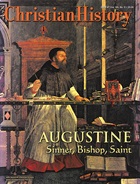
Fighting Words


Despite Augustine's long and dominating shadow over 1,500 years of Western church history, his central ideas have not been universally accepted or uniformly interpreted. The Eastern Orthodox regard some of Augustine's key ideas as pernicious, if not heretical. Anabaptists have rejected much of his theology, while Protestants in general claim selected teachings and ignore others.
Nonetheless, Augustine is widely regarded as the church's most influential philosopher and theologian. His five central ideas were forged in the heat of theological conflict, and they remain controversial today:
1. The nature and source of evil.
2. The nature of the church and its sacraments.
3. Original sin.
4. The relationship of grace and free will.
5. Predestination.
Augustine refined each of these doctrines as he battled what he believed were heresies, or at least false worldviews: a dualistic "cult" known as the Manichees, a Christian sect in North Africa known as the Donatists, and the beliefs of a British monk named Pelagius and his followers. Augustine's distinctive teachings are essentially answers to these theological enemies.
Evil nothings
One of the most pressing theological problems in Augustine's time was how to justify belief in an omnipotent and perfectly good Creator when sin and evil were obviously deeply woven into the created beings.
The Manichees taught that two eternal beings control the universe, one of them good and the other evil. Even if the all-good deity is superior, they argued, it cannot at present conquer or control the evil one. The Manichees also taught that evil is intrinsically associated with matter and that only spirit is good. Thus, the good deity created spirits but not matter.
Against this double dualism (reminiscent of both Zoroastrianism and Gnosticism), Augustine developed an idea he believed was consistent with biblical revelation and the best of philosophy: evil is not some "thing" or "substance" but only the privation of the good (privatio boni). It is to goodness what darkness is to light.
The source of evil, then, is not God's creation (how could God create "non-being"?) but the misuse of human free will. According to Augustine, evil "is nothing else than corruption, either of the measure, or the form, or the order that belong to nature." Elsewhere Augustine wrote, "The only evil thing is an evil will."
The vast majority of later Christian thinkers depended on Augustine's "theodicy" (defense of God) to reconcile the reality of evil with God's goodness. Some Christians, though, have found Augustine's concept of evil insufficient to account for the power and types of evil we experience. Nonetheless, Augustine's response to dualism was largely triumphant over Manicheism.
Church as a mixed bag
Augustine also fought with the Donatists, especially their perfectionist theology of the church.
Donatists believed the grace of God could be found only in an undefiled church, and since they restricted their membership to those they believed to be true saints, they believed they had a monopoly on grace. Thus they considered only their baptism and Lord's Supper valid.
Augustine, however, argued that the church is both universal (not limited to a particular branch) and mixed (some members saved, others not). Only God can know definitely which baptized persons are truly regenerate. Augustine accused the Donatists of a sin worse than condoning impurity: dividing the church.
Augustine and the Donatists also differed on the qualifications of priests. Donatist priests had to be morally pure; specifically they must not have lapsed during Roman persecution. Augustine, like his North African predecessor Cyprian of Carthage, based priestly authority not on irreproachable behavior but on the criterion of apostolic succession—Jesus' disciples laid hands on the next generation of leaders, who laid hands on the next, and so on.
Augustine contended that God's saving grace was conveyed ex opere operato, that is, by Christ himself through his priests regardless of their character or beliefs. If the recipient of the sacrament is not resisting grace, and if the priest performing the sacrament is rightly ordained and in good standing with the Catholic church, grace is conveyed. The human priest is merely Christ's extended hand in the sacrament.
"What these [priests] administer," wrote one Augustine scholar, "is the baptism of Christ, whose sanctity cannot be corrupted by unworthy ministers, any more than the light of the sun is corrupted by shining through a sewer."
Augustine's ideas became the Catholic church's bulwarks against all forms of sectarian and schismatic reform. Even the "magisterial" reformers (Luther, Zwingli, Calvin, Cranmer) accepted most of Augustine's answers to Donatism, though they all rejected ex opere operato, arguing that recipients of the Eucharist must have faith for grace to be effective. The Anabaptists, on the other hand, rejected these ideas and repeated Donatism's insistence on a pure, or at least regenerate, church.
Of human bondage
Augustine's notions of original sin, grace and free will, and predestination are inextricably bound together, and they were shaped by his debates with the Pelagians.
Augustine believed that humankind suffers from original sin, meaning that since the fall of Adam, we are depraved—incapable of doing good without supernatural help. The commands of God to do good were given, Augustine concluded, simply to point out our inability and throw us on the mercy of God.
Pelagius, however, believed that if God commands us to live good and even morally perfect lives, he must give us the ability to obey without any special, supernatural assistance. Thus Pelagians denied there was any "original sin" or "depravity." Instead of being "depraved," the only disadvantage we currently have is that, living in a sinful world, we are more likely to develop sinful habits. Sin is a social disease, not an inherited spiritual-genetic defect.
Thus, Pelagius concluded, we are capable of living sinless lives simply by exercising our wills for the good. "A man can be without sin and keep the commandments of God, if he wishes," he wrote, "for this ability has been given to him by God."
Augustine was more outraged by Pelagius than by any other rival, and in response, he argued even more forcefully that we are born condemned for Adam's sin and incapable of not sinning.
"A man's free will," he wrote against Pelagius, "avails for nothing except to sin." Only the supernatural power of God's grace, imparted through baptism, could heal the deadly wound of sin upon the human soul. (Hence the need for infant baptism—to heal that wound immediately.)
Furthermore, only the power of God's grace could restore in some measure the free will lost in the fall of Adam's race. Grace cannot be received by an act of human will or even cooperated with (synergism)—it must be given as a gift.
"The Spirit of grace therefore causes us to have faith," he wrote, "in order that through faith we may, upon praying for it, obtain the ability to do what we are commanded."
The chosen few
Why do only some receive this gift of faith? In On the Predestination of the Saints, written not long before he died, Augustine concluded that God simply chooses some persons out of the mass of fallen humanity to save and leaves others to their deserved condemnation. The reason some are so graced and others passed over lies only in "the hidden determinations of God."
The basic outlines of what later came to be known as "Calvinism" are found in Augustine's later anti-Pelagian writings. The Catholic church appropriated some of these ideas, such as inherited guilt (though not total depravity) and the absolute necessity of supernatural grace for meritorious works of righteousness. However, Catholic theology by and large passed over Augustine's doctrine of predestination in favor of an emphasis on human cooperation with grace after baptism.
Wycliffe, Luther, Calvin, and other reformers reaffirmed Augustine's doctrine of predestination, inherited depravity, and the sovereignty of grace—though Anabaptists and other radical reformers rejected the same (but without affirming Pelagianism).
Most theologians define their positions in relation to Augustine's doctrines. Almost all of them can appeal to something in the great North African church father, and almost all of them neglect some aspects of his teaching in favor of others. But no one after him can ignore him. Augustine's teachings on these and other controversial subjects have determined much of the agenda for Christian theology for a millennium and a half.
Influencing the Influencers
Martin Luther refers to Augustine more often than to any other theologian, echoing, for example, his gloomy view of human will: "Where reason is in error and the will turned away, what good can man attempt or perform?" But Luther felt he had moved beyond Augustine on the matter of justification: "In the beginning I devoured Augustine, but when the door into Paul swung open and I knew what justification by faith really was, then it was out with him."
Thomas Aquinas cited Augustine when defending his views on original sin and infant baptism: "According to the Catholic Faith we are bound to hold that the first sin of the first man is transmitted to his descendants, by way of origin. For this reason children are taken to be baptized soon after their birth, to show that they have to be washed from some uncleanness. The contrary is part of the Pelagian heresy, as is clear from Augustine in many of his books."
John Calvin, when accused by the Roman Catholic church of theological innovation, argued that he was instead hearkening back to Augustine: "Augustine is so completely of our persuasion, that if I should have to make written profession, it would be quite enough to present a composition made up entirely of excerpts from his writings."
When English Reformer Thomas Cranmer commissioned a portrait of himself from Gerlach Flicke, he had a copy of Augustine's De Fide et Operibus ("On Faith and Works") painted on the table in front of him. In Cranmer's personal copy of the book, he had underlined the phrase "a good life is indeed inseparable from faith."
Anabaptist leader Menno Simons disagreed with Augustine on many things, including church leadership, the nature of Christian community, and infant baptism. In fact, he dismissed any influence when he wrote that if Augustine and other church fathers could support their teaching "with the Word and command of God, we will admit that they are right. If not, then it is a doctrine of men and accursed according to the Scriptures."
Copyright © 2000 by the author or Christianity Today/Christian History magazine.
Click here for reprint information on Christian History.

Support Our Work
Subscribe to CT for less than $4.25/month