Spare the Rod and Spoil the Church


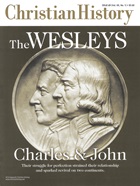
When the Methodist movement began to grow, John Wesley faced the problem of dealing with converts who returned to their old ways. Many Methodists came from the lowest social classes, so nothing in their background or environment helped them live the "sober, quiet, godly lives" Wesley prescribed. Their backsliding discouraged those who were trying to follow Christ and gave Methodism's detractors ammunition.
The solution to this problem came in a way no one expected. The Methodists had contracted a debt to build a preaching house. In an effort to pay off the debt, the leaders volunteered to visit each Methodist each week and collect a penny.
When they found that it was easier if the people came to the leader, the Methodist class-meeting was born. The people still paid the penny, but the meetings quickly became more pastoral than financial. Leaders used the meetings to instruct members and check up on their spiritual progress.
Seeing how effective this practice was convinced Wesley that the work of God could not prosper without church discipline. With church discipline, however, Methodism did prosper, reaching almost a million people before Wesley's death.
Wesley made church discipline work through four main strategies: (1) he preached it, (2) he taught his lay leaders to administer it lovingly, (3) he organized people into small groups where they could look out for each other, and (4) he publicized the benefits of obeying the Lord in this area.
Preaching "This is the way"
Wesley frequently preached a sermon on Matthew 18, the passage in which Jesus describes the steps to take upon discovering a brother's sin. Wesley said that the admonition to begin the process of church discipline is not just a suggestion, but "a plain command of God." He said, "No alternative is allowed, no choice of anything else: this is the way; walk thou in it."
In teaching 1 Corinthians 5, where Paul tells the congregation to cast out the immoral man, Wesley commented that the congregation has the responsibility to rid itself of the impenitent man because "one sin, or one sinner … diffuses guilt and infection through the whole congregation."
Wesley also reminded his followers that the early church practiced discipline. In another oft-preached sermon he informed his followers: "It was a common saying among the Christians in the primitive Church, 'The soul and the body make a man; the spirit and discipline make a Christian'; implying, that none could be real Christians without the help of Church discipline."
The church as a whole needed discipline, too, for without discipline there could be no true Christianity. "Is it any wonder that we find so few Christians," Wesley asked, "for where is Christian discipline? In what part of England (to go no farther) is Christian discipline added to Christian doctrine? Now, wherever doctrine is preached, where there is no discipline, it cannot have its full effect upon the hearers."
Tough love
Wesley lived a disciplined life and was not afraid to hold other Methodists to a similar standard. Reading certain sections of his journal gives the impression that he spent as much time throwing people out of Methodist societies as he did persuading them to come in.
During one early visit to Bristol, he purged almost 20 percent of the society for sins including drunkenness, dishonest business practices, gossip, theft, arguing in public, and cheating on taxes.
Later, when he found a whole group of Methodists whose behavior was substandard, he "told them in plain terms that they were the most ignorant, self-conceited, self-willed, fickle, intractable, disorderly, disjointed society that I knew in three kingdoms." Evidently the group listened well, for Wesley reported that "many were profited" and not one was offended.
What Wesley learned through his experience administering church discipline, he passed on in sermons like "The Duty of Reproving Our Neighbor" and "The Cure of the Evil-Speaking." The key to success in a case of church discipline, Wesley said, is the spirit of the one who points out the sin.
Because so much depends on a right spirit, the one who goes to reprove should first earnestly ask that the Lord "guard [his] heart, enlighten [his] mind, and direct [his] tongue." The Lord's servant must "avoid everything in look, gesture, word, and tone of voice that savors of pride or self-sufficiency."
Above all, love must be the motive for discipline. Quoting his brother's hymn, Wesley said,
Love can bow down the stubborn neck,
The stone to flesh convert;
Soften, and melt, and pierce, and break
An adamantine heart.
Sometimes this gentle approach succeeds, but other times, Wesley noted, the "mildest and tenderest reproof will have no effect." In such cases one or two others must go with the one who has already gone, first expressing their love for the errant brother, then establishing the facts of his sin, and finally exhorting him to repent.
If this second attempt fails, the concerned Christians should take the matter to the church. It becomes the minister's responsibility to rebuke the sinner and, if necessary, put him out of the church.
Wesley tells his hearers that the matter is then out of their hands: "When, therefore you have done this, you have done all which the Word of God, or the law of love, requireth of you: you are not now partaker of his sin, but if he perish, his blood is on his own head."
Emphasizing tenderness in discipline did not prevent Wesley from being blunt. When his first lieutenant, Thomas Maxfield, began to claim sinless perfection and say that no one could teach him anything, Wesley wrote a letter detailing what he liked and disliked about Maxfield's ministry:
"Without any preface or ceremony, which is needless between you and me, I will simply and plainly tell you what I dislike about your doctrine, spirit, or outward behavior. … As to your spirit, I like your confidence in God and your zeal for the salvation of souls. But I dislike something which has the appearance of pride, of overvaluing yourself and undervaluing others, particularly the [other] preachers."
Wesley expected other ministers to speak as plainly to him—and to everyone else—as he did to them: "Tell everyone what you think wrong in him, and that plainly, as soon as may be; else it will fester in your heart. Make all haste to cast the fire out of your bosom."
Class confession
Wesley was able to practice what he preached about church discipline because he organized his followers into small groups. A Methodist society included all the Methodists in an area. It was divided into groups, or classes, of 12. The people met each week to study the Bible, pray, and report on the state of their souls. Each class had a leader who reported to the preacher in charge of the society.
Wesley published a list of questions for the class leaders to help the members examine themselves:
1. What known sins have you committed since our last meeting?
2. What temptations have you overcome?
3. How did God deliver you?
4. What have you thought, said, or done that might be sinful?
When the questions revealed sin, the offenders were given another chance. "If they forsook their sins," Wesley said, "we received them gladly; if they obstinately persisted therein, it was openly declared that they were not of us. The rest mourned and prayed for them, and yet rejoiced, that, as far as in us lay, the scandal was rolled away from the society."
Because the leaders knew each class member intimately, they could tailor their words to each individual need. The frequent meetings meant that wrong attitudes could be stopped before they developed into sinful actions. In this context of frequent, personal, and loving contact, church discipline became a powerful redemptive force.
"Do right and fear nothing"
Although church discipline yielded so many positive results, Methodist leaders were not always eager to exercise it. Throughout his career Wesley had to admonish his deputies to examine the societies and expel all who disobeyed the rules.
Wesley wrote to Adam Clarke, "Be exact in every point of discipline." To Francis Asbury he advocated "a strict attention to discipline." To William Holmes, who perhaps feared losing his congregation, he sent this order: "Do right and fear nothing. Exclude every person that will not promise to meet with his or her class, the steward in particular. I require you to do this. You have no choice. Leave the consequences to God."
Wesley knew that church discipline can cause churches to split. He nevertheless ordered one of his assistants to remove an errant leader:
"I require you to put him out of our Society. If 20 of his class will leave the society, too, they must. The first loss is the best. Better 40 members should be lost than our discipline be lost. They are no Methodists that will bear no restraints."
To the end of his ministry, Wesley's concern with church discipline remained strong, for he knew that without follow-up, all he had worked for would be lost. A 1763 trip to Wales caused him to give this advice to future Methodist generations:
"I was more convinced than ever, that the preaching like an Apostle, without joining together those that are awakened, and training them up in the ways of God is only begetting children for the murderer. How much preaching has there been for these 20 years all over Pembrokeshire! But no regular societies, no discipline, no order or connection; and the consequence is, that nine in ten of the once-awakened are now faster asleep than ever."
Charles Edward White is professor of Christian thought and history at Spring Arbor College.
Copyright © 2001 by the author or Christianity Today/Christian History magazine.
Click here for reprint information on Christian History.

Support Our Work
Subscribe to CT for less than $4.25/month