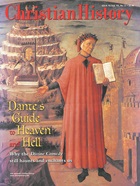









Dante's Guide to Heaven and Hell: Christian History Interview - Classics of Common Memory


With 1994's The Inferno of Dante (Farrar, Straus, and Giroux), Robert Pinsky, America's poet laureate from 1997 to 2000, joined the long line of bards—including Henry Wadsworth Longfellow, Dorothy Sayers, and John Ciardi—who had translated at least one canticle of Dante's Divine Comedy into English. Earlier Pinsky had been among 20 poets tapped by author and anthologist Daniel Halpern to translate one or two cantos of Inferno for a new collection. That volume's introduction hinted at the potential for 20 new translations, but so far Pinsky is the only writer to take the challenge.
To find out what drew this contemporary poet to the nearly 700-year-old Comedy, Christian History e-mailed Pinsky at Boston University, where he teaches English and creative writing. He also serves as poetry editor for the online magazine Slate.
You have said that you had "a religious upbringing"—your parents were nominally Orthodox Jews, your grandfather married a Christian, and you were intrigued by the Catholic church across the street from your childhood synagogue. How did this heritage intersect Dante's worldview as you worked on Inferno?
I could share some of his disgust with orthodoxy and clergy, his sense of being saturated with invasive but precious conceptions, images, forces. Above all, I could relish and try to imitate the patchwork, syncretic, improvising, sometimes outrageously eclectic nature of his historical imagination. The unlikeliness.
You began translating Inferno as part of a larger project, but there's a big difference between translating two cantos and translating 34. What made you want to continue the project?
I did the translation because I could. I saw a way that I could make a close, faithful translation of the Inferno that was also a work of art in English. No one had done that since Longfellow. To put it differently, it was the technical challenge that drew me on.
Unconsciously, the notion of another exchange with the familiar yet alien world of Christianity may have had some appeal.
You've translated only Inferno, not the other two sections of Dante's poem. Is some of the meaning of Inferno changed or lost when it is read on its own?
Yes, beyond a doubt. The action of the Inferno, a going-down-and-through to get out on the other side, is not the turning of Purgatorio or the lifting of Paradiso. Inferno is about sadness, not about work or elevation. The whole Comedy traces an arc through depression, striving, and elevation.
What was the most difficult part of completing the translation? What was most rewarding?
The answer to both is the same: getting the sounds right while maintaining as much as possible of the speed and crispness of the original. Immersion in that difficulty was immensely rewarding. On a different level, of course, the pleasure readers take in the translation is rewarding, after the fact.
What do you hope readers will learn or experience through reading this translation?
It is the most profound work ever written about wanhope, which we name depression. Like the plays of Shakespeare, it exerts the astonishing power of what is simultaneously remote and intimate.
Mark Galli, the former editor of Christian History, kept two quotes from you tacked above his desk. One is, "A people is defined and unified not by blood but by shared memory." Can you elaborate on this?
I hope to be a kind of remote nephew of figures like Dante or [seventeenth-century devotional poet] George Herbert. By memory. Only in the most remote way, as a member of the same species, am I likely to be related to them by blood. That's it on an individual level.
On a national or communal level, I take this idea to be one of the great goals and premises of the United States of America.
The other quote is, "Deciding to remember, and what to re-member, is how we decide who we are." What did you mean by that?
Americans, I hope, remember Duke Ellington and Emily Dickinson, the Bill of Rights and the films of Preston Sturges, the Dodgers of Jackie Robinson and Willa Cather's My Antonia, the Declaration of Independence, and—yes, in another way—the Inferno of Dante.
Not all of us all the time, but enough of us enough of the time, share certain memories, carry certain things inside us. And what we choose to carry around in us and to carry from one generation to another expresses our will and belief as to who we are.
How has the Divine Comedy functioned as "shared memory" over the centuries? Do you think it will continue to function this way?
The answer to the second part is "yes"—the poem has become seasoned wood, like iron at this point. I won't presume to answer the first part; it would be like writing the history of the world.
The heroes of epics had been noble galoots with sword. Here is a comedy, and the hero is a sometimes timid, irritable fellow with a pen. He mixes his personal grudges with the largest tides of history, his town's politics with cosmology, his jokes and wonderments with metaphysics. He bridges realms.
Copyright © 2001 by the author or Christianity Today/Christian History magazine.
Click here for reprint information on Christian History.

Support Our Work
Subscribe to CT for less than $4.25/month