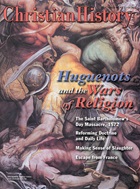








The Saint Bartholomew's Day Massacre
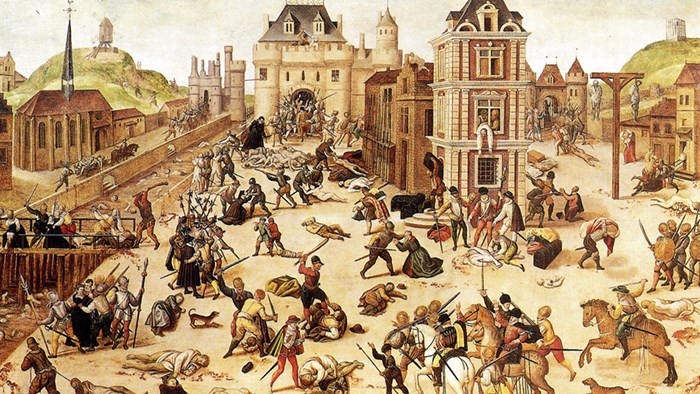


Before dawn on the morning of August 24, 1572, church bells tolled in the Saint-Germain-l'Auxerrois quarter of Paris. Just moments earlier, soldiers under the command of Henri, duke of Guise, had overcome resistance and assassinated the admiral of France, Huguenot leader Gaspard de Coligny, in his bedroom. They threw the body from the window to the ground below, where angry crowds later mutilated it, cutting off the head and hands, and dragged it through the streets of Paris. As Guise walked away from Coligny's lodging, he was overheard to say "it is the king's command."
The killing unleashed an explosion of popular hatred against Protestants throughout the city. In the terrible days that followed, some 3,000 Huguenots were killed in Paris, and perhaps another 8,000 in other provincial cities.
This season of blood—known as the Saint Bartholomew's Day massacre—decisively ended Huguenot hopes to transform France into a Protestant kingdom. It remains one of the most horrifying episodes in the Reformation era.
The dangerous decade
Historians have long debated the causes of the massacres of 1572. Drawing upon Francis Hotman's De Furoribus Gallicis (1573), Protestant interpreters since the sixteenth century have often portrayed Coligny and his coreligionists as heroic victims of a premeditated plot to destroy the Huguenot movement, masterminded by the wicked queen mother, Catherine de Médicis.
Catholic historians, on the other hand, have usually followed the royal interpretation that the king, Charles IX, issued two days after the violence began. In this view, the king and his council ordered the violence as a justified preemptive strike to protect the Catholic crown from a Protestant revolt.
Although differences remain, historians today are in general agreement that the massacres can only be understood in light of the dangerous political developments and seething religious resentments of the preceding decade.
The premature death, following a jousting accident, of King Henri II in 1559 created a protracted political crisis in France. His sons who succeeded him in turn—Francis II (1559-60), Charles IX (1560-74), and Henri III (1574-89)—were young and weak, subject to their ambitious mother, and vulnerable to manipulation by powerful noble factions.
The explosive growth of Protestantism in France only exacerbated this dangerous political situation. By 1562, there were perhaps two million Protestants and nearly 1,250 Reformed churches in France, flourishing despite repeated royal censures and harsh persecution.
"We have churches in nearly all the cities of the realm," boasted Jean Morély, "and soon there will be scarcely a place where one has not been established." Such unbridled optimism was shattered by the onset of war in the spring of 1562. Nonetheless, the powerful Protestant party remained a dangerous factor in the French political crisis.
For the next decade, Catherine and Charles IX struggled feebly between two competing noble factions. The Huguenot party was championed by the admiral Coligny, Louis of Condé (until his death in 1569), and the young Bourbon princes Henri of Navarre and Henri of Condé. It sought legal recognition and freedom of worship for the Reformed churches. The Catholic faction, led by the powerful Guise family, defended the time-honored French tradition of "one king, one faith, one law" and demanded the extermination of the Protestant heresy.
Violence radicalized both Catholic and Huguenot positions and fueled popular resentments. During the decade before Saint Bartholomew's Day, France was ravaged by three successive religious wars. The first war of religion began in April 1562, shortly after Francis, duke of Guise, and his soldiers slaughtered some 60 Protestants who were worshiping in a barn at Vassy.
The war ended a year later in a military stalemate when Francis himself fell to an assassin's bullet. The Guise family promised to avenge his death by killing Coligny, whom they suspected (probably incorrectly) of ordering the assassination. This rhythm of sectarian violence and retribution recurred in the second (1567-68) and third (1568-70) religious wars, as well as in hundreds of local riots and massacres.
Historian Natalie Zemon Davis has noted that in religious riots Huguenots tended to attack property, while Catholics more frequently attacked people. Nevertheless, both groups used deadly force.
Protestant crowds pillaged and desecrated churches, smashed Catholic images, and assaulted priests and monks. At a riot at Saint Médard's Church in 1561, they paraded through the streets, chanting "The Gospel, the Gospel; where are the idolatrous priests?"
Catholic crowds, in turn, showered insults and stones on Huguenot neighbors, burned Protestant Bibles and books, and disrupted Reformed worship services to cleanse their towns of the pollution of heresy. Sometimes they took more drastic measures, incited by inflammatory sermons or placards. One placard posted in Paris in 1566 proclaimed, "Cut them down. … burn them. … kill them without a qualm."
Massacres spawned by such sectarian hatred became increasingly common. In the months prior to Saint Bartholomew's Day, angry mobs massacred Protestants in Orange, Rouen, Troyes, and Dieppe. The French king was powerless to stop the violence.
Prelude to massacre
On Monday, August 18, 1572, the Protestant prince Henri of Navarre married Margaret of Valois, the sister of King Charles IX, in a lavish ceremony in Paris' Notre Dame cathedral. In the week that followed, French notables indulged in sumptuous banquets, formal balls, and colorful tournaments. Protestant nobles in the entourage of Navarre, Coligny, and Condé were welcomed guests at the wedding and walked freely about the city.
The monarchy hoped that this marriage alliance of Valois and Bourbon would help to heal sectarian hatred and end a decade of civil war. Nevertheless, religious tensions remained high.
Catholic preachers had long threatened the terrible judgment of heaven if the marriage took place. As Bishop Simon Vigor reportedly preached, "God will not endure this detestable union!" Catholics suspected that the royal marriage indicated the king's willingness to work with sworn enemies and heretics.
This rapprochement between the crown and the Huguenots had ominous political implications as well. It appeared that Charles now endorsed Coligny's plan to "export" the French religious wars to the Netherlands by sending a united force against the Spanish armies of the duke of Alva, which were attacking Dutch Protestants on the northern frontier of France.
From a Catholic perspective, both the unwelcomed marriage and Coligny's influence at court in the summer of 1572 threatened to bring not peace, but war with arch-rival Spain. The pageantry and festivities surrounding the royal wedding did not quiet these lurking fears and deep resentments.
The uneasy calm was shattered on Friday morning, August 22. A would-be assassin named Maurevert fired two shots from a window, wounding Coligny in the right hand and left arm as he returned from a meeting with the king. The admiral's companions rushed him to the safety of his lodging, where other Huguenot leaders soon joined him.
The king and his council visited the admiral at his bedside later in the afternoon. They found the Huguenots angry and distrustful, demanding prompt royal action and threatening vengeance. Coligny and his company found little consolation in Charles IX's repeated promises to find and punish the attacker. Rumors of the assassination attempt and the angry Huguenot reaction spread quickly through the streets of Paris, deepening the climate of suspicion, fear, and hatred.
Historians have usually accused Catherine de Médicis of hiring Maurevert to kill Coligny. They argue that the queen mother was envious of the admiral's influence over her son Charles and wished to avert war with Spain. Other historians have suggested that Maurevert acted alone or was hired by the duke of Alva. More likely (though impossible to prove), the assassination was ordered by one or more members of the Guise family, seeking to satisfy the longstanding vendetta against Coligny. Regardless of motive, the abortive attack was the fuse that detonated the general massacre two days later.
In an emergency session of the royal council on Saturday evening, August 23, the king, his brother Henri, duke of Anjou, Catherine, and other trusted advisers concluded that the Huguenot leaders should be killed. Primary responsibility for the assassinations was given to the royal guard and to the soldiers of Anjou, under the command of Henri, duke of Guise, and the duke of Aumale.
That same evening, the king ordered the mayor to close the city gates, chain boats on the Seine, and mobilize the militia. Sources are unclear whether the council's decision was due to panic, resulting from a real or imagined Huguenot plot, or a calculated attempt to annihilate or weaken the Huguenot leadership in view of impending civil war. What is almost certain, however, is that the plan was not premeditated, but a response to the crisis created by Maurevert's assault on Coligny. Likewise, the council clearly did not anticipate the mob violence unleashed by the royally sanctioned murders.
The season of blood
The killing began around 4 a.m. After assassinating Coligny, the royal guard turned on other Huguenot leaders. Some were executed by the sword, still rubbing sleep from their eyes. Others were shot by harquebuses as they tried to flee. A few died with sword in hand. In the Louvre, the Bourbon princes Navarre and Condé were placed under house arrest as 30 of their companions were cut down in cold blood.
By dawn the city militia and Catholic extremists had started a prolonged orgy of murder and looting. Mobs attacked Protestants in their homes, indiscriminately slaughtering men, women, and children. Victims were stabbed, shot, or beaten to death; their bloodied bodies were often dismembered, dragged through the streets, and thrown into the Seine. Vigilante bands searched for suspected Protestants and looted their homes and shops.
Despite royal pleas for calm, the violence continued in Paris for almost a week. In this season of blood, Hotman noted bitterly, Huguenot-hunting became a popular sport.
The violence soon spread to other cities in the kingdom. In Orléans the massacres began on August 26. Catholic extremists herded Protestants to the city wall and slaughtered them, mocking their victims by chanting the opening verse of Psalm 43: "Vindicate me, O God. … and rescue me from wicked men." In two days, around 1,000 men, women, and children were killed.
In Lyon, city officials placed Protestants under protective custody in the city's convents and jails on August 29. Two days later, crowds broke in and massacred the prisoners by sword, strangulation, and drowning. Witnesses reported that the Rhone River flowed red with several thousand mutilated corpses.
Nearly a dozen other French cities witnessed deadly violence from August to late October, among them Rouen, Saumur, Bourges, Meaux, Bordeaux, and Toulouse. The horror of these months is captured in a Genevan diplomatic dispatch from the period: "The whole of France is bathed in the blood of innocent people and covered with dead bodies. The air is filled with the cries and groans of nobles and commoners, women and children, slaughtered by the hundreds without mercy."
Many Protestants managed to escape. Some found refuge in the Huguenot strongholds of Sancerre and La Rochelle. Thousands of others fled the kingdom, bound for Geneva, Basel, Strasburg, or London. The refugees brought with them stories of shocking brutality and extraordinary courage.
A young boy—the future duke of La Force—feigned death on a Parisian street for several hours beneath the corpses of his father and brother. A Catholic man finally found the blood-covered boy and hid him in his home until he could be brought to safety.
Equally dramatic was the account of Pierre Merlin, Coligny's chaplain. At the admiral's side moments before his death, Merlin fled to a barn and hid in a hayloft three days, narrowly avoiding the probing swords of soldiers searching for him. Thereafter, Merlin and his family found refuge in the household of a noblewoman, who brought them out of Paris in her coach.
As these stories attest, some Protestants survived due to the assistance of Catholic neighbors, who risked their lives to protect the hunted Huguenots.
In the months following Saint Bartholomew's Day, thousands of Protestants recanted their faith. For some, this was a temporary compromise, extracted by torture or mortal danger. For others, it was a permanent decision to abandon a religious cause that now seemed hopeless.
One eyewitness reported more than 5,000 abjurations in Paris alone by the end of September. Even the Bourbon princes Navarre and Condé submitted to threats and (temporarily) converted to Catholicism. Reformed leaders were stunned. Theodore Beza remarked, "The number of apostates almost defies counting!"
Evidence suggests that not all of these conversions were simply the product of fear or cowardice. At least some Protestants were shocked by God's apparent indifference to their plight and viewed the slaughter as divine judgment against them. For Protestants, the brutal massacre raised haunting questions: Why did God remain silent? Had God rejected his Church? These questions remained long after the massacres ended in late October 1572.
As the violence ebbed, both Catholic and Protestant writers attempted to describe and interpret the season of bloodshed. Catholics in Rome and Spain celebrated news of the massacres. The pope even issued a special medallion to commemorate the "holy" event. For many, the death of so many "heretics" was a miracle—a conclusion that seemed confirmed by the appearance of the great nova in the night sky in November.
By contrast, Protestant authors recast the horrifying events of 1572 as the age-old story of the "elect" people of God struggling against Satan and his minions. Despite terrible suffering and sorrow, a remnant would remain; God's people would be vindicated. Protestants like Beza clung to this hope: "The Church never triumphs except under the cross."
The massacres in retrospect
Saint Bartholomew's Day dramatically altered the political and religious landscape of France. The Huguenots lost many of their chief nobles and military leaders. Navarre remained alive but discredited; it would take him over a decade to win back the trust and support of his coreligionists. The Huguenot cause seemed to be, in the words of one contemporary, "absolutely defeated."
The massacres also perpetuated—and intensified—the cycle of violence and warfare in France. Only weeks after Coligny's death, Catholic forces initiated the fourth War of Religion by laying siege to Protestant strongholds at Sancerre and La Rochelle. Huguenot assemblies in southern France subsequently rebelled against royal authority, laying the foundation for a revolutionary "state within a state."
Political pamphlets written by Huguenot authors such as Francis Hotman, Theodore Beza, and Lambert Daneau provided justification (and encouragement) for such acts of resistance. They argued that kings who committed manifest tyranny forfeited their "contract" to rule and could be resisted by inferior magistrates in the kingdom.
In the decades following Saint Bartholomew's Day, the Huguenots never again trusted the Valois kings. France was shaken by four more religious wars. Reformed churches struggled for survival in a climate of repression, political instability, and social unrest. Although Huguenots welcomed the Edict of Nantes (1598) and the restricted freedoms it promised, they recognized that prospects for reform had been decisively curtailed. Protestants would remain an unpopular minority, living "under the cross" in Catholic France.
Scott M. Manetsch is assistant professor of church history at Trinity Evangelical Divinity School and author of Theodore Beza and the Quest for Peace in France, 1572-1598.
Copyright © 2001 by the author or Christianity Today/Christian History magazine.
Click here for reprint information on Christian History.

Support Our Work
Subscribe to CT for less than $4.25/month