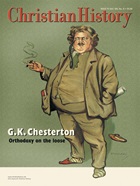
The Road to Rome


At the place where the roads meet there is no doubt of the convergence. A man may think all sorts of things, most of them honest and many of them true, about the right way to turn in the maze at Hampton Court. But he does not think he is in the center; he knows."
So wrote media star, mystery writer, and amateur theologian G.K. Chesterton in The Thing: Why I Am a Catholic. In the years leading up to this statement, though, he doubted whether roads met or even existed, and he was not at all sure what lay at the center of his life's maze. The story of his twisting, halting search for that place where truth makes sense is in many ways the story of his life.
Descent into madness
Chesterton's spiritual search began with his family's Liberalism. His parents were religious enough to have him baptized by the Church of England in 1874, but they otherwise had little use for traditional Christianity. If anything, they leaned toward Unitarianism.
"My own father and uncles," Chesterton wrote in his Autobiography, "were entirely of the period that believed in progress, and generally in new things, all the more because they were finding it increasingly difficult to believe in old things; and in some cases in anything at all."
Chesterton described the cultural atmosphere of his youth as distinctly post-Christian. There was "nothing new or odd about not having a religion. … We might almost say that agnosticism was an established church."
In his youth, Chesterton expressed some curiosity about orthodox Christianity (though he disliked Roman Catholicism) and twinges of anxiety about Liberalism. These explorations soon stalled. His earliest writings extolled the French Revolution, condemned dogma, and preached the exaltation of humanity.
All of this changed, however, at the Slade School of Art.
Chesterton enrolled at the Slade School in late 1892, and over the next year he went through a nihilistic phase. He called this episode "my period of madness." Friends also feared for his sanity.
The fashion of the day was Impressionism, which celebrated the artist's perspective while downplaying physical reality. "Its principal," Chesterton wrote, "was that if all that could be seen of a cow was a white line and a purple shadow, we should only render the line and the shadow; in a sense we should only believe in the line and the shadow, rather than in the cow."
Seized by this mentality, he began to doubt the world around him. "It was as if I had myself projected the universe from within, with its trees and stars; and that is so near to the notion of being God that it is manifestly even nearer to going mad. Yet I was not mad, in any medical or physical sense; I was simply carrying the scepticism of my time as far as it would go."
Radical realism
Chiefly by reading authors who affirmed existence and its basic goodness (particularly Robert Browning, Robert Louis Stevenson, and Walt Whitman), Chesterton emerged from the depths of depression by late 1893 or early 1894. He began to cultivate gratitude for life and wide-eyed wonder at the world—ideas so counter-cultural at the time, they seemed almost radical.
He took these insights with him as he left the Slade School in 1895 and began a career in publishing. He headed to London's journalistic hub, Fleet Street, and spent the next several years honing his ideas before a large and varied readership.
Much of Chesterton's intellectual development can be traced in his weekly columns for the mass-market Daily News between 1901 and 1913. To grab readers in a highly competitive market, the traditionally Nonconformist (low-church Protestant) paper assembled several strong writers and gave them broad leeway to comment on society, ideas, and world events. Chesterton became one of the publication's stars, aiding a rise in circulation from 56,000 in 1900 to 400,000 in 1909.
As Chesterton developed his personal philosophy, he faced the professional challenge of stimulating and provoking his readers without alienating either them or his long-suffering editor, A.G. Gardiner. The balance grew more precarious as he gravitated further from the Liberalism most of his readers embraced and closer to earthy traditions they deemed retrograde.
Chesterton's brother, Cecil, described the situation this way in 1908: "Thousands of peaceful semi-Tolstoian Nonconformists have for six years, been compelled to listen every Saturday morning to a fiery apostle preaching … War, Drink and Catholicism."
In fact, Chesterton did not preach Catholicism, or any coherent system, in his early career. He was still working out the details of faith and philosophy, wondering where his fundamental commitments to gratitude and against modern skepticism would lead. He and his readers would soon find out.
Steps toward faith
Behind the scenes of his professional success, a number of personal factors pulled Chesterton toward orthodox Christianity and, eventually, Roman Catholicism.
Taking a first step in the direction of faith, Chesterton realized that the gift of life, for which he had grown so grateful, must have been given by someone. "The truth presented itself to me, rather, in the form that where there is anything there is God," he wrote.
Chesterton had help in taking the second step toward faith.
In 1896, he met and became enamored with Frances Blogg, an officer of a London debating salon. Chesterton admired her confidence and discovered that it was rooted in her devout High Anglican faith. Her religion was "the unique quality that cut her off from the current culture and saved her from it."
Chesterton credited Frances with leading him from his vestigial Unitarianism to Anglicanism. But even though he was moving toward High Anglicanism at the time of their 1901 marriage, he still had a clearer sense of what he rejected than of what he believed. His criticism of modern theology and philosophy, laid out in Heretics (1905), left his affirmation of orthodox Christianity largely implied.
Chesterton finally asserted his faith in 1908 with Orthodoxy. In this book, he defines orthodox Christianity as the "philosophy of sanity" and shows how Christian beliefs answer deep modern problems.
For example, because Christians believe in an Incarnation, they believe in matter, spirit, and interaction between the two. This gives Christians respect for both the rational and mystical aspects of life. It also saves them from the radical doubts that nearly drove Chesterton mad in art school.
Furthermore, the historical doctrines of Christianity, so often blamed for blinding people from reality, actually reveal reality by keeping believers from blinding themselves with personal heresies. Fancy new schemes for understanding the world simply cannot compete with orthodoxy's tradition of defining dogmas. That tradition, he wrote, has not "told this truth or that truth, but has revealed itself as a truth-telling thing."
Truth is not the only thing Christian orthodoxy lavishes on its followers. In the "old theology [rather] than the new," Chesterton wrote, "we get wonder, curiosity, moral and political adventure, righteous indignation-Christendom." And, of utmost importance to Chesterton, Christians also get a Creator to whom they can express their gratitude.
Which church?
But Chesterton's spiritual search did not end with his full acceptance of orthodoxy. Indeed, even as he wrote Orthodoxy, he was wondering which church was most orthodox. He spent the next 14 years weighing the claims of the Anglican and Roman Catholic churches.
Despite boyhood prejudices against Catholics, Chesterton consistently expressed greater interest in Catholic culture and belief than his Protestant and secular peers. In particular, since youth he had felt an intense interest in the Virgin Mary. As an adult, he claimed that Mary had always symbolized Roman Catholicism to him.
There were also several early personal Roman Catholic influences on Chesterton, including his friend Hilaire Belloc, whom he met in 1900, and Father John O'Connor (the loose inspiration for Father Brown), whom he met in 1904. Additionally, Chesterton's close friend Maurice Baring became a Roman Catholic in 1909, as did his beloved brother, Cecil, in 1913.
Chesterton's beliefs at this point aligned him with the Anglo-Catholics, Christians who accepted most Catholic doctrines and practices but gave allegiance to English rather than Roman hierarchy. It was a difficult position to define, and many Anglo-Catholics moved on to either firmer commitment to reforming the Anglican Church or full communion with Rome.
Chesterton would take the second route, but only after another full round of soul-searching.
"I did not start out with the idea of saving the English Church, but of finding the Catholic Church," he wrote. "If the two were one, so much the better; but I had never conceived of Catholicism as a sort of showy attribute or attraction to be tacked on to my own national body, but as the inmost soul of the true body, wherever it might be."
One of the things that drew Chesterton toward Roman Catholicism was his fear that the Anglican Church could not combat theological Modernism. Chesterton saw in Modernism, which emphasized the rational and ethical aspects of Christianity but undermined its supernatural component, a dangerous rupture between mind and spirit-the same sort of rupture that had led to his breakdown at Slade.
He still believed that the Church of England could be both English and Catholic, so that Anglicans were not bereft of "the authority that can alone maintain dogma." But he also confessed to being "in some doubt" about the "seat of this Catholic authority."
Before Chesterton chose between Canterbury and Rome, he dropped many hints in Rome's direction. O'Connor claimed that Chesterton told him in the late spring of 1911 that he had decided to join the Roman church, but other matters of conscience restrained him. He was especially concerned about his wife, Frances, to whom he owed his orthodoxy and whose discernment he still admired.
Frances did not share her husband's anxieties about Anglicanism. She also had been grieved permanently when her brother who converted to Roman Catholicism committed suicide in 1906.
Furthermore, Chesterton's family was disturbed by Cecil's attraction to Rome, and G.K. did not want to introduce additional tensions. Finally, he was not yet so convinced by Roman Catholicism that he felt morally required to convert.
He almost ran out of time to make a decision. In November 1914, he collapsed. Around Christmas he became comatose. During a period of lucidity, he expressed a desire to be received into the Catholic church, but he faded out again before anything could be done.
It would seem that Chesterton had moved beyond intellectual acceptance of Catholic teachings to a personal embrace. Yet after he recovered, in 1915, he was even more worried about Frances, having given her such a scare with his illness. It took him a few more years to translate his beliefs into practical behavior.
A vow in Italy
The final stages of Chesterton's march to Rome were marked by a couple of dramatic events, a growing disaffection with Anglicanism, and sustained self-examination.
In 1919, London's Daily Telegraph sent him to Jerusalem to file a series of dispatches. During this trip, December 1919 to April 1920, Chesterton had two experiences that were pivotal in his religious development.
Seeing where Christ had lived heightened his sensitivity to the importance of tradition, particularly the heritage of the saints. His thoughts achieved startling clarity when he heard Benediction in the Church of the Ecce Homo on Palm Sunday. In a letter to his friend Maurice Baring, he wrote, "my train of thought, which really was one of thought and not fugitive emotion, came to an explosion."
Following this spiritually charged journey to Palestine, the Chestertons returned to Britain by way of Italy. While in Brindisi on Easter, they visited a Catholic church with a statue of the Virgin Mary. Chesterton prayed before it and made "the freest and hardest of all my acts of freedom," promising her "the thing that I would do if I returned to my own land." He was committing himself to trust God, through Mary's mediation, to see him safely to his spiritual home.
He found it easier to fulfill that vow by the summer of 1920, as he contemplated the declarations of the Anglican Church's Lambeth Conference. At Lambeth, the Anglican bishops showed willingness to bend doctrines in the name of Christian unity and offered only tepid condemnation of such quasi-Christian movements as spiritualism, Christian Science, and theosophy. Chesterton detected the taint of Modernism throughout.
As he elaborated a few years later, in the Toronto Daily Star, "the Church of England does not speak strongly. It has no united action. I have no use for a Church which is not a Church militant, which cannot order battle and fall in line and march in the same direction." Only in Rome, where rebellion against modernity was the rule, did unequivocal orthodoxy prevail.
Peace at last
While the spirit seems to have been fully willing by late 1920, the flesh remained weak until mid-1922. This hesitancy was not simply a case of Chesterton's usual slowness to action. Only his feelings about Frances held him back.
Ever since he began realizing that he was a Roman Catholic, he had hoped to convince her to convert as well. Yet he also feared alienating her, believing that the slightest touch could give her either great faith in or great hatred for Rome.
To talk through the issues, he called in John O'Connor, at Frances's request. On July 27, 1922, O'Connor told Frances that only anxiety about her reaction was keeping her husband from converting.
Frances replied that she would be greatly relieved if he took the step, for it would finally give them both the peace that his preoccupation had been preventing. But she also stressed that she could not move with him.
Satisfied at last that Frances had consented, Chesterton was received into the Catholic Church July 30, 1922. To his joy, Frances eventually joined him, in 1926.
Roman Catholicism fulfilled crucial traits of orthodoxy that he had long lauded. For example, in rejecting the dualistic Modernism that he thought was besetting Anglicanism, Roman Catholicism best upheld the orthodox synergy of spirit and matter.
He further judged Roman Catholicism the best source of authoritative, consistent Christian truth-telling because of its doctrinal center (the papacy) and commitment to tradition. He thus regarded this faith as the lone contemporary Christian church unwilling to cut its creed to suit the mood of modern times, making conversion to it "a form of revolt … [against] the established convention of much of the modern world."
Finally, Roman Catholicism affirmed his principle of gratitude. Its main theology, Thomism, held as its "primary and fundamental" belief "the praise of Life, the praise of Being, the praise of God as Creator of the World." Chesterton also found the Roman Catholic rite of mandatory, sacramental confession a unique means of atonement for ingratitude.
Leading the leaders
As Chesterton had followed some of his closest friends into orthodox Christianity, many more British authors followed him. C.S. Lewis, T.S. Eliot, Ronald Knox, Christopher Dawson, David Jones, Graham Greene, and Evelyn Waugh all avowed a conscious debt to Chesterton's work and, even more significantly, demonstrated an unconscious one.
As Knox asserted, his generation was often "thinking Chesterton" without realizing it. It is hardly surprising that these Christians were "thinking Chesterton" when his thoughts were such as these (from the poem "The Convert"):
The sages have a hundred maps to give
That trace their crawling cosmos like a tree,
They rattle reason out through many a sieve
That stores the sand and lets the dust go free:
And all these things are less than dust to me
Because my name is Lazarus and I live.
Adam Schwartz, assistant professor of history at Christendom College, Virginia, is working on a study of modern British converts to Catholicism, including Chesterton.
In His Own Words
Chesterton's take on the art school experience.There is nothing harder to learn than painting and nothing which most people take less trouble about learning. An art school is a place where about three people work with feverish energy and everybody else idles to a degree that I should have conceived unattainable by human nature. Moreover those who work are, I will not say the least intelligent, but, by the very nature of the case, for the moment the most narrow; those whose keen intelligence is for the time narrowed to a strictly technical problem. They do not want to be discursive and philosophical; because the trick they are trying to learn is at once incommunicable and practical; like playing the violin.
Thus philosophy is generally left to the idle; and it is generally a very idle philosophy. In the time of which I write it was also a very negative and even nihilistic philosophy. And though I never accepted it altogether, it threw a shadow over my mind and made me feel that the most profitable and worthy ideas were, as it were, on the defensive. …
[T]he whole mood was overpowered and oppressed with a sort of congestion of imagination. As Bunyan, in his morbid period, described himself as prompted to utter blasphemies, 1 had an overpowering impulse to record or draw horrible ideas and images; plunging in deeper and deeper as in a blind spiritual suicide. I had never heard of Confession, in any serious sense, in those days; but that is what is really needed in such cases. I fancy they are not uncommon cases.
Anyhow, the point is here that I dug quite low enough to discover the devil; and even in some dim way to recognise the devil. At least I never, even in this first vague and sceptical stage, indulged very much in the current arguments about the relativity of evil or the unreality of sin. Perhaps, when I eventually emerged as a sort of theorist, and was described as an Optimist, it was because I was one of the few people in that world of diabolism who really believed in devils.
—From The Autobiography of G. K. Chesterton, 1936
In His Own Words
G.K.'s silly and serious sides.On absent-mindedness
I used to say that my autobiography ought to consist of a series of short stories like those about Sherlock Holmes; only that his were astonishing examples of observation, and mine astonishing examples of lack of observation. In short, they were to be "Adventures" concerned with my absence of mind, instead of his presence of mind.
One, I remember was called "The Adventure of the Pro-Boer's Corkscrew," and commemorated the fact that I once borrowed a corkscrew from Hammond and found myself trying to open my front-door with it, with my latch-key in the other hand. Few will believe my statement, but it is none the less true that the incident came before and not after the more appropriate use of the corkscrew. I was perfectly sober; probably I should have been more vigilant if 1 had been drunk.
Another anecdote, expanded into "The Adventure of the Astonished Clerk," accused me of having asked for a cup of coffee instead of a ticket at the booking-office of a railway station, and doubtless I went on to ask the waitress politely for a third single to Battersea. I am not particularly proud of this characteristic, for I think that presence of mind is far more really poetical than absence of mind.
On Confession
When people ask me, or indeed anybody else, "Why did you join the Church of Rome?" the first essential answer, if it is partly an elliptical answer, is, "To get rid of my sins." For there is no other religious system that does really profess to get rid of people's sins. It is confirmed by the logic, which to many seems startling, by which the Church deduces that sin confessed and adequately repented is actually abolished; and that the sinner does really begin again as if he had never sinned.
And this brought me sharply back to those visions or fancies with which I have dealt in the chapter about childhood. I spoke there of the indescribable and indestructible certitude in the soul, that those first years of innocence were the beginning of something worthy, perhaps more worthy than any of the things that actually followed them: I spoke of the strange daylight, which was something more than the light of common day, that still seems in my memory to shine on those steep roads down from Campden Hill, from which one could see the Crystal Palace from afar.
Well, when a Catholic comes from Confession, he does truly, by definition, step out again into that dawn of his own beginning and look with new eyes across the world to a Crystal Palace that is really of crystal. He believes that in that dim corner, and in that brief ritual, God has really remade him in His own image. He is now a new experiment of the Creator. He is as much a new experiment as he was when he was really only five years old. He stands, as I said, in the white light at the worthy beginning of the life of a man. The accumulations of time can no longer terrify. He may be grey and gouty; but he is only five minutes old.
—From The Autobiography of G. K. Chesterton, 1936
Copyright © 2002 by the author or Christianity Today/Christian History magazine.
Click here for reprint information on Christian History.

Support Our Work
Subscribe to CT for less than $4.25/month