








A Mingling of Minds


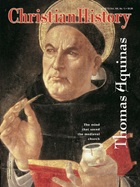
The work of Thomas Aquinas may be distinguished from that of any of his contemporaries by his attention to the writings of Moses Maimonides (1135-1204), a Jew, and Avicenna, (980-1037) a Muslim. His contemporaries, especially in Paris, were responsive to the work of another Muslim, Averroes (1126-1198), for his rendition of Aristotle, but Aquinas's relation to Averroes and to those who took their lead from him was far more ambivalent.
Aquinas respected Rabbi Moses and Avicenna as fellow travelers in an arduous intellectual attempt to reconcile the horizons of philosophers of ancient Greece, notably Aristotle, with those reflecting a revelation originating in ancient Israel, articulated initially in the divinely inspired writings of Moses. So while Aquinas would consult "the Commentator" (Averroes) on matters of interpretation of the texts of Aristotle, that very aphorism suggested the limits of his reliance on the philosophical writings of Averroes, the qadi from Cordova.
With Maimonides and Avicenna his relationship was more akin to dialogue, and especially so with Rabbi Moses, whose extended dialectical conversation with his student Joseph in his Guide of the Perplexed closely matched Aquinas's own project: that of using philosophical inquiry to articulate one's received faith, and in the process extending the horizons of that inquiry to include topics unsuspected by those lacking in divine revelation.
We may wonder at Aquinas's welcoming assistance from Jewish and Muslim quarters, especially when we reflect on the character of his times: the popular response to the call to arms of the Crusades as well as a nearly universal impression on the part of Christians that the new covenant had effectively eclipsed the old.
Aquinas may have shared these sentiments, for all we know, yet his overriding concern in reaching out to other thinkers was always to learn from them in his search for truth.
In this respect, he epitomized the medieval respect for learning, with its conviction that "truth was where one found it." So he was more inclined to examine the arguments of thinkers than their faith, trusting in the image of the Creator in us all to search out traces of the divine handiwork.
It is worth speculating whether the perspective of Aquinas and his contemporaries was not less Eurocentric than our own. What we call "the West" was indeed geopolitically surrounded by Islam, which sat astride the lucrative trade routes to "the East." Moreover, the cultural heritage embodied in notable achievements in medicine, mathematics, astronomy, as well as the logic, philosophical commentary, translation, and original work in metaphysics begun in tenth-century Baghdad, represented a legacy coveted by western medieval thinkers.
Noted historian Marshall Hodgson has called the culture that informed this epoch and extended from India to Andalusia "the Islamicate," intending thereby to include within its scope Jewish thinkers like Maimonides who enjoyed the protected status of dhimmi and contributed to Muslim civilization. Christians like John of Damascus enjoyed a similar status, reserved by Qur'anic authority for "people of the book," yet the divisions in Christendom saw to it that thinkers in Paris were better acquainted with Muslim and Jewish writers than with their co-religionists in Islamic regions.
Aquinas's own geographic and social origins could well have predisposed him to a closer relationship with thinkers representative of the Islamic than his contemporaries could be presumed to have had, in Paris at least. His hometown of Aquino in the region of Naples, itself a part of the kingdom of Sicily, reflected a face of Europe turned to the Islamicate, as evidenced in the first translations commissioned from Arabic: "Latin, Muslim, and Jewish culture mingled freely in Sicily in a unique way that was peculiarly Sicilian."
Moreover, in his later years, when his Dominican province asked him to direct a theological studium, Aquinas expressly chose Naples (over Rome or Orvieto) for its location, and that for intellectual reasons: "there was a vitality about Naples that was absent from Rome or any other city in the Roman Province."
So it might be surmised that these dimensions of his own personal history led him to be more open to thinkers from the Islamicate than his co-workers from Cologne or Paris might have been. In any case, the number and centrality of his citations from Avicenna and Maimonides leave no doubt as to their place in his intellectual development.
David B. Burrell, C.S.C., teaches theology and philosophy at the University of Notre Dame. This article was adapted from The Cambridge Companion to Aquinas, edited by Norman Kretzman and Eleonore Stump (Cambridge University Press, 1993). Used by permission.
Copyright © 2002 by the author or Christianity Today/Christian History magazine.
Click here for reprint information on Christian History.

Support Our Work
Subscribe to CT for less than $4.25/month