


Popes, Philosophers, and Peeping Thomists


A significant Catholic moment occurred in the middle of the twentieth century.
Consider these American success stories: Catholic Archbishop Fulton Sheen's TV program Life Is Worth Living (1951-1957) reached 30 million viewers and earned an Emmy. The great French Catholic philosophers Jacques Maritain and Etienne Gilson taught in major, secular, American universities and developed a wide lay readership.
Trappist monk Thomas Merton's autobiography, The Seven Storey Mountain (1948), became an improbable best seller. Catholic fiction writer Flannery O'Connor began a promising career with her first novel, Wise Blood, in 1952. She was soon followed by fellow Southerner Walker Percy, also a Catholic, whose first novel, The Moviegoer, won the National Book Award in 1962.
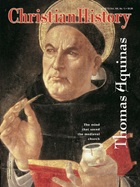
Few Americans, even Catholic Americans, realize that this mid-century flourishing of Catholicism was made possible by a papal encyclical, Aeterni Patris, composed in 1879 by Pope Leo XIII. Yet, nearly all the significant figures in this movement benefited from Leo's efforts to revive Catholic philosophy by reviving the writings of Thomas Aquinas. The Catholic moment in mid-twentieth century America was very much an Aquinas moment as well.
Hero or scapegoat?
Between the publication of his greatest works, in the mid-thirteenth century, and Pope Leo's encyclical, Aquinas's popularity waxed and waned.
Just a few years after his death, the famous Parisian condemnations of 1277 declared some of the propositions he taught contrary to the faith. In the late thirteenth and early fourteenth centuries, Aquinas's thought was at the center of fierce intellectual battles between the Dominicans, his religious order, and the Franciscans, who defended the rival ideas articulated by their leading theologians, Bonaventure and Scotus.
Despite all this, Aquinas was canonized as a saint in 1323. He has received a host of additional accolades and titles over the years as well: "universal" teacher (1317), the "angelic" teacher (1450), a "doctor" of the church (1567), and the patron of all Catholic schools (1880).
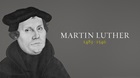
Aquinas came under attack again during the Reformation, when Martin Luther and others accused him of placing reason before faith and of leaning too heavily on non-Christian ideas. Luther, who called Aquinas both a "blind cow" and a "holy man," focused his harshest criticisms on Aquinas's fidelity to Aristotle, alleging that "the spirit of Christ does not reign where the spirit of Aristotle dominates."
During these lean years, when Aquinas took flak from Protestants and from the founders of modern science, the Dominicans kept him alive. Then the Jesuits, the most influential modern religious order, adopted him.
At the Council of Trent (1545-1563), called to reform the church from within and to clarify doctrines central to the clashes with Protestantism, his authority was so great that his Summa Theologica was placed on the altar alongside the Scriptures. Aquinas's teachings on the Eucharist, grace, and on faith and reason are intimately woven into Trent's decrees on these topics.
Out of retirement
After the early modern period and well into the nineteenth century, Catholic philosophy was a hodgepodge of disparate elements: scholastic theology, Newtonian science, and philosophical theses from Immanuel Kant and G.W.F. Hegel. When John Henry Newman, the great nineteenth-century Anglican divine and convert to Catholicism, visited Rome, he was astounded at the lack of knowledge of Aquinas among the church's leading intellectuals.
With his encyclical letter Aeterni Patris (1879), Pope Leo XIII set out to change all that. The pope saw that many of the greatest challenges to Christianity in the modern age were philosophical and that these challenges needed to be met with a philosophy rooted in the wisdom of Scripture and the Fathers of the Church.
Concerning the preeminence of Aquinas, Leo quoted an early modern commentator: "Because he had the deepest veneration for the sacred Doctors of old, he acquired, in a measure, the intelligence of them all."
Although such great scholars as Gilson, Maritain, and Charles DeKonninck wrote books on Aquinas intended for the non-specialist, their work cannot account entirely for the modern attraction of Aquinas. Gilson confessed that, after all his years of careful study, he could not rival the penetrating picture of Aquinas found in G.K. Chesterton's Saint Thomas Aquinas (1933), a book that made no "pretense to be anything other than a popular sketch."
Chesterton's "sketch" contains an audacious comparison of Aquinas and Francis of Assisi as the two great revolutionaries of the thirteenth century. In Francis's love of nature as the reflection of God and Aquinas's embrace of Aristotle as the philosophical voice of created nature, both men "reaffirmed the Incarnation by bringing God back to earth."
Thomas Merton, whose encounter with the texts of Aquinas while a student at Columbia University contributed directly to his conversion, strikes a similar note in his remarks on Aquinas. In the Ascent to Truth, a book on mysticism, Merton argues that Aquinas's devotion to philosophy and the integrity of human reason is in no way opposed to Christian devotion. On the contrary, Aquinas's "intellectualism" is a feature of his "sanity," his refusal "to divide man against himself," his insistence that you cannot "sanctify men by destroying their humanity."
Aquinas's teachings on grace and on the nature and function of art piqued the interest of novelist Flannery O'Connor. Known for her grim, Gothic tales, she was once accused of being a "hillbilly nihilist." She responded curtly that she was a "hillbilly Thomist." O'Connor was particularly taken by Aquinas's teaching, which Maritain communicated to her, that the excellence of a work of art consists in the artifact, not in the good intentions of the artist.
And the figure of Edith Stein—Jewish convert to Catholicism, ardent reader of the works of Thomas, victim of the Holocaust, and now on her way to becoming a Catholic saint—promises to loom large in any retelling of the influence of Aquinas in the twentieth century.
Although most of the work on Stein thus far has been hagiography of rather poor quality, a number of scholars are beginning to examine her philosophical writings, particularly her writings on Thomas.
Not dead yet
But even as Thomism was undergoing this mid-century renaissance, voices of discontent could be heard. In Catholic colleges, where students were required to take at least six courses in philosophy, they rarely encountered the texts of Aquinas directly. Instead, students read arid scholastic manuals, composed by lesser minds more preoccupied with multiplying distinctions than with engaging living philosophical questions.
Even where serious philosophical and theological debate took place, there was a sense that the writings of Gilson and others were not enough. Just as had been true in the early modern period, so too in the mid-twentieth century, the complaint was that Thomas's scholasticism was embarrassingly outdated.
In the late 1960s, in the wake of Vatican II, many Catholics—some with trepidation, others with gleeful anticipation—predicted the demise of Thomas Aquinas. Yet, in striking testimony to what Pope John Paul II has called the "enduring originality" of Aquinas's thought, we have witnessed yet another Thomistic revival.
Unlike previous revivals, which were typically instigated by popes, councils, bishops, and religious orders, recent interest in Aquinas is neither centralized nor systematic. And for the first time in history, participants include numerous non-Catholics, especially Protestant philosophers and theologians.
Ralph McInerny, a student of the aforementioned DeKonninck, coined the term "peeping Thomist" to describe this new group.
Among peeping Thomists are the recently deceased Mortimer Adler, whose dogged determination helped engineer the curricular innovation known as "great books" education, and the Calvinist philosopher of religion Alvin Plantinga, who identifies Aquinas as one of the forerunners of his own highly influential theory of human knowledge.
The present pope has made no mean contribution to the current revival of things Thomist. In his latest encyclical, "Faith and Reason," John Paul II recalls philosophy to its ancient vocation: the pursuit of wisdom, a pursuit rooted in love, seeking truth about the highest things, especially God.
Although the pope is careful to recommend a wide-ranging philosophical curriculum, spanning both West and East, he reaffirms the central role of Aquinas in the intellectual life of the Catholic Church. John Paul II commends Aquinas especially for his understanding of faith and reason, whose essence is captured succinctly in the assertion that "faith does not destroy reason but rather restores, elevates, and perfects it."
As Stanley Hauerwas, a premier Protestant moral theologian who has produced many young students of Aquinas, likes to say, serious students of theology today are not asking, "How far can I go?" or "What can I get away with theologically?" but "What ought I to believe?" and "What can my tradition teach me?" So long as Christians ask these questions, they will turn to Aquinas.
Thomas S. Hibbs teaches medieval philosophy at Boston College.
Copyright © 2002 by the author or Christianity Today/Christian History magazine.
Click here for reprint information on Christian History.

Support Our Work
Subscribe to CT for less than $4.25/month