




Thomas Aquinas: Christian History Interview - He's Our Man


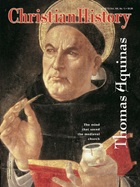
In a 1974 Christianity Today article marking the 700th anniversary of Aquinas's death, author Ronald Nash said some nice things about the deceased but ultimately judged his system of thought "unsuitable for a biblically centered Christian philosophy" and "beyond any hope of salvage." Norman Geisler disagreed with that assessment then, and he disagrees with it now. We asked Dr. Geisler, president of Southern Evangelical Seminary and author of Thomas Aquinas: An Evangelical Appraisal (Baker, 1991), for his evaluation of the Angelic Doctor.
You've studied Aquinas for 45 years now. What makes him so appealing?
He's insightful, he's incisive, he's comprehensive, he's systematic, he's biblical, he's devout, and he's successful. By successful, I mean, first, how many other books are still being read 700 years later? Second, he single-handedly withstood the onslaught of intellectual Islam in the thirteenth century. He reversed the course of history.
Why isn't Aquinas more popular with evangelicals?
Evangelicals have largely misinterpreted Aquinas, and they have placed on him views that he did not hold. Many people are concerned that he separated faith and reason, denied depravity (especially the effects of sin on the human mind), and stood for everything that "Roman Catholic" means to Protestants today. Let me take those concerns one by one.
Francis Schaeffer criticized Aquinas for giving rise to modern humanism and atheism by separating faith and reason. Aquinas would do cartwheels in his casket if he heard that!
He believed in the integration of faith and reason, not the separation. He made a distinction but no disjunction. Aquinas said that faith brings the highest kind of certainty and that reason, weak and fallen, cannot attain Christian faith.
Still, Aquinas held human reason in such high regard that some accuse him of denying depravity. He did not. He believed in original sin, he believed in the effects of sin on the mind, and he believed that the mind was so depraved that it could not know supernatural truths. God's revealed truths could be accepted only by faith.
And then there's the concern that Aquinas was a Roman Catholic, and we Protestants disagree with Catholicism at key points. In truth, most Protestants today could have accepted what the Roman Catholic church taught up to the time of the Reformation.
Even Martin Luther and John Calvin believed that the Roman Catholic church, up to the Council of Trent, was basically orthodox—a true church with sound fundamental doctrines as well as significant error.
Many of the Catholic beliefs that concern Protestants most were not declared dogma until long after Aquinas. For example, Aquinas denied the immaculate conception of Mary, and it was not declared dogma until 1854. Aquinas never believed in the bodily assumption of Mary, which was defined in 1950. Aquinas didn't believe in the infallibility of the pope. That was not pronounced until 1870—600 years after Aquinas.
On the other hand, Aquinas held many beliefs associated with the Reformation. He upheld a version of sola scriptura. He believed in salvation by grace through faith—just look at his commentary on Ephesians 2:8-9.
John Gerstner, the late Calvinist theologian, went so far as to claim that Aquinas was basically a Protestant.
How can we avoid the misconceptions and find the real Aquinas?
Read him! Quotes and excerpts in other people's books don't count, because many of his critics have taken him out of context. Get it from the horse's mouth, or should I say the dumb ox's mouth.
Aquinas is worth reading. He has stood the test of time. And even where he errs, you can learn more from the errors of a great mind than you can learn from the truths of a small mind. You can see a whole lot farther standing on the shoulders of giants.
What will people find when they read Aquinas, besides philosophy?
People are rediscovering Aquinas as a biblical exegete. He wrote some of the greatest commentaries on the Bible—no one has surpassed his commentary on the Gospels to this day. He has 10 pages on John 1:1, and 78 pages on chapter one. He culls from the Fathers, from the second century up to the thirteenth century, and weaves them together in a continuous commentary.
After all, he was a member of the Order of Preachers. They had to preach the Bible every day and go through the entire Bible in three years.
What can thinkers engaged in today's theological and philosophical debates learn from Aquinas?
We can learn from him in the way he answered Muslim Aristotelianism. He answered it by fighting bad ideas with good ideas, by fighting the pen with the pen, not the sword. We're not going to win the battle of ideas by the sword. We're going to win the battle of ideas with ideas—better ones, more logical ones, more consistent ones.
Second, we can learn how important it is to understand the philosophy of the day. It's like 1 Chronicles 12:32 says, the men of Issachar "understood the times."
Aquinas studied the philosophy of the day, which was Aristotle. He understood it better than his opponents, and he could use it to refute opponents who misused it. We need to do the same thing in every field.
Aquinas is a tremendous example for us because, today, the basic battle is the battle for God. The only way we're going to defend the orthodox, historic view—held by Aquinas, Augustine, the Reformers, and the creeds and councils of the church—that God knows the future infallibly, that God is eternal and unchangeable, that God even exists, is to go back to Aquinas and his great arguments.
What can Christians who aren't theologians or philosophers learn from Aquinas?
First of all, his absolute, unconditional commitment to Christ. He was an extremely devout person. He spent hours in prayer and Bible reading and Bible study. His whole life had a biblical basis—just read his prayers.
In one Thomistic class I took at a Catholic institution, the professor would pray a brief part of one of Aquinas' prayers before class. He would say, "Inspire us at the beginning, direct our progress, and complete the finished task within us." Aquinas had such a succinct way of getting to the heart of an issue.
Here's another of his prayers: "Give me, O Lord, a steadfast heart, which no unworthy affection may drag downwards; give me an unconquered heart, which no tribulation can wear out; give me an upright heart, which no unworthy purpose may tempt aside. Bestow on me also, O Lord my God, understanding to know you, diligence to seek you, wisdom to find you, and faithfulness that may finally embrace you, through Jesus Christ our Lord."
I can't tell you how Aquinas has enriched and changed my life, my thought. He has helped me to be a better evangelical, a better servant of Christ, and to better defend the faith that was delivered, once for all, to the saints.
Copyright © 2002 by the author or Christianity Today/Christian History magazine.
Click here for reprint information on Christian History.

Support Our Work
Subscribe to CT for less than $4.25/month