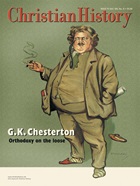
The Un-Apologist


In one of his most important books, Orthodoxy, G.K. Chesterton claims that he is doing spiritual autobiography, not apologetics. He goes so far as to declare: "I never read a line of Christian apologetics." Yet in this and many other works, he made his era's most robust case for faith.
Defense on the attack
Several elements come together to produce Chesterton's unique—and unusually effective—apologetic style.
First, though the word apologetics means literally "defense," Chesterton was never defensive. As one commentator put it, he "wrestled the initiative from the skeptics and presented the historic faith upon a note of triumphant challenge."
By exposing the false and irrational presuppositions of unbelief, Chesterton shows that the self-styled rationalist is as naked as the monarch in "The Emperor's Clothes." A few examples typify Chesterton's withering logic.
He observes that "the man who denies original sin believes in the Immaculate Conception of everybody."
Against the argument that we must remain agnostic and never claim that God has in fact revealed himself in this world, he says, "We don't know enough about the unknown to know that it is unknowable."
He says to those who believe that evolution eliminates God's creative activity, "It is absurd for the Evolutionist to complain that it is unthinkable for an admittedly unthinkable God to make everything out of nothing, and then pretend that it is more thinkable that nothing should turn itself into everything."
Chesterton never tires in pointing out the unjustified and unrecognized dogmatism of the unbeliever, contrasting this close-mindedness with the open and attractive worldview of the orthodox Christian. "The Christian," he writes, "is quite free to believe that there is a considerable amount of settled order and inevitable development in the universe. But the materialist is not allowed to admit into his spotless machine the slightest speck of spiritualism or miracle."
Facts for faith
In today's apologetic climate, there are two major schools of thought. The presuppositionalists hold that, because of sin, the unbeliever always starts from his or her presuppositions of unbelief, and that only by starting from the presupposition of Christian truth can one achieve anything. The evidentialists argue that we can and must convince the unbeliever of Christian truth by presenting factual evidence.
Chesterton would certainly have joined the evidentialist camp. Note how he defends the miracles of the New Testament, which constitute the central evidence for Christ's deity:
"Somehow or other an extraordinary idea has arisen that the disbelievers in miracles consider them coldly and fairly, while believers in miracles accept them only in connection with some dogma. The fact is quite the other way. The believers in miracles accept them (rightly or wrongly) because they have evidence for them. The disbelievers in miracles deny them (rightly or wrongly) because they have a doctrine against them."
Chesterton's point, here and in general, is that the facts support Christian orthodoxy. If one is willing to investigate those facts, the truth of the faith will become plain. Unbelieving dogmatism keeps a fallen race from the gospel, not an absence of evidence.
Ronald Knox, the great translator of the New Testament, noted this essential characteristic of Chesterton's apologetic as it is reflected in the methods of Father Brown:
"The real secret of Father Brown is that there is nothing of the mystic about him. When he falls into a reverie—I had almost said, a brown study—the other people in the story think that he must be having an ecstasy, because he is a Catholic priest, and will proceed to solve the mystery by some kind of heaven-sent intuition. And the reader, if he is not careful, will get carried away by the same miscalculation. … And all the time Father Brown is doing just what [Agatha Christie's sleuth Hercule] Poirot does; he is using his little grey cells. He is noticing something which the reader hasn't noticed, and will kick himself later for not having noticed."
Eat, drink, and witness
We have all heard that "actions speak louder than words." This certainly applies to Christian witness. The lives of some apologists have been so unattractive that no one will listen to their arguments.
In evangelical circles, the problem has often been one of sanctimonious pietism. For example, prohibitionists who attempted to tell their neighbors of Christ's love were reviled for their stance on alcohol and ignored on all other counts. Protesters shouting slogans outside theaters and pool-halls met deaf ears when they attempted to make reasoned cases for faith.
Chesterton never fell into this trap. He had a strong doctrine of Creation and saw the beauties and pleasures of this world as gifts of God. He consistently criticized pietistic legalism and even devoted an entire novel to the absurdities of Prohibition.
In The Flying Inn, Chesterton supposes that England elects a Muslim prime minister, who abolishes all inns and pubs. This creates all the same evils faced by Prohibition-era America: bureaucracy, crime, and the general increase—not decrease—of social problems. The happy-go-lucky creators of a "flying inn," which moves from place to place just ahead of the authorities, display the kind of relaxed openness that characterizes believers who are comfortable with God's world.
Chesterton himself enjoyed fine cuisine and wines. He dressed idiosyncratically and sometimes eccentrically. He understood the scriptural emphasis on the unique importance of each individual before God and hated all bureaucratic attempts at enforced conformity. He was the polar opposite of the Pharisee, and there is little doubt that his transparent genuineness reinforced his apologetic arguments.
Ripples
One way to assess the significance of Chesterton's apologetic work is to look for people he influenced. They are easy to find.
Etienne Gilson, the great medievalist of the mid-century, called Orthodoxy the best apologetic the twentieth century had yet produced.
When Chesterton died, Charles Williams of the Oxford Inklings lamented, "The last of my Lords is dead."
In his obituary for Chesterton, famed poet and literary critic T.S. Eliot stated that Chesterton "did more than any man of his time" to "maintain the existence of the [Christian] minority in the modern world."
C.S. Lewis and J.R.R. Tolkien also felt Chesterton's impact. Concerning the Gospel, Lewis asserts that "here and here only in all time the myth must become fact; the Word, flesh; God, Man," and Tolkien declares, "this story is supreme; and it is true. Art has been verified. Legend and history have met and fused." Both echo Chesterton, who wrote:
"In answer to the historical query of why it was accepted, and is accepted, I answer for millions of others in my reply: because it fits the lock; because it is like life. It is one among many stories; only it happens to be a true story. It is one among many philosophies; only it happens to be the truth."
In the final volume of the Chronicles of Narnia, Lewis has the children find in Narnia companions they thought they would never see again and learn that in God's kingdom "no good thing is ever lost." Lewis picks up where Chesterton left off:
"Paradise is somewhere and not anywhere, is something and not anything. And I would not be so very much surprised if the house in heaven had a real green lamp-post after all."
Recalled to duty
No one writes in a cultural vacuum, and Chesterton, as a professional journalist, produced much ephemera that few but scholars read today. But the apologetic value of his contributions remains unassailable.
One of the major reasons for this is the resurfacing of theological liberalism. Many thought that two World Wars would put an end to the humanistic theology Chesterton targeted so often, but liberalism returned in guises like process theology and the "death of God movement."
In many respects, the pendulum has swung back to the kind of liberalism that Chesterton opposed with such force and effectiveness. The "Jesus Seminar" and Bishop Shelby Spong echo the arguments of such turn-of-the-century figures as Harry Emerson Fosdick and Bishop James Pike. All of them, in their rationalistic refusal to take the Gospel records seriously, place themselves directly in the sights of Chesterton's heavy artillery.
To all such deviations from classical Christian orthodoxy, Chesterton continues to speak:
"On the third day the friends of Christ coming at daybreak to the place found the grave empty and the stone rolled away. In varying ways they realised the new wonder; but even they hardly realised that the world had died in the night. What they were looking at was the first day of a new creation, with a new heaven and a new earth; and in a semblance of the gardener God walked again in the garden, in the cool not of the evening but the dawn."
John Warwick Montgomery is an English barrister and Distinguished Professor of Apologetics at Trinity College and Theological Seminary (Indiana).
Copyright © 2002 by the author or Christianity Today/Christian History magazine.
Click here for reprint information on Christian History.

Support Our Work
Subscribe to CT for less than $4.25/month