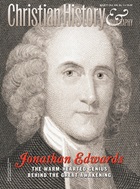
A Mind on Fire


A battered file box, deep in the basement of Yale University's Beinecke Library, contains a startling memorial to the final years of Jonathan Edwards's life.
In other similar boxes, stacks of notebooks contain in their neat pages crisp rows of Edwards's spidery handwriting. Their content is remarkable: profound, vivid, masterfully argued, piercingly clear—the fruit of a lifetime of fervent thinking about the nature of God, humankind, and the world. But their physical form is unremarkable.
Not so the notebooks contained in this box. One after another is stitched together from a riot of scrap paper: Half a page of a friend's letter, left blank under the signature. The wide margin of a Boston newspaper. Several large sheets with semi-circles cut out of them.
Across these makeshift pages runs Edwards's cursive script—tiny, cramped. It crawls from edge to edge of the paper, even between the lines of newsprint, wasting no fraction of white space.
These notebooks date from the great theologian's Stockbridge phase—the period between 1751 and 1758. Ejected from his comfortable Connecticut Valley church after 21 years of loyal service, Edwards eked out these years with his wife and seven of their children at a mission church on Massachusetts's western frontier. There, paper was presumably scarce, expensive, or both.
Some of the sheets sewn together in the Stockbridge notebooks were off-cuts from the manufacture of paper fans, which his children decorated and sold to add a few dollars to the family coffer. The other scraps would once have landed in the rubbish pile—but they could not be wasted any more.
In thriving Northampton, the pastor-theologian had enjoyed the resources of a prominent pastorate in a major New England town (though his salary, as he complained, was not always paid on time). Now he wrote his most influential intellectual works on such scraps, between preaching to a small congregation, catechizing converts among the Housatonic Indians and other tribes, and championing these Native Americans' rights against the area's powerful merchants.
The Freedom of the Will, True Virtue, Original Sin—how often, as he scratched out the ideas for these great treatises on the pages of his patchwork notebooks, was his work interrupted by worries about whether there would be vegetables and meat enough for the week's meals, or how he would afford the wood necessary to mend a fence?
Born again through beauty
Timothy and Esther Edwards had 11 children. Jonathan, the fifth, was the only son, born October 5, 1703. If, in New England, to be a minister was to be an aristocrat, he came from good stock. Timothy, a third-generation New Englander, served his East Windsor parish faithfully and ably; Esther's father was Solomon Stoddard, whose decades of ministry in Northampton added luster to an already noble New England family.
What we know of Edwards's childhood suggests that he was religiously serious even then, although he judged himself unconverted: the building of little dens in the woods is hardly unusual behavior for a young boy, but using them to hold prayer meetings alone or with friends certainly is!
Edwards describes his own conversion as an event that was not fundamentally intellectual (that is, about understanding the gospel in any better way) or even moral (that is, about desiring to follow Christ), but aesthetic: doctrines of God's absolute sovereignty, which had appeared "repugnant" to him, suddenly seemed beautiful. Both the defense of Calvinism as an essential part of Christianity, and conceptions of beauty, became lasting features of his theology, which suggests how significant this event was in his life.
He was conscious that he had come to faith in an unusual way, and this concerned him. He records having doubts about his conversion because he could not fit his experience to the standard Puritan maps of the way God leads a troubled soul to salvation.
Distinguished saints
From his conversion onward, Edwards remained fascinated with the problem of how to tell whether a Christian's professed faith was truly real and saving. He contemplated the question throughout the Awakening in the 1730s and 1740s, and eventually gave the subject his fullest and most influential treatment in his Treatise on the Religious Affections (1746). Why was the question of such concern to him?
First, Edwards inherited a common Puritan concern about "temporary faith." This idea, introduced by John Calvin, is a way of explaining the fact that church members sometimes fall away after years of faithful service, even though the Calvinist doctrine of the perseverance of the saints ("once saved, always saved") insists that true Christians cannot fall away. The way of squaring this circle was to suggest that there is something that looks like true faith but is not—temporary faith. Thus, finding distinguishing marks of true faith becomes a necessity.
Second, Puritans responded to this problem by identifying a particular set of steps in a particular order as "the" way to salvation. Edwards disagreed with this aspect of the tradition. It fitted neither his own experience nor his pastoral observation. Thus, when he discussed how to identify true faith, he was sometimes aiming a critique at this tradition—a tradition now remote for most modern readers.
Third, in his cultural context, Edwards believed—as many still do—that fallen humanity is inherently religious. There is that within us that desires spiritual fulfillment; as Augustine put it, "thou hast made us for thyself, and our hearts are restless till they find their rest in thee." However, while today unsaved "seekers" for religious satisfaction might find it in myriad fashionable religious practices, in Edwards's New England, options were limited. Such seekers likely dwelt in the margins of the church, where they might appear to be zealous Christians while actually not being Christ-centered at all. Thus the issue of genuineness confronted the pastor in unavoidable ways.
So Edwards aimed to identify "The Distinguishing Marks of the Spirit of God."
The makings of genius
That all lay in the future, however. Meanwhile, Edwards went to the Collegiate School, a new and troubled college, later to be called Yale, to train for the ministry. After graduating, he served, from 1723 to 1726, a Presbyterian congregation in New York. Then he came back to Yale to teach. While there, he suffered serious ill health.
Some time during this period, Edwards read and was deeply influenced by Locke's Essay Concerning Human Understanding.
The precise date is difficult to determine, but a story told by one of his first biographers, which had a precocious, teenaged Jonathan reading it "with great delight and profit," is almost certainly false. (It was based in part on an assumption that a philosophical notebook Edwards kept, Notes on the Mind, was written very early in his career. Recent chemical analyses of the inks used in that notebook show that the entries in fact span his adult life. We can also now trace with some exactness when copies of Locke's work arrived at Yale, which again casts doubt on the older story.)
This is important, as Edwards has been painted as a precocious philosophical genius who failed to live up to his early promise when the fetters of anti-intellectual Calvinist theology gripped him. In fact, his philosophical development occurred alongside his theological development, and his thought in each of these areas deeply influenced the other.
Revival!
In 1726, Solomon Stoddard celebrated his eighty-third birthday. His congregation, feeling their paster needed some assistance, called Stoddard's young grandson to his side. A year later Edwards joined Sarah Pierrepont in what has become a fabled marriage (see p. 23), marked as it was by mutual support and admiration, not to mention a remarkable line of illustrious descendants.
Edwards's ministry was deemed acceptable, and when Stoddard died in 1729, his grandson was called to succeed him. He pastored the congregation for 21 years, through momentous times.
While local revivals of religion were not unusual in New England (Stoddard had seen five in his ministry), what began in Northampton in 1734 was something new. For six months through the winter, the town was seized by a deep and serious concern for religion. More than 300 professed to be converted; in Edwards's words, "the town seemed to be full of the presence of God: it never was so full of love, nor so full of joy. … There were remarkable tokens of God's presence in almost every house. … God's day was a delight … everyone earnestly intent on the public worship, every hearer eager to drink in the words of the minister as they came from his mouth."
This spirit flowed out from Northampton and touched almost every community in the Connecticut River Valley.
Too soon, it came to an end. Edwards labored to re-ignite the flame, but that work belonged to another. On September 14, 1740 George Whitefield landed at Rhode Island. He announced his reason for coming by preaching six times in the first three days of his visit, and for two years following, religious fervor was common across New England.
Edwards took his part in the preaching, but his more significant contribution, perhaps, was a series of books defending the revivals against both those who would have no emotion in their religion, and those who would have nothing but emotion in theirs.
Sermons that sparked the flame
In Edwards's mind there was no doubt what, under God, led to the beginning of this Great Awakening, and he later published five of his sermons that had sparked the original excitement in 1734. These are carefully argued defenses of various aspects of Calvinist doctrines related to salvation. Each ends with an application, to be sure, but they are mainly composed of theological argument.
Reading them today, we might find it difficult to believe that the hearers remained awake, let alone responded as they did. Of course, compared to most modern churchgoers, Edwards's congregation would have been more used to following doctrinal sermons. And Edwards himself was clearly an able rhetorician. He also streamlined the form considerably. While his father, Timothy Edwards, had apparently once announced "and sixty-sixthly …" from the pulpit, Jonathan developed and applied only a handful of points in each sermon.
There is more, however, to the reaction of Edwards's "awakened" hearers. Take his most famous composition, "Sinners in the Hands of an Angry God" (1741).
Rhetorically, "Sinners" is stunning: it recalls a then-current style of sermons preached to condemned criminals just before their execution, during which the minister would stress their imminent encounter with God and exhort them to repent. Such sermons were often published, so most would have recognized the genre.
In a shocking move, Edwards applied this form to his hearers in Enfield, emphasizing the sinfulness of even respectable church folk. As he hammered home the instability of their position before God, whose hand alone held them from immediate death and the judgment that followed, he was in effect comparing them to condemned murderers.
The form of the sermon echoes and reinforces its content in a magnificent way. But that is not the source of its power, or at least not the only source. We can know this because, a few weeks before preaching at Enfield to the accompaniment of the screams of convicted sinners and the joyful weeping of new converts, Edwards had preached virtually the same sermon (we have his manuscript and can see how few amendments were made) to his own flock in Northampton. But his flock responded only, as far as we know, by shaking his hand and saying "fine word, pastor" as they went home to lunch.
All of this reinforces Edwards's own analysis of the revivals: the word is the occasion for awakening, and a necessary one, but the Spirit of God does the work, and he "blows where he wills." His passing could be seen in lasting changes: People made humble, faithful, prayerful, holy. Churches made earnest in worship and hungry for the word. Towns where, to quote Charles Simeon, a century later, "goodness" became "fashionable."
Screams, faintings and other such spectacular phenomena were nothing either way: they did not demonstrate the Spirit's presence, and they did not preclude it either. Such was Edwards's final analysis of the revivals in The Religious Affections (1746).
Rejection, exile, and prolific publishing
By the time this work was published, however, the Awakening had subsided. Edwards found it necessary to encourage the nascent transatlantic evangelical community, in print, to unite in prayer that God might renew his work.
On the home front, things were even bleaker, as the Northampton pastor found himself engaged in controversies over church order that would lead to his expulsion from his pulpit (see p. 35). On July 1, 1750, with no post to move on to, Edwards preached his farewell sermon to the church at Northampton.
He explored various possibilities, including a move to Scotland—he would have no problem subscribing to the Presbyterian scheme, he assured his regular correspondents there.
But he eventually accepted a call to Stockbridge, a post combining missionary endeavor among the Housatonic Indians there with pastoral duties to a small church composed of the New Englanders who lived in the town.
In August 1751 he was installed. The family endured just under seven years of hardship there, during which time Jonathan, bearing all the marks of worldly failure in his poverty and dismissal from his pastorate, produced a series of works that make him arguably still the greatest philosopher or theologian to have been born on the North American continent.
His output there was prodigious. Some works were responses to old controversies (the Humble Enquiry and Misrepresentations Corrected, which addressed the disputes which had led to his removal from Northampton).
Others, not intended for publication, reflected his interest in the End Times, with analyses of how wars against Catholic Spain might fulfill prophecies in the Apocalypse (Edwards was of a generation that never thought to question the identification of the Pope as the Antichrist).
Two sets of works are particularly important, however: his private notebooks and his projected defense of Calvinism.
A checkerboard coat
Throughout his life, Edwards wrote copiously in various notebooks, recording quotations, observations, ideas, and arguments on every conceivable subject.
His Miscellanies, the largest and most important of these, are only now being published, a rich mine of general theological fare. But there are others: a book devoted solely to controversial subjects in which he was interested; the Blank Bible, a small Bible in which he sewed a large sheet between every pair of pages, so he could record notes and comments on texts next to them; and so on.
For most of his life (though this seems to have changed somewhat during the Stockbridge years) he took such notes principally to help him develop sermons. When out riding, he would scribble his thoughts on scraps of paper as they struck him, then pin them to his coat. One of his early biographers gives us the wonderful image of the stern Puritan pastor arriving at his door after an intellectually fruitful trip, with his black coat a checkerboard.
Two sets of notebooks are particularly interesting: First, Edwards's belief that everything in nature and history spoke of Christ and his gospel, if only it was rightly understood, shines forth from a series of books on "Images," "Types," or "Shadows" of divine things (see p. 40).
In these he suggests, for example, that springtime's gradual progress is ordained by God to illustrate the gradual increase of the Kingdom on earth, and that the "filth" in which newly born babies are covered is God's way of stressing to us the sinfulness and guilt that is theirs even from birth.
Second, the Miscellanies are perhaps the center of the notes and can be used to trace the development of ideas that finally appeared in print, or would have, had he lived, as well as his exploration and rejection of other positions. Edwards struggled with concepts and changed his mind regularly on certain issues, all the while striving to be more and more faithful to the gospel of Christ. He recorded the whole process in books we can now read.
The pinnacle
The defense of Calvinism produced three of Edwards's greatest works. Of these, The Freedom of the Will is perhaps the pinnacle. Had he written nothing else, this one book would have ensured his fame.
The main argument of the book is ethical: he sets out to prove that the Calvinist account of predestined humanity is—far from a moral abomination—morality's greatest support. Better than the alternative views, it holds human beings responsible for their actions.
On the way to this point, Edwards pauses to develop an argument for why freedom and predestination are essentially compatible. Though a mere introduction to his main argument, this is the most intellectually powerful such defense ever published.
The companion volume, Original Sin, is a solid and cogent defense of that controversial doctrine, mostly on biblical grounds.
The third work is one that Edwards never published. To see why, we need to return to the events of his life.
After seven years of exile at Stockbridge, Jonathan Edwards's intellectual stature was finally recognized, and he was invited to become president of the college in Princeton.
At first his humility caused him to balk. But after seeking advice, he accepted and went ahead of his family to the town. Smallpox was then rife, and Edwards received vaccination on February 23, 1758. That science was in its infancy, however, and he contracted the disease. He never recovered.
Voicing the vision
At his death, a work sat on his desk, ready to go to the printer. This was Two Dissertations. One part of this book, titled "True Virtue," is a profound theological analysis of ethics. In it, Edwards argues (against all cultural fashions of the day) that goodness can never be separated from godliness; so that which is not done to serve Christ in any way should not be called good.
The book's other part, "A Dissertation Concerning the End for Which God Created the World," is the closest Edwards ever got to expressing the heart and soul of his theology, his piety, and his life.
Why did God create the world? Edwards had worried over this question all his life, recording his successive analyses in the Miscellanies. What did God gain by having a creation? What caused his desire to do so?
Edwards traced the question to many of its dead ends, and his mature analysis is profound:
God gains nothing from creating, as God's happiness in himself is so perfect that it cannot be added to. But the perception of the beauty of God's perfection—his glory—is a great good; so God desired there to be intelligent creatures who could see his glory and respond with ecstatic joy, with abundant love, with extravagant praise. Everything that God has done tends toward this single end.
As a young man, Edwards had found faith in Christ when he glimpsed the beauty of God's sovereignty through nature. That vision drove much of what he said and thought thereafter. And now, at last, he found doctrines to express the vision's meaning.
These towering works were the mere run-up to a projected magnum opus. Edwards had in mind a synthesis of Christian doctrine and ethics, arranged historically.
This work would have ranked (there is every reason to suppose) alongside Aquinas's Summa, Calvin's Institutes, and few others in theological history. But his death, on March 22, 1758, at age 54, killed that Edwardsian Summa at its birth.
Jonathan Edwards's last words encapsulated his life. First he spoke of his love for Sarah and urged his children to find faith in God. Then he asked that he not be given an elaborate funeral but that what money was available be given to charity. And then he looked once more to Jesus.
To those around, it seemed he had lapsed into unconsciousness, and they spoke freely of the loss that the college, and God's church, would have to bear. He heard still, and he spoke one last sentence: "Trust in God, and you need not fear."
To this, his last and briefest sermon, what could or should be added?
Stephen R. Holmes is a lecturer in Christian doctrine at King's College in London and a member of the leadership team at Ashford Baptist Church.
Copyright © 2003 by the author or Christianity Today/Christian History magazine.
Click here for reprint information on Christian History.

Support Our Work
Subscribe to CT for less than $4.25/month