The Northampton Eviction


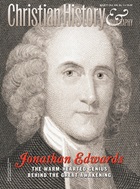
Jonathan Edwards was, for the most part, a withdrawn, soft-spoken man. Yet much of his life was caught up in controversy, and he faulted himself for an argumentative tendency.
The "Resolutions" he drew up while serving a small congregation in New York in 1722-23 are laced with reminders "never to say anything at all against anybody." He clearly struggled with "egotism" and "dogmaticalness" (as he put it) that he afterwards regretted.
"If I had more of an air of gentleness," Edwards lamented while tutoring at Yale in 1725, "I should be much mended."
But he never quite developed that air. He had been the pastor at Northampton for six years when the Connecticut River Valley was scandalized in 1734 by the calling of Robert Breck, a Harvard graduate suspected of Arminianism, as the pastor of the church at Springfield, just downriver from Northampton. The ministers of the Hampshire Association tried to have the call rescinded. But they could persuade neither the Springfield church nor the civil authorities in Boston to interfere, and Breck was duly installed.
As the pastor of the Connecticut Valley's greatest church, Edwards played a leading role in the controversy, writing the Hampshire Association's Letter of protest and taking the occasion to preach against Arminianism. This earned him a reputation for "meddling with the controversy in the pulpit"—not to mention the lasting enmity of Robert Breck.
For a time, it seemed Edwards could afford to ignore the costs of
the Breck debacle. In December 1734, "the Spirit of God began extraordinarily to set in" among the people of Northampton in the first of the great revivals he would see there, and "a great and earnest concern about the great things of religion" brought "more than 300 souls … to Christ."
But controversy was never far from his door. "The people of Northampton are not the most happy in their natural tempers," Edwards wrote ruefully, "They have, ever since I can remember, been famed for … a difficult turbulent temper."
Some of this taste for argument was rooted in Northampton's changing circumstances. All through the 1730s, farm property in western Massachusetts increased in price. Younger families found themselves increasingly squeezed off the land, and town meetings in Northampton grew more and more acrimonious. Edwards's preaching was particularly well received by these younger people, who hungered for the hope he gave them in God's absolute predestination of all things. It went down less easily among the status-conscious, established families, who did not like being reminded that none of their personal achievements amounted to anything in God's estimate.
When the head of one of these families, a lawyer and spiritual depressive named Joseph Hawley, committed suicide on June 1, 1735, the Northampton revival collapsed. Edwards now had another group of enemies.
Once again, however, it seemed the gathering storm would disperse harmlessly. The arrival of George Whitefield in Northampton in 1740 marked a renewal of the revival energies that would culminate in the Great Awakening. A relieved Edwards became one of the principal figures in defending the Awakening against its critics.
Soon, however, Edwards felt he needed to place limits on this second revival's exuberance. By the beginning of 1742, the revival in Northampton had become a pandemonium.
"The people were exceedingly moved, crying out in great numbers in the meetinghouse," Edwards wrote, "There were some instances of persons lying in a trance, remaining for perhaps a whole twenty-four hours motionless," and "a great deal of caution and pains were found necessary to keep the people, many of them, from running wild." In the end, the revival in Northampton did not last, and Edwards was blamed.
What was worse, the Christian character of some of those touched by the revival fell noticeably short of the heights of their religious experience. Faced by worldliness among the newly revived (and among some of the church's established families), in March 1742 Edwards moved to require that applicants for church membership undergo screening and make "a solemn public renewal of their covenant with God."
On paper, this was not asking much. But Edwards was imposing this on Solomon Stoddard's congregation, which prided itself on Stoddard's innovation of open communion for the entire parish. Northampton interpreted Edwards's gesture as a power grab and a slur on the memory of Stoddard. Applications promptly dried up, and between 1744 and 1748, not one new candidate for membership appeared.
As early as 1743, the town began finding fault with Edwards's salary and the way his family spent money. And the following year, he mishandled a minor incident involving some of the young people who had been his choicest converts during the revivals.
In March 1744, Edwards learned that several "boys" in the parish had been using a midwives' manual for some untutored lessons in female anatomy. This was not, in itself, a serious matter. But Edwards handled it in almost the worst way imaginable: by reading the names of the offenders from the pulpit. Not only were several of them from very well-placed Northampton families, but some were not "boys" at all—the average age was twenty-four—and were really part of Northampton's rootless young people, who now turned on their former mentor as one who had betrayed them.
Meanwhile, Edwards had become more convinced than ever that the church membership policies, inherited from Stoddard, were unwise. In the spring of 1749, he wrote a comprehensive treatise on the subject, An Humble Inquiry into the Rules of the Word of God, Concerning the Qualifications Requisite to … Full Communion. The book took aim at his grandfather's open communion doctrine and at any notion of church membership that did not restrict itself to "such as are in profession and in the eye of the church's Christian judgment godly or gracious persons."
Here Edwards was questioning the practice not only of Northampton, but also of much of Massachusetts Congregationalism. A number of ministers ripped off impassioned replies, including one of Edwards's distant relatives, Solomon Williams. Edwards, forgetting "gentleness" in the heat of dispute, thrust back a sharp riposte in 1752, Misrepresentations Corrected, and Truth Vindicated, slicing up Williams's arguments in exquisite detail.
In 1749, a new applicant for church membership, Mary Hulbert, presented herself to Edwards and agreed to make the "profession of religion" he required. Though Hulbert was agreeable to Edwards's new requirement, the Northampton church's committee on membership was not, on the grounds that this would compel a complete re-constitution of the church.
In October Edwards asked the church to invite a council of ministers to judge the question. The church agreed "that it was therefore time that a council was called to bring the controversy to an issue." But what they wanted was a council "to endeavor after a separation." Edwards countered with a demand that he first have an opportunity to explain his position from the pulpit. After some backing and filling, he was allowed to begin a series of Thursday lectures in the church in February and March 1750.
There is no evidence that Edwards's lectures changed anyone's mind. On May 3, after a series of confused and acrimonious church meetings, it was finally agreed to call a council of ministers to recommend for or against a dismissal of Edwards.
Chief of the three Northamptonites chosen to represent the town before the council was, as Edwards later remembered, "a young gentleman of liberal education and notable abilities, and a fluent speaker … a man of lax principles in religion, falling in in some essential things with Arminians." This was Joseph Hawley, whose father had committed suicide fifteen years before and who "very strenuously urged before the council the necessity of an immediate separation."
The council, made up of ten clergy and nine lay delegates, met on June 19. Among the clergy, none was more prominent than Robert Breck of Springfield. After three days of examination, the council voted to recommend "that this relation be immediately dissolved." The Northampton congregation ratified the decision by a resounding 230 to 23.
On July 1, 1750, Edwards preached his farewell sermon. He could not resist a final warning: "Let me therefore earnestly exhort you, as you would seek your own future good, hereafter to watch against a contentious spirit."
A person can be undone as easily by their virtues as by their flaws. Edwards's conscientious insistence on congregational purity embarrassed Northamptonites who were increasingly concerned with social standing in the church.
But it was not just the zealous pursuit of theological ideals that got Edwards into trouble with his congregation. The time he spent on his writings was time taken away from the life of his people—a steep cost, as it turned out when he needed to appeal for their loyalty and sympathy.
"He did not make it his custom to visit his people in their own houses, unless he was sent for by the sick, or heard that they were under some special affliction," wrote his protégé Samuel Hopkins, "for it appeared to him, that he could do the greatest good to the souls of men … by preaching and writing, and conversing with persons under religious impressions in his study."
Hopkins's assessment may be accurate. Edwards's motives throughout his tenure at Northampton may have been impeccable. But in the end, Jonathan Edwards found himself too distant from his congregants at too many points to salvage his relationship with them.
Allen Guelzo is Dean of the Templeton Honors College at Eastern University and Grace F. Kea Professor of American History.
Copyright © 2003 by the author or Christianity Today/Christian History magazine.
Click here for reprint information on Christian History.

Support Our Work
Subscribe to CT for less than $4.25/month