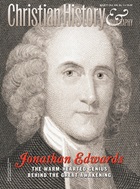









Jonathan Edwards: Christian History Interview - On His Own Terms


Great thinkers like Jonathan Edwards can be hard to approach. Many who have read him are convinced that the Northampton divine has much to offer the church today. But he seems to float somewhere above us—severe, austere, out of reach. What a shame! He is surely one whose teachings transcend his own time.
There's no denying that, unlike John Wesley, his colleague in the transatlantic awakening, Edwards can seem distant and forbidding. But some of this is a factor not of who he was, but of the distance between our world and his. We see him through a glass darkly.
In search of the "real Edwards," CH spoke with George Marsden, whose biography, Jonathan Edwards: A Life, is being published in 2003 by Yale University Press. Marsden helped us see beyond our misconceptions to the precious legacy of this imposing man.
Was Edwards a "cold fish"? He refused to do regular pastoral visitation, he seemed more comfortable with his books than his people, and eventually he pushed his ideals on his congregation so hard that they tossed him out.
There is some basis for the stereotype. Edwards was a serious person, particularly serious about matters of salvation. When he wrote letters to his children, almost invariably the first thing he said was, "You are away from home, and it is possible you might die, and we hope that you will care for your eternal soul—that would give us great joy," or words to that effect. There's not a lot of chit-chat about family news.
When his son, Jonathan Edwards Jr., was 10 years old and away on a missionary trip to learn Indian languages, Edwards wrote him a letter. The week before, the elder Edwards had fallen off a horse and been badly injured. But in this letter, he never mentions that to his son. You would think he'd mention it as an example to say, "be careful," or as a good story, but he limits his letter to salvation and serious matters. That is characteristic.
On the other hand, he apparently could relate well to people who were close to him. He had 10 sisters and 11 children, and they all seemed very affectionate toward him. Also, relations of the heart were at the center of Edwards's theology. The heart was more important than the intellect in his personal relationships and his relationship with God. His whole theology was built around the love of God and the ways we should be reflecting that love.
So along with that seriousness, there is a lot of warmth and genuine concern for others. Edwards is thought of as a stern, cold minister, but in fact, he had his entire congregation and the entire town of Northampton completely "under his spell." Though this relationship did eventually go awry, the intensity of the breakup mirrors the intensity of their earlier affections.
Socially, he seems an elitist, someone who might even have been out of step in his own, increasingly egalitarian age.
Think of him as a creature of the world of British hierarchical relationships—think (even though they were later) of the novels of Jane Austen. Whereas today we tend to see structures of patriarchal privilege as demeaning, people of the eighteenth century tended to see social hierarchy and the deference that went with it as good things. These relationships held society together.
There was no question where Edwards stood in that social hierarchy: He played the role of an aristocrat—part of an important family of ministers and magistrates. The most significant of these was his uncle and chief patron, John Stoddard. He ran much of the government of Western Massachusetts and was chief judge and a military leader as well. Edwards was related to a whole network of people like that.
Now, it is true that there was some chafing under that hierarchical system. So Edwards was coming into conflict, in the 1740s, with those who wanted to see change. But he did sometimes break the old molds. Like his father, Timothy, he worked against some of the prerogatives that men had and women did not. He encouraged his sisters, wife, and daughters to pursue education—though this did not include college, since women did not go to college in his day.
On the other hand, like most in his age, he had a blind spot toward slavery. Though affirming a kind of spiritual equality by welcoming slaves into his congregation, he himself held slaves and saw no need to set them free. In the decades after Edwards's death, though, during the era of the American Revolution, Edwards's closest disciple, Samuel Hopkins, became an anti-slavery leader.
If we can get past some of these things, how should we understand the legacy of Edwards? Do we see his fingerprints on American religion today?
He was the first person to publicize revival on a large scale, and he became part of the wider movement that, during his lifetime, birthed what we now know as evangelicalism. His was not an itinerant or mass-meeting revivalism, however, but a local, church-based one.
His legacy can be most clearly seen in the many churches today that still have ongoing and renewing "revivals." He was also the great theoretician of revivals; he analyzed them, seeking to distinguish between legitimate and illegitimate revivals. Revivalists ever since have referred back to that work.
His fingerprints are also seen in American education. Most of the important colleges and even state universities founded in America in the first half of the nineteenth century were founded by New Englanders seeking both to educate and to evangelize the nation. They moved into the Midwest, taking ideals of education with them inspired directly by Timothy Dwight, Edwards's grandson and president of Yale. Many of these college founders looked to Edwards himself as one of their inspirations.
Many of those same people pursued a related program of national social reform, founded on Samuel Hopkins's notion of "disinterested benevolence"—a reworking of an Edwards idea. Their efforts profoundly shaped the nation.
What can we learn today from Edwards about religious experience?
Edwards spent his whole life working on the question of discerning which religious experiences were valid and which were not. At first, he defended most of the extravagant manifestations of revivals, the physical things, on grounds that they don't prove anything one way or another.
But by the time he wrote Religious Affections, he was more cautious. The signs of true affections he offers in that book are all about how your experiences play out in the quality of your Christian life—in attitudes, fruit of the spirit, love, joy, peace, and so forth. He argues that people are missing the point if they say that there is some sort of physical manifestation that is characteristic of true Christianity.
He still wants to say that there's nothing intrinsically wrong with such manifestations. But his principle is that every revival will be imitated by Satan—that's why it's hard to tell whether revival experiences are really benefiting those involved. The long-run test was the qualitative change in your life, not the joy bells ringing for a while.
What about Edwards's theology? What does it offer today?
First, Edwards's theology was God-centered. That seems obvious, but the Enlightenment was pushing God to the borders of the universe and inflating the human self. In Edwards's time and ever since, Enlightenment-influenced theologies have started with humans, built a system of morality that suits us, then tried to tailor God to fit our morality.
Edwards, on the other hand, insists on starting with God, as He is portrayed in Scripture. Whatever is true virtue, he says, must be first a virtue that is related to the loving God who stands at the center of reality.
What did "Edwards the scientist" do with the Newtonian universe, with its distant God and its mechanical processes?
For Edwards, the universe itself is the language of God, declaring His glory. It is not identical to God, but it is the medium through which He speaks. So Edwards saw types of Christ not only throughout Scripture, but also through nature (see pp. 40-41). If you are given the eyes or ears to do so, you can see and hear the beauty of God in all reality.
Edwards didn't buy the clockwork universe and absent clockmaker god of the deists. He said that in a dynamic, Newtonian universe, the most basic, important relationships are personal ones, not mechanical ones. Everything is in relationship with God and is upheld by his love.
Copyright © 2003 by the author or Christianity Today/Christian History magazine.
Click here for reprint information on Christian History.

Support Our Work
Subscribe to CT for less than $4.25/month