Bishop Before His Time
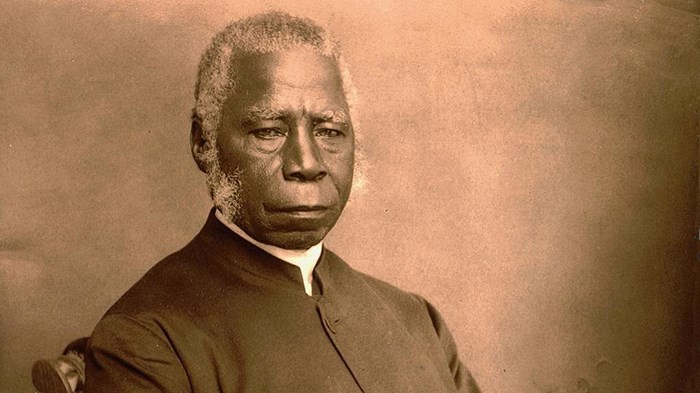


"And he never saw his family again."
For the millions of Africans taken as slaves between the sixteenth and nineteenth centuries, this sad statement is their story. But not so with Ajayi. In 1821, the 13-year-old member of the Yoruba tribe, from what is now western Nigeria, was eating breakfast when word came that Muslim slave raiders from another tribe were attacking his town.
"The most sorrowful scene imaginable was to be witnessed," Ajayi would later recall. "Women, some with three, four, and six children clinging to their arms, with the infants on their backs, running as fast as they could through prickly shrubs. … While trying to disentangle themselves from the ropy shrubs, they were overtaken and caught by the enemies, by a rope noose thrown over the neck of every individual, to be led in the manner of goats tied together."
Many families were separated this way, Ajayi wrote. But he, his mother, two sisters, and other family members ended up roped together. (He never again saw his father, who survived the raid but later died in a similar battle.)
But as Ajayi was bought and sold six separate times, he did become separated from his family. Despondent and suicidal, he was placed (with about 190 other captives) on a Portuguese slave ship near Lagos, bound for the transatlantic market.
The slavers, however, did not control the seas. Great Britain, which had abolished the slave trade the year Ajayi was born, was now feverishly atoning for its national sin through international abolitionist activities, including steaming its navy along the African coast. The Portuguese slave ship, the Esperanza Felix, hadn't even traveled a day when the Myrmidon and Iphigenia began their attack.
More than half of the slaves died in the attack, but Ajayi survived, even encountering his Portuguese owner bound in fetters aboard the British ship. "[I] had the boldness to strike him on the head while he was standing by his son," Ajayi later wrote. "An act, however, very wicked and unkind in its nature."
British policy sent Ajayi not back to Nigeria, but to Sierra Leone (the capital, Freetown, is pictured at left), where abolitionists and missionaries had set up an evangelistic community—a light for the "dark continent."
Eventually, Ajayi would not only return to Nigeria, but he would find his mother and other family members there. "We could not say much, but sat still, casting many an affectionate look towards each other, an affection which 25 years had not extinguished," he said.
In the intervening time, Ajayi had been ordained as an Anglican priest and missionary to his native land. His mother was one of the first converts he baptized. She took the Christian name Hannah, because of its biblical significance. It is the name of the mother of the prophet Samuel—and by then Ajayi was already becoming widely known in English missionary circles under his new name: Samuel Ajayi Crowther. As Anglicanism's first African bishop, Crowther would become the most famous African Christian of the century. But his struggles in that position—and the reasons behind them—are still debated today.
"White man's graveyard"
"About the third year of my liberation from the slavery of man, I was convinced of another worse state of slavery, namely, that of sin and Satan," Crowther wrote. "I was admitted into the visible Church of Christ here on earth as a soldier to fight manfully under his banner against spiritual enemies."
The church embraced him quickly, and he soon became a model for what the missionaries had hoped for African converts. After a few years of schooling in the colony, he went to London, then returned to Sierra Leone to become one of the first four graduating students of Fourah Bay College, sub-Saharan Africa's first university. He soon developed a reputation for linguistic skills and was recruited by the Church Missionary Society to work on the Niger Expedition of 1841.
This was only one year after David Livingstone had first left Scotland as a missionary to southern Africa, and if British Christians thought about Africa at all, it was usually as the White Man's Graveyard. Nevertheless, the idea that drove Livingstone—Thomas Fowell Buxton's belief that "Christianity, Commerce, and Civilization" in Africa could end slavery for all—was also behind the Niger Expedition. Crowther, along with a missionary of German descent named J. F. Schön, was to implement the Christianity part of the triad.
Two months into the journey, the chief medical officer wrote, "Fever of a most malignant character broke out on the Albert, and almost immediately on the other vessels, and abated not until the whole expedition was paralyzed."
Discovery of the malaria parasite was still more than half a century away—Europeans knew nothing about how to protect themselves against it, thinking it was caused by "bad air" (thus the name of the disease). But they knew it could be deadly, as indeed it was to the Niger contingent.
One ship was loaded with the ill and sent back. Within two days there were enough casualties to send another. Eventually, all but 15 of the 145 Europeans on the Niger Expedition contracted malaria, and 40 died.
The mission is usually remembered as "ill-fated." But Schön and Crowther survived—and Crowther's reputation thrived. Not only was his work the most thorough of any on the journey, but he was an African, and thus deemed more fit for African travel. Schön urged the CMS to make Africans like Crowther a key part of evangelism on the continent.
A colleague in Sierra Leone agreed: "There is no one more fit to be entrusted with the ministry of the gospel, among his own brethren, than Samuel Crowther. However rarely the solid knowledge of Samuel Crowther is found among his brethren, it is so far more rarely combined with such modesty as his."
The CMS head at the time, Henry Venn, needed little convincing. He believed overseas churches should be "self-supporting, self-governing, and self-extending," and therefore wanted African priests and bishops to oversee the African churches. Crowther was an ideal candidate.
Crowther was summoned back to England and made a priest on Trinity Sunday, 1843. Then he returned to Sierra Leone and began preaching in both English and a language on which he had begun to write linguistic texts—his own native Yoruba.
This was probably the first time that an African language had been used in liturgy. It was certainly the first time the Yoruba had heard the gospel in their own tongue—something that Crowther himself found overwhelming.
"Although it was my own native language, with which I am well acquainted, yet on this occasion it appeared as if I were a babe, just learning to utter my mother-tongue," he wrote. "The work in which I was engaged, the place where I stood, and the congregation before me, were altogether so new and strange, that the whole proceeding seemed to myself like a dream. … At the conclusion of the blessing, the whole church rang with ke oh sheh—so be it, so let it be!"
Shortly after his arrival, Crowther was sent to Abeokuta, Yorubaland (western Nigeria) with a German missionary named C. A. Gollmer, several Yoruba Christians from the Sierra Leone mission, and English missionary Henry Townsend—who would go down in history less for his mission work (he was reportedly an excellent linguist, devoted to Abeokuta) than for his opposition to Crowther.
Crowther's team was greeted warmly, and each morning, between 100 and 200 of the town's 50,000 people listened to him preach in Yoruba under a tree between two markets. Crowther's mother, with whom he reunited during this time, was not his only convert.
Some historians suggest that the response was so positive because a local pagan oracle urged the town to be hospitable to the missionaries. Other forces were at work, too. When the missionaries organized British military reinforcements to help Abeokuta repel an invading army of some 10,000 to 15,000 men (and women!), it was hardly a surprise that other local chiefs asked for their own holy men with such friends. Buxton's plan seemed to work in Abeokuta, as the town left the slave economy for the cotton trade.
The patient quarry worker
"Crowther was no mere romantic, bowing to native custom and practice," says Yale University historian Lamin Sanneh (himself a Nigerian convert from Islam to Christianity). "[He] would not denounce or applaud indigenous institutions or native authorities merely for their being African."
Nevertheless, while Crowther confronted representatives of Islam and the old religions of Africa, he treated these groups less harshly than did many of his white counterparts. Some of the latter, for example, criticized Crowther for not being stricter against polygamy—or against alleged lapses by his own African assistants.
To everything there is a season, Crowther replied. "Rough quarry men … hew out blocks of marble from the quarries, which are conveyed to the workshop to be shaped and finished into perfect figures by the hands of the skillful artists. In like manner native teachers can do, having the facility of the language in their favor, to induce their heathen countrymen to come within reach of the means of Grace and hear the word of God."
"What is lacking in good training and sound evangelical teaching," he said, could be provided by others.
But Crowther was not, as some critics claimed, soft on sin. In later years, when taken hostage by a local chief who demanded 200 slaves for his release, the former slave said he would rather die than see one more African taken captive into slavery, "a great abomination in the sight of God."
Black bishop
In 1854, a new Niger Expedition was planned, and again the CMS enlisted Crowther for the task. This time, the team met with success and no loss of life. Venn then sent Crowther on a third mission up the Niger River. A shipwreck that left him stranded turned out to be a blessing, as the African priest began work with the Nupe and Hausa peoples. As Crowther's work began to reap converts, Venn's dream of an African church planted and maintained by Africans began to take form. It only needed one thing.
An African bishop.
"Can one among the African clergymen be found to whom so great a responsibility can with safety be trusted?" asked the Church Missionary Intelligencer in May 1864. "This question the Church Missionary Society has ventured to answer in the affirmative. Nearly 21 years have elapsed since the Rev. Samuel Crowther was ordained a deacon. … He has made full proof of his ministry. The new missions on the Niger imperatively require episcopal superintendence.
… To delay any longer the native episcopate would be unduly to retard the development of the native church."
Not everyone agreed. Chief among the opponents of such a move was Crowther's missionary colleague, Henry Townsend. "The superiority of the white over the black man, the Negro has been forward to acknowledge," he said. "The correctness of this belief no white man can deny."
The only reason that Africans accepted Crowther's authority, Townsend argued, was because he answered to a white man. Better, he said, to keep blacks as schoolmasters and catechists. "There is one other view that we must not lose sight of, vis., that as the Negro feels a great respect for a white man, that God kindly gives a great talent to the white man in trust to be used for the Negro's good. Shall we shift the responsibility? Can we do it without sin?"
Townsend's views were not shared by everyone in the missions community. The CMS Parent Committee, for example, warned him that such sentiments were not fit for a missionary. "Townsend's only advantage, and a critical one at that, was his racial views being shared by all the white missionaries [on the Niger mission] … as the CMS found out when it asked directly which of them would be willing to serve under Crowther," writes Sanneh. "It was a disconcerting discovery."
But Venn would not be dissuaded. He brought Crowther back to London and said he was recommending his consecration as bishop. The priest initially refused, but he was apparently persuaded by the advice of Schön and by Venn's own pained rebuke, "My son Samuel Ajayi, will you deny me my last wish before I die?" (He had another nine years of life left at the time.)
And so, in a June 29, 1864, ceremony that filled Canterbury Cathedral beyond capacity, Crowther became the first African bishop in the Church of England.
But bishop of what? On one hand, his see was impossibly large, sometimes defined as "the countries of Western Africa beyond the limits of the Queen's dominions" or "from the Equator to Senegal." On the other hand, he wasn't granted control over the major outposts such as Lagos and Abeokuta, since the CMS apparently feared angering his missionary critics.
Crowther was headquartered in Lagos, spending as much as nine months of the year there—and thus away from his diocese (still more a mission diocese than Venn's vision of a self-supporting church). In addition, he was dependent upon local merchants of the West Africa Company—not always supportive of religious figures, let alone African ones—to travel up the Niger.
This was remedied in part when English supporters gave him his own steamer, appropriately named the Henry Venn, after the missionary statesman, recently deceased. Crowther planned to let an African merchant run the ship, so long as its commercial profit made its way back into the missionary work. But Venn's replacement overruled the bishop and handed the boat over to two whites. With it, he gave them authority over all Africans involved in the Niger Mission—without asking or even telling Crowther.
From there, tensions only escalated. Venn's replacement further undercut Crowther's authority by handing control of the Niger Mission's "temporalities" to a committee in 1879, following it the next year by appointing a Commission of Inquiry into allegations of misconduct by Crowther's subordinates. Chief among the charges was that the bishop's African assistants were neglecting Christianity for commerce, though other charges were more shocking. For example, a lay leader under Crowther's care was charged with beating a housemaid to death.
The Commission of Inquiry's report, says Sanneh, "was a hatchet job, highly damaging to Crowther and the mission, and libelous to the extent that it was secreted out to London without Crowther or any of his assistants seeing it."
All but three of the Niger Mission's 15 Africans were fired. When Crowther protested, he was charged with violating his code of office. He died shortly thereafter, and a white bishop was put in his place. The continent would not see another African Anglican bishop until 1952, sixty years after Crowther's death.
White missionaries like Townsend won the battle, but they lost a significant part of the war. They had their white bishop, but African Christians were so outraged by the treatment of Crowther that they rebelled. In the year after Crowther's death, several African Anglicans—including five of Crowther's Niger Mission assistants dismissed by the commission—formed the Niger Delta Pastorate, independent from the Church of England. It was not quite Venn's vision of a three-self church, but it would define much of African Christianity for the next century.
Ted Olsen is online managing editor for Christianity Today.
Copyright © 2003 by the author or Christianity Today/Christian History magazine.
Click here for reprint information on Christian History.

Support Our Work
Subscribe to CT for less than $4.25/month