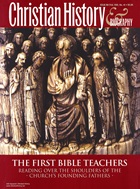
Classical Ear-Training


Blessed are the meek," Jesus taught in the Sermon on the Mount, "for they shall inherit the earth." When Chrysostom, Theodoret of Cyrrhus, and Eusebius heard Jesus speaking of meekness, they immediately thought of Moses.
Theodoret cites Numbers 12:3, a text referring to Moses "as very meek, more than all men that were on the face of the earth." Eusebius comments that "whereas Jesus promised the meek inheritance of the earth, Moses promised Israel inheritance of the land."
But no modern commentator on Matthew's Gospel links Moses with Jesus' teaching on the meek and the kingdom. Why?
The church fathers' tendency to find allusions and allegories within the broader biblical narrative can seem to many modern readers forced and fanciful. Why did they so often take a text that at first glance appears to refer to one thing —meekness, for instance—and find in it things that surprise modern interpreters?
Homer as Scripture
Think of an educational system in which the study of Homer's great works, the Iliad and the Odyssey, played a central role in forming young, impressionable Greek minds. Homer was the backbone—even the Bible—of the Greek-speaking world. Greek culture turned to Homer for guidance and insight much as Jews turned to Moses.
The church fathers were educated, for the most part, in this Greek culture. They were raised on these stories, and the way they learned to read Homer and Virgil deeply influenced the way they read Scripture.
For example, unlike modern texts, ancient texts did not have spaces between words. The result was that the text was more easily read by sounding the words than by only seeing them. So students of Homer repeatedly read him aloud, pronouncing the words carefully, thus committing the stories to memory—in every detail.
Students not only read Homer aloud, they "heard" the inner music of his accounts. As they listened, the harmonies and melodies of Homer's text, its narrative connections and allusions, were unveiled.
This immersion in the text, using three faculties (hearing, speaking, seeing) rather than one, enabled students of Homer to see and hear things in the text that modern readers often overlook. For example, the Fathers were quite adept in picking up very subtle allusions in Scripture. Think of our earlier reference to Jesus' teaching in the Sermon on the Mount. New Testament scholar Dale Allison has observed that Matthew expects his readers to recognize, almost automatically, the allusions he has planted in his text to the larger biblical narrative. Rather than being a self-enclosed text, Matthew is more like "a chapter in a book." If we are to be sensitive to Matthew's particular contributions to the gospel story, our minds must be soaked in the entire biblical narrative.
Gospel harmonics
A central difficulty for modern readers, though, is what Allison calls their "historically conditioned deafness to oblique allusions in the Bible." Because of modern Christians' reliance upon their eyes in reading, they often demonstrate an inability to hear the echoes and harmonies of Scripture and frequently doubt whether genuine allusions are present at all.
Before we conclude that the Fathers are conjuring false melodies, we might consider a modern analogy. Allison reminds us how well we remember songs we have heard on the radio.
"Those who habitually listen to music over the radio can often identify a popular song after hearing just the smallest portion of it. There are in fact contests … which require people to name a musical piece after hearing only a slight excerpt from it, one lasting no more than a second or two, and consisting of no more than two or three notes or chords. The uninitiated will discern only noise. But to those with the requisite musical knowledge (gained, be it noted, not through arduous study but through effortless listening), the briefest extract can conjure up a world: a song, an album, a musical group. Was it maybe not similar with those Jews who first heard the Gospel of Matthew?"
Or, I would add, might it not have been the same with the Greek fathers who had learned to read and memorize texts by reciting Homer out loud? Might not they hear things in the Bible to which we remain strikingly deaf?
The Fathers, our music teachers?
So, the significance of the Fathers' insights into the biblical text grows when we remember how Greek fathers learned to read Homer, or Latin fathers Virgil. Unlike modern students of the Bible, they had learned to read slowly, scrutinizing each syllable and word with their tongues and ears as well as their eyes, and they could easily transfer this way of reading to their study of the biblical text.
As Allison notes, the Fathers "still read aloud. … They still had, because of their educational methods, magnificent memorization skills. And they still heard Scripture chanted. They were accordingly attuned to hear things we no longer hear, things which we can only see after picking up concordances or doing word searches on our computers. I have come to believe that if we find in Matthew or another New Testament book an allusion to the Old Testament that the Fathers did not find, the burden of proof is on us; and if they detected an allusion which we—here I am thinking of modern commentaries—have not detected, investigation is in order."
Through their grounding in Homer and Virgil, the church fathers were attuned to tonal qualities in the biblical text that modern readers who rely solely on their eyes will rarely perceive. The Fathers see and hear where we often tend to "walk by sight" alone.
Christopher A. Hall is professor of biblical and theological studies at Eastern University, St Davids, Pennsylvania.
Copyright © 2003 by the author or Christianity Today/Christian History magazine.
Click here for reprint information on Christian History.

Support Our Work
Subscribe to CT for less than $4.25/month