



Living History


Christian Saxon king unearthed
An inspection for a road widening project in the town of Prittlewell, Essex, has yielded what British archeologists are calling the most important find in decades: an early 7th-century tomb of an apparent Anglo-Saxon king. "Two foil crosses, probably originally laid on the body or sewn to a shroud, suggest that the king had converted from paganism to Christianity," senior archaeologist Ian Blair told the press. The crosses, the first of their kind found in England (they were more popular on the continent) also may be a key to the king's identity. The skeleton has long decayed in the acidic soil, but the grave may be that of Sabert, the first Christian king of Essex. That the burial chamber also contained other goods, such as his sword and shield, copper bowls, and glass containers-not typical for Christian burials-supports the story of church historian Bede: Immediately after Sabert's death, he writes, the king's three sons "began openly to give themselves up to idolatry, which, during their father's lifetime, they had seemed somewhat to abandon, and they granted free license to their subjects to serve idols." The sons also drove out the bishop, and it wasn't until King Sigbert accepted Christianity in 653 that the faith took deeper root. Some scholars speculate that the chamber belonged to Sigbert rather than to Sabert, while most say it's too early to tell. The artifacts are now at the Museum of London.
"God's Acre"
Around the world, Moravian graveyards are known as "God's Acre." But the original Gudsageren can still be found in the East German town of Herrnhut, the home base of Moravianism's founder, Count Nicolaus Ludwig von Zinzendorf. Moravianism's precursor group, the 15th-century Unitum Fratrum, believed strongly in the equality of all Christian women and men. That leveling is reflected in the gravestones in God's Acre, which lie flat and level with the ground. "Whatever a Brother or Sister may have achieved in life, in death one could not presume to set oneself above the brethren, even those enslaved," Zinzendorf reportedly said. Only the stones of Zinzendorf and his family are raised. It is here in God's Acre that the Moravians have held their Easter Sunday sunrise services, saying "The Lord is risen" as the sun first breaks the horizon.
Icons of faith
We are so used to the word iconic that we forget how forceful the stylization of actual icons can be," said a New York Times editorial about "Byzantium: Faith and Power (1261-1557)," a major exhibit at New York's Metropolitan Museum of Art. The exhibit runs through July 4, 2004 and has a massive companion volume. Some of the 350 pieces of Byzantine art from 30 countries have never been seen outside the churches and monasteries that normally house them. But in his address opening the exhibit, Patriarch Bartholomew said it's the faith that created the art, not the art itself, that viewers should behold. "May the works in this exhibit lead us to the right path of true faith from which true spiritual power derives," he said. "This spiritual power, in turn, is the creative power behind these works of art. Most importantly, it is the creative power behind works of life that are less glamorous, but nevertheless are works that produce love for one another, joy and hope in life."
Rare songs and sermons released
The most critically acclaimed box set of music in the last year may not be that of Johnny Cash, or George Harrison, or Peter, Paul, & Mary-or even come from an actual record label. Goodbye, Babylon, the only offering from Dust-to-Digital Records, is a six-CD set of 135 early 20th-century gospel music recordings and 25 sermon excerpts, some as old as the Dinwiddie Coloured Quartet's 1902 "Down on the Old Camp Ground." While collections of old blues from the days of 78 RPM records are ubiquitous these days, never before has the sound of old gospel-both white and black-been compiled so extensively. Goodbye, Babylon includes such familiar names as Blind Willie McTell, Mahalia Jackson, the Carter Family, Thomas A. Dorsey, and Hank Williams. Others, from Pentecostal, Baptist, and other backgrounds, aren't known outside these recordings. Having already sold out of several printings after top reviews in Rolling Stone, Entertainment Weekly, and other publications, producer Lance Ledbetter says he's planning a sequel. "We fit as much music on six discs as we possibly could, but there's a lot more I wanted to get on there," he told The Washington Post. "Stuff like 'Sermon on a Silver Dollar,' and 'Something's Wrong With the Bible'; there just wasn't enough room." Such sermons, he noted, are the foundation of modern rap music.
Fire on Mount Athos
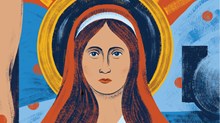
It was a bad March for the monks of Mount Athos, in northern Greece. About half of the 12th-century Chilandari (also known as Helandari or Helandariou) Monastery, home to two dozen Serb monks, was destroyed when fire broke out in the abbot's quarters and spread to the rest of the compound over the following 12 hours. Frescoes from the 16th and 18th centuries were lost, and only the exterior walls remain. But the monks were able to save their lives, along with the monastery's most valuable books, manuscripts, relics, and icons. "The catastrophe is unfathomable," said a monk from a nearby monastery (Mount Athos has 20). "It was horrible; we wrested everything we could from … the flames. May God help the brotherhood." Tradition has it that another fire centuries ago engulfed much of the rest of the mountain but miraculously ceased when monks revealed its famous 12th-century icon of Mary, in which she has three hands. The nearby Church of Protaton, central church for all of the mountain's monasteries, was similarly blessed as another blaze broke out there three weeks after the Chilandari fire. Though that fire burned for three hours, firefighters were able to extinguish it before it did more than damage a bell tower.
Did Jesus heal the lepers?
As many Bible notes explain, the Greek word lepra and the Hebrew word shara aren't restricted to leprosy. They can also refer to other skin ailments, like psoriasis. In fact, some historians have doubted that leprosy, now known as Hansen's disease, even existed in Jesus' world. Not any more: Israeli archaeologist Shimon Gibson has uncovered the remains of a first-century victim of the disease-the earliest known case in the Middle East. Church fathers saw Jesus' healings of leprosy as both evidence of his divinity (in his ability to heal) and his humanity (in stretching out his hand to heal). They also decried the stigmas associated with the disease. Jesus touched the leper, said Origen, "that he might teach us that we should despise no one, or abhor them, or regard them as pitiable, because of some wound on their body." But the shame associated with Hansen's disease continued for centuries. The Council of Ancyra in 314 suggested that the disease was transmitted through bestiality, and both church and state enacted laws to isolate lepers from everyone else. They were forbidden to marry and were symbolically declared dead and buried by the church. One 13th-century chronicler estimated that about 19,000 leper houses were active in Europe in his day. The radical means of isolation may indeed have limited infection, but many today suggest that the special stigmas added to the disease wreaked a kind of spiritual death.
Along the Waldensian trail
This summer pilgrims from all over the world will travel the "Waldensian trail" through the picturesque hilltop villages of Provence. The Waldensians were followers of Pierre Valdo of Lyon (ca. 1140-1217). Protestant three centuries before Luther, they scorned transubstantiation, refused to accept the exclusive right of priests to interpret the Bible and administer Holy Communion, and would not venerate saints or accept the practice of selling indulgences. Condemned as heretics and persecuted by the Inquisition, thousands of Waldensians fled to the isolated Lubéron mountains of Provence. In 1545, a Papal army led by the Baron of Oppède marched against them in a bloody crusade that killed at least 2,700 and sent 600 in chains to man the galleys in Marseille. Many French villages, now stops on the "Waldensian trail," were burned to the ground. Waldensians still exist, and Valdo lives on in placenames such as Valdese, North Carolina, and Colonia Valdese in Uruguay. Many American pilgrims visit a museum in Mérindol, the Waldensian "capital" in Provence, to trace their Waldensian roots. The Association of Waldensian Studies runs a website at www.route vaudoisluberon.com.
Copyright © 2004 by the author or Christianity Today/Christian History & Biography magazine.Click here for reprint information on Christian History & Biography.

Support Our Work
Subscribe to CT for less than $4.25/month