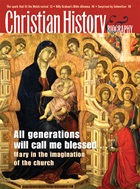
Temple & Sword
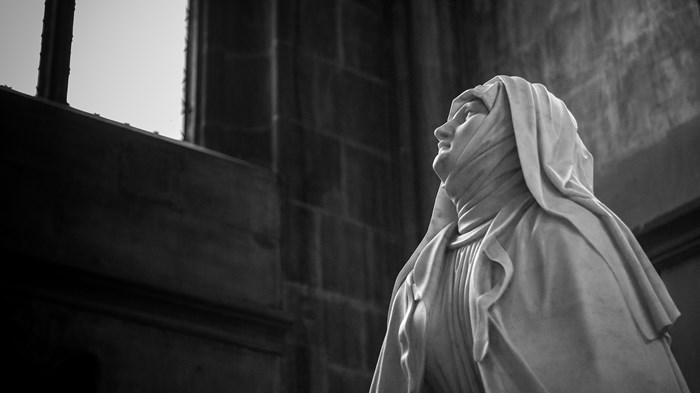


Luke's elegant two-volume literary work, the Gospel and the Acts of the Apostles, is shaped, plot-wise, like a 45 degree angle. At the vertex, the point of departure, is a Jewish girl of a Jewish family, keeping the feasts, expecting the consolation of Israel. She lives within pilgrimage distance of Jerusalem, not obligated like the men to attend the thrice-yearly observances in the holy city, yet pious and devoted to the God who brought her ancestors out of Egypt. Their collective story long antedates the occupying Romans, who are but another checkmark on a long list of oppressors—at this point, anyway, no worse than Philistines or Assyrians or Babylonians.
The temple of the Jews dates back 1,000 years (as the center of righteous worship, if not the building itself), and it is this temple that marks the distance along Luke's angle-shaped story, as the one axis veers further and further from the other. By the end of the historian's tale, the temple, soon to be obliterated, has been left behind by persecuted Christians who are driven away from the center of Israel's faith in order to convert the nations. The angle opens wide into an embrace that must, of necessity, include all the Gentiles. But trace its lines back, back before the expulsion, before the trial of the Messiah, the cleansing and the controversies, and you find the young Mary with her husband Joseph, presenting the child Jesus, just as Zechariah prophesied in that same Temple months before.
A temple-dwelling girl
In the popular imagination of the church, this is not Mary's first visit to the temple. Apocryphal though they are, the 2nd-century Greek Protevangelium of James and its 8th-century Latin copycat the Gospel of Pseudo-Matthew fill in details of Mary's early life that all the canonical documents pass over in silence. In these colorful tales, Mary's parents Anne and Joachim suffer the typical childlessness of an Old Testament couple. When they are at last granted a daughter, they gratefully dedicate her to the Lord's service. The festival of her presentation in the temple was brought to the Western church from the East in 1372 and is still celebrated on November 21st. The three-year-old heroine dances at her presentation and then moves in. Actually, this is historically unthinkable, though Jewish propriety once more gains the upper hand when, at the age of 12, Mary is moved out again lest her womanly issue contaminate the holy precinct's purity.
Meanwhile, during her residence, the Protevangelium reports that Mary is fed by an angel, spins thread, and weaves scarlet and purple cloth for the temple veil, the same veil that will be torn in two when her son dies. Pseudo-Matthew contributes the fresh detail of her weaving the seamless tunic that Jesus wore, first fitted for childhood and then magically growing along with the young Savior's body. Just as Mary clothed Jesus in flesh in her womb, so she clothed him in garments of lesser metaphysical import. As a result, iconography occasionally depicts Mary with spindle in hand. Even the floating balloons of gossamer that transport newly hatched spiders are called in French fils de la Vierge—the threads of the Virgin (which includes a nice pun, since fils also means "son").
Bringing the burning ember
But back to the canon. At the time of Mary's son's presentation, the family of three assembled, most likely, at the gate of Nicanor, on the eastern side of the Court of Women. There the wives of Israel came for their ritual purification after childbirth, at the limit of the temple grounds extended to women. Mary's devotion is evident, in good Jewish fashion, according to her keeping of the law: "And when the days of her purifying are completed, whether for a son or for a daughter, she shall bring to the priest … a burnt offering and … a sin offering, and he shall offer it before the Lord and make atonement for her. Then she shall be clean from the flow of her blood" (Leviticus 12:6-7). The offering, "a pair of turtledoves, or two young pigeons," betrays her poverty, for she cannot afford a year-old lamb.
Certainly Mary knows already that her son is set apart for the Lord, conceived in her virginity and birthed to a choir of angels. But even according to the law, without the celestial fanfare, her son is deemed holy, spared from the hand of death as a contrast to Pharaoh's eldest. Thus spake the Lord: "Consecrate to me all the firstborn. Whatever is the first to open the womb among the people of Israel, both of man and of beast, is mine" (Exodus 13:2; cf. vv. 12, 15). Out of the nine times in the whole gospel that Luke uses the expression "the law of the Lord" or the "law of Moses," five of them appear in this report of Jesus' presentation and early childhood. The message cannot be mistaken: Jesus is a Jew and the son of Jews. His prophetic career begins where it ought, in the Temple, in his mother's arms, dedicated to the service of the Lord. In Orthodox churches, this is expressed by the image of Mary's arms as a pair of tongs, handing the holy burning coal over to the prophet, as in Isaiah's vision. As Joseph the Hymnographer wrote, "Thou camest to the temple like mystical tongs, bearing the mystical Ember, O all-pure one." Here, as of yet, there is only the obedience and faith of the covenant, no controversy.
The seven maternal sorrows Of course, there is a hint of what is to come. Joyful Simeon blesses the Lord that at last he may depart in peace, but he warns the parents that no such peace awaits them and their compatriots. This child is destined for the rise and fall of many in Israel, a "disputed" sign, hard to explain, impossible to ignore, exposing many secret thoughts. The faith of the mother does not grant her immunity from the trial ahead. A sword will pierce your soul also, your very life, the prophet warns her.
"Dear Mary, you have borne a Son. The world, the flesh, and the devil will be against him," paraphrases Luther, adding his own remark, "What a congratulation this was to offer a mother of six weeks!"
The evocative power of this one verse (2:35) eventually led to the piety of Our Lady of Sorrows. From the end of the 11th century through the 14th, the cult of the mater dolorosa flourished in Italy, England, France, Spain, and the Netherlands. In time, Pope Paul V (1605-1621) fixed the number of the Virgin's sorrows at seven—they had previously ranged in number from 5 to 15-the first of which was Simeon's prophecy.
The iconography, suitably, shows the virgin mother with seven swords embedded in her heart. The same sacrifice of her son, presiding over his presentation in the temple, has also led to the image of Mary as a priest.
She not only presents a pleasing offering to the Lord in dedicating her son to his service, but makes God present in creaturely matter within her womb, much like the priest making the divine body and blood out of the eucharistic bread and wine.
In Luke's telling, the sword piercing Mary's soul arrives far sooner than the crucifixion—in fact, there is no mention of Jesus' mother at the foot of the cross in the third gospel at all. It occurs in the very next scene, the single account of Jesus' boyhood in the New Testament. If the presentation foreshadows Jesus' sacrifice on the cross, his loss and re-discovery in the temple mirrors the resurrection.
It is Passover—the boy will not return to Jerusalem until his final Passover as a grown man—and after the feast, the child is lost and sought for three days. Mary scolds him for his disappearance, complaining of how they have been seeking him all this time. Jesus responds that she should have known where to find him, just as the angel chides the women at the tomb for seeking the living among the dead. In Luke's parlance, being found is the same as being saved from death: the father says that his prodigal son "was dead, and is alive; he was lost, and is found."
Already Mary must learn that the salvation to be brought by her son means a loss to herself. The 2nd-century apocryphal infancy gospel of Thomas interpolates into this story (after a long and disturbing series of episodes in which a malicious little Jesus kills off anyone who so much as bumps into him on the road) praise to Mary from the temple rabbis: "You more than any woman are to be congratulated, for God has blessed the fruit of your womb! For we've never seen nor heard such glory and such virtue and wisdom." But these teachers who are now amazed by his wise answers will someday turn on him.
It is no light burden to be the mother of the Messiah. The cross casts its shadow on the infant's earliest days, and so inevitably on his mother as well. Even the temple, the dwelling place of the Most High God, is no refuge. Although the angel called Mary "full of grace," she is truly a lady of sorrows as well.
Sarah Hinlicky Wilson is a doctoral student in systematic theology at Princeton Theological Seminary.
What is the rosary and how does it work?
This early Marian practice is really more about Jesus than about his mother:
The old story goes like this: during the fight against the Albigensian heresy in Toulouse, St. Dominic (1171-1221) saw an apparition of Mary while praying. Mary told him to meditate on the life, death, and glory of her Son, which would remedy the evils he lamented. Dominic did so, eventually formalizing the prayer as the rosary.
Most historians believe, however, that the rosary was actually developed in the 11th and 12th centuries. As the medieval church dwelt more on the events of Jesus' life and death, they elaborated prayers on these events.
But devices similar to the rosary date back to' the 2nd and 3rd century, when the desert monks used first stones, and eventually beads on a string, to count their prayers.
How it's done
Since the second Vatican council in the early 1960s, the rosary's popularity has dipped significantly, and many Catholics under age 50 rarely if ever use it in prayer. Some don't even know how it's done. Books like Alice Camille's The Rosary (Acta, 2003) and Scott Hahn's Hail, Holy Queen (Doubleday, 2001) offer easy-to-follow instructions, and Catholics eager to learn more about their heritage are turning them into best-sellers.
The rosary is essentially a group of guided meditations, called "Mysteries," on the lives of Christ and his mother. The mysteries come in four categories: joyful (Annunciation, Visitation, Nativity, Presentation, and finding in the Temple), luminous (baptism, miracle at Cana, proclamation of the Kingdom, transfiguration, and Eucharist), sorrowful (agony in the garden, scourging at the pillar, crowning with thorns, carrying of the cross, and Crucifixion); and glorious (Resurrection, Ascension, descent of the Holy Spirit, assumption of Mary, and crowning of Mary). Eighteen of the twenty mysteries are about Jesus and are based on the Gospels or the book of Acts. Five—the "luminous"—were added in 2002 by Pope John Paul II.
To pray the rosary, the worshiper first makes the sign of the cross; then, while holding the crucifix at one end of the rosary, she recites the Apostles' Creed. From then on, whenever she encounters a large bead, she prays the Lord's Prayer. Small beads signify the Hail Mary, woven from the words of Gabriel and Elizabeth: "Hail Mary, full of grace, the Lord is with you. Blessed are you among women, and blessed is the fruit of your womb, Jesus," with the latter addition: "Holy Mary, Mother of God, pray for us sinners now and at the hour of death." The space following a small bead stands for the doxology: "Glory to the Father, and to the Son, and to the Holy Spirit, as it was in the beginning, is now, and will be forever." That is the basic form, though many Catholics add favorite prayers.
A Christ-centered practice
What do the mysteries have to do with the Hail Marys? The pray-er thinks about the biblical scenes while saying the prayers. A rosary includes five decades, or sets of ten small beads, each preceded by a large bead and followed by a space. After saying the Lord's Prayer at the beginning of each decade, the pray-er announces the mystery for meditation. Then, while repeating ten Hail Marys, she focuses her attention on one of the 20 scenes, moving on to the next mystery when she comes to the next decade. By the time she completes the circle, she will have meditated on five episodes in Jesus' life. Catholics are encouraged to meditate on one set of mysteries each day-the joyful mysteries on Mondays and Saturdays, the sorrowful mysteries on Tuesdays and Fridays, the glorious mysteries on Wednesdays and Sundays, and the luminous mysteries on Thursdays.
Catholics maintain that authentic devotion to Mary is praise of her Son. The rosary helps believers focus on the life of Christ with the help of his mother and her perspective. When we pray the rosary, writes Catholic educator Alice Camille, "we seek the engagement of thought, imagination, emotion and desire in order to move from the state of simple reflection to union with Christ. Since Mary was the first person to experience that union, who can more perfectly show us the way?"
—the editors
Copyright © 2004 by the author or Christianity Today/Christian History & Biography magazine.
Click here for reprint information on Christian History & Biography.

Support Our Work
Subscribe to CT for less than $4.25/month