Recovering a Protestant Mary


Timothy George is dean of Beeson Divinity School, an interdenominational, evangelical theological school within a Baptist university (Samford University, Birmingham, Alabama), and an executive editor of Christianity Today. He is author of the article "The Blessed Evangelical Mary" in the December 2003 issue of Christianity Today, which is a short version of a chapter from Mary: Mother of God, edited by Carl E. Braaten (Eerdmans, 2004).
In your article, you suggest that Protestant believers have cut themselves off too hastily from Mary, a biblical figure who was at the forefront of the church's imagination from the post-apostolic period through the Reformation and beyond. Could you say a little about this?
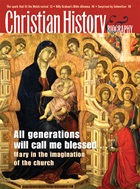
I take my bearings from the Reformers. On the one hand, they were very critical of what they considered Marian excesses, and they talked at length about some of the ways in which Mary was given too much veneration, too much almost idolatrous worship, substituting her for Christ himself in some ways at the popular devotional level. On the other hand, they themselves had a very explicit devotion to Mary, especially Luther but also Zwingli and Calvin in their own way. They wanted to give honor to Mary. They wanted to remind the church that she was to be called blessed in every generation. They honored her as the vehicle of God's grace in giving Jesus to the world and an example of justification by faith alone, because she believed so purely in the gospel. I think we need to go back and reclaim something of the Reformers' more positive view of Mary, insofar as it really is biblical. It really is a part of our own Protestant heritage.
How did Martin Luther's regard for Mary manifest itself in particular beliefs or practices?
Luther continued to celebrate three of the great Marian festivals-Purification, Annunciation, and Visitation. He also continued to use the Ave Maria prayer; that is, the first part of it: "Hail Mary, full of grace, blessed are you among women, and blessed is the fruit of thy womb." The latter part, "Pray for us sinners in the hour of our death," actually came later, added by the Carthusians after the Reformation. All the Reformers, even the relatively radical Zwingli, continued to say the first part of the Ave Maria. Of course, they did not say it as a prayer to Mary—they made that very clear—but as an acknowledgement of the fact that God's grace was so manifest in the virginal conception and her giving birth to Jesus.
Also, Mary is prominent in some of the hymns that come from the Lutheran Reformation. And if you take it to the next century, obviously this continued with, for example, Bach's Magnificat and so forth surrounding both the Advent of Christ and also Mary at the cross. So in worship, in liturgy, in theology, despite the Reformers' critique, Mary continued to have a prominent place for early Protestants—I think an appropriately prominent place.
Sometimes there would also be religious plays. This is the one part of the Marian devotion that we still practice, in a way, with the Christmas pageant. That is really a remnant of medieval Marian devotion: it enters the Christian tradition with St. Francis's devotion to the crèche (pp. 22, 24). So today, even we good old-fashioned Southern Baptists always have a Christmas pageant: one of the young ladies dresses up like Mary; sometimes she carries a live baby. This is a good thing, to keep this part of the tradition. But sometimes that's the only acknowledgement that we have, and even that is often done without serious reflection on the meaning of the Incarnation, which is what Advent and Christmas are all about.
If the Christmas pageant is not enough, how else can Protestants re-connect, without buying into some of the non-canonical doctrines?
I think a good place to start—perhaps the best place for today's Christians—is with Mary under the cross. Many people over the past year have started here, as they have viewed Mel Gibson's powerful movie, The Passion of the Christ. Here we see the events of the passion through the mater dolorosa, the weeping Mary, witnessing her son's death, cradling his corpse. This Mary stands in solidarity with all believers who also live under the shadow of the Cross, including many whose lives are at risk today because of their witness for Christ.
This Mary was the one disciple of Jesus who didn't flee when all the other disciples fled, but who stayed and accepted the burden of being under the cross to the very end. When we suffer or are persecuted, we can look to this Mary who remained faithful and obedient even in that grim moment. That's the Mary that you see in the famous Gruenewald painting, for example.
But Mary at the cross is important even for those of us not under persecution. Wendell Berry puts it well in his poem "The Way of Pain": "Unless we grieve like Mary / at His grave, giving Him up / as lost, no Easter morning comes."
Is this a sense in which the traditional view of Mary as a forerunner and symbol of the whole church is on the right track?
Yes, Eastern iconographers have it right: they never depict Mary alone, but always with Christ, the apostles, and the saints. The New Testament portrays her as bridging the Old and New Testaments at Jesus' birth, and then at the end of Jesus' life, Mary is both among the last at the cross, and among the first in the Upper Room, for the birth of the church at Pentecost.
And it has not been just the Eastern Orthodox or the early and medieval fathers who have seen Mary as a representative par excellence of the church. The Reformers noticed that when all of the disciples had fled in fear, Mary remained true to Christ and his word. Her fidelity unto the Cross showed that the true faith could be preserved in one individual. And the Reformers honored her for this, considering her the mother of the (true remnant) church.
What other traditional moments or characterizations of Mary can be helpful for us today as Protestants?
There are two statements that Mary makes in the Gospels, both of which I think are absolutely exemplary for the Christian life.
The first is this: "Let it be unto me according to your Word." This act of surrender, submission, standing in awe before the presence of the Holy, is the very posture of humility and surrender all of us are called to take before God. And Mary's words anticipate Jesus' statement in the garden, "Not my will but yours be done."
Mary's second exemplary saying comes at the wedding at Cana. First Jesus has this little, almost, tussle with his mother, saying, "Woman, my hour has not yet come"—which sounds a little bit gruff, Jesus speaking to his mama like that. But then she says to the wine stewards, "Whatever he says unto you, do it." Well, again, this is the call to, as evangelical Protestants sing, "trust and obey." So from the lips of Mary you've got probably the two most salient words of counsel for living the Christian life.
But there is, especially among Roman Catholics, a continued fascination and popular devotion focused on Mary—prayers to her, apparitions, miracles, and so forth. What's the root of that?
I think much of this falls under the heading of "folk" Catholicism rather than "official" Catholicism. Because when you talk to Catholic theologians often they're, if not embarrassed, a bit reticent to endorse this. The church itself is very careful not to weigh in on the authenticity of all these apparitions. It will say, "It is possible Mary may be coming here. Go in faith." But the church doesn't give its approval to all these stories of apparitions.
This cautious attitude stems from Vatican II. At that watershed council in the 1960s, there was a debate over whether Mary should be given a separate chapter on her own in the documents coming out of the council. And it was decided that Mary would be treated in the context of Lumen Gentium, the council's statement on the doctrine of the church. Mariology, in other words, was treated as a part of ecclesiology, rather than being given prominence in a separate doctrinal document. And so I think this reticence about Marian apparitions and miracles stems from this effort to be faithful to the spirit of Vatican II, over against the swelling, surging devotion to Mary that sometimes overwhelms this reticence at places like Lourdes and Fatima.
If Mary is simply a historical figure, dead and gone, why should she be considered part of believers' prayer lives?
Well, I believe that the Virgin Mary is alive and aware in heaven. I don't pray to Mary, but it's not inconceivable to me that Mary knows what's going on—as all the saints and blessed departed may. It's quite possible that they could all be praying for us. But the Bible doesn't say.
Somebody once wrote a letter to me and wondered why evangelicals didn't pray to Mary. And my response is we need all the prayers we can get: Mary, the saints, everybody. But we don't have any biblical warrant for asking for them. And we already have direct access to Jesus. If Mary and the saints want to pray for us in heaven as our friends do here on earth, then wonderful. But there's no biblical warrant for us incorporating this into Christian piety.
But can we learn from that passage in Hebrews 12 about the "cloud of witnesses" that, first, we are being "watched" and, second, Mary and others who have gone on before may be appropriate examples in the faith?
Absolutely in both cases. Yes. Where our tendency may simply be to focus on the flesh-and-blood saints around us, there may be reasons to meditate and be aware of those who have gone before. And Mary is, I think, to be included among the saints in heaven who we should remember and honor and learn from.
Copyright © 2004 by the author or Christianity Today/Christian History & Biography magazine.
Click here for reprint information on Christian History & Biography.

Support Our Work
Subscribe to CT for less than $4.25/month