How Arianism Almost Won
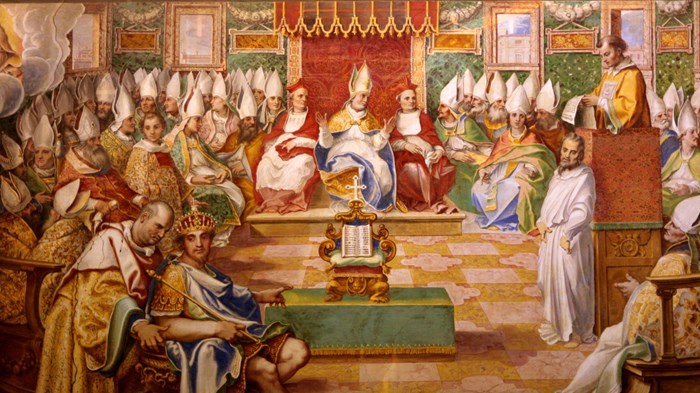


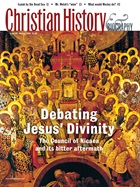
At the Council of Nicaea, Arius and his ideas lost. But for decades after the council, it appeared that an Arian perspective on the person of Christ would carry the day and the conclusions of Nicaea would disappear in a theological and ecclesial dustbin. Why? The Roman emperors were an important influence. A series of emperors (beginning with Constantine) understood their role to include the right to intervene in the affairs of the church, particularly when division within the church threatened the unity of the Roman Empire itself. Thus, if a Roman emperor was disposed favorably toward Arian ideas—as Constantius and Valens were—bishops supporting the creed formulated at Nicaea could be severely punished, most often by being deposed and exiled. If an emperor favoring Nicaea was in power, Arian believers would suffer.
Yes, the bishops of the church continued to play the major role in interpreting Scripture and constructing theology based on biblical exegesis. Yet behind the bishops and presbyters during and after the Council of Nicaea stood a series of Christian Roman emperors more than willing to intervene in the church's affairs and doctrine. When a series of pro-Arian emperors arrived on the scene, Arianism spread like wildfire.
Take the case of Constantine himself. Concerned over the growing rift within the church over Arius's ideas, Constantine both convened and intervened in the Council of Nicaea. Rowan Williams observes that when Constantine viewed Arius as a schismatic, the emperor penned a letter to Arius "and his supporters which is extraordinary in its venom and abusiveness, dubbing Arius an 'Ares,' a god of war, who seeks to create strife and violence."
Constantine was not averse to taking harsh legal steps to bring wayward theologians back in line. Williams notes that the emperor's acid reply to Arius grouped Arius and his supporters with Porphyry, "the great pagan critic of the church." Constantine ordered "that Arius's works be treated like those of Porphyry: they are to be burnt, and anyone who does not surrender copies in his possession is to be executed."
Within ten years of the Council of Nicaea, though, Constantine became convinced that Arius's ideas fell within the pale of orthodoxy, though the exact details of Arius's position—at least as represented to the emperor in the years following Nicaea—remain somewhat murky. What is clear, though, is that neither Constantine nor later sons such as Constans and Constantius were skilled biblical interpreters or theologians. These Roman emperors were more concerned with preserving the unity of the church than engaging in prolonged debates over what to them often seemed theological nitpicking. Manlio Simonetti, for instance, comments that Constantine was "convinced that religious peace could be assured only by a broad concentration of moderate elements" and "was as averse to some of Arius's more radical opponents as he had been to the radicalism of the Arians." Both Arius and Athanasius experienced Constantine's displeasure. It was Constantine who in A.D. 335 ordered the first of Athanasius's five exiles—the same year Arius regained the favor of the Roman emperor.
Over the 56 years separating the Council of Nicaea and the Council of Constantinople, Roman emperors frequently deposed and exiled bishops and presbyters they deemed schismatic and heretical. These actions created a long-lasting atmosphere of suspicion, intrigue, division, and hatred within the church. Eastern bishops who supported Nicaea suffered severely during the reign of Constantius. After the murder of Constantius's brother Constans in 350, the empire was consolidated under the rule of Constantius. It appeared that the entire Christian world had fallen into Arian hands. Though Constantius died in 361, successors were more concerned with maintaining the unity of the empire than with pursuing theological clarity. When Valens took command in the East in 364, Simonetti says, he behaved "ferociously" against bishops who questioned the Arian position.
Rational, but wrong
In addition to the help they got from the emperors, Arius's ideas were deeply attractive because they offered a rationally satisfying model of the relationship between the Father and the Son. Arius began with the fundamental presupposition that the divine essence is an indivisible unity, not a substance that can be divided or distributed like helpings of mashed potatoes. If this was true, how could one argue coherently that God could be divided into persons? It was impossible for God to "beget" a divine Son, for such a begetting or generation would involve dividing the inherently indivisible.
Thus, the Son must be created rather than uncreated. If we were to draw a line between the uncreated divinity and all creatures—however exalted those creatures may be—the Son would necessarily be included with all other creatures. Though Arius did not question the Son's exalted status over all creation, he could not be eternal in the same sense as the Father. "There was a time when he was not," Arius said.
Nicaea's response to Arius was that the Son was of the same substance (homoousios) with the Father, a statement vigorously debated throughout the fourth century. The church needed these years to sort through and clarify what the creed meant by homoousios. Some Christians criticized the homoousios clause because they believed it led to the disturbing conclusion that there is no genuine distinction between the Father and the Son. That is, the Nicene Creed simply served as a disguise for Sabellianism (also called Modalism).
Some believers who firmly affirmed the deity of the Son advocated the idea that the Father and the Son share a similar nature, not the same nature. This formula seemed to avoid the confusion caused by homoousios, but it raised questions of its own. If the Son's essence is only similar to that of the Father's, in what way is it different?
Aggressive intelligence
The theological pressure cooker of the years between Nicaea and Constantinople revealed the hidden fault-lines in the Arian model. Nicene advocates such as Athanasius continued to think through the implications and underpinnings of the creed formulated at Nicaea. In Athanasius we perceive the power of personality in history. His bright mind was linked to an aggressive, contentious personality that drove his opponents crazy but strengthened him through years of conflict and exile. Perhaps only a person such as Athanasius possessed the intelligence, industriousness, and persistence to weather the theological warfare that dominated the fourth century. Robert Payne observes that "in the history of the early Church no one was ever so implacable, so urgent in his demands upon himself or so derisive of his enemies. There was something in him of the temper of the modern dogmatic revolutionary: nothing stopped him."
Athanasius saw that if the Arian belief in Christ as an exalted creature won the day, the gospel itself would be lost. Two of Athanasius' central points bear repeating:
- Only God can save. A mere creature can save no one. While Arius worked hard to preserve an exalted status for the Son, picturing him as elevated above all other creatures, his understanding of Christ faltered at this strategic juncture. The Arian Christ, Athanasius insisted, was not a Savior. No creature possessed the ability or prerogative to save from sin. Salvation was the prerogative, privilege, and potential act of God alone. "The maker must be greater than what he makes … and the giver has to bestow what is in his possession."
- Christ was worshiped in Christian churches, including churches that followed the teaching of Arius. Athanasius asked how a church could worship Christ if Christ were not God. To worship a creature is to commit blasphemy. In fact, Athanasius contended, Arius and his followers committed blasphemy on two counts: They worshiped a creature as God and called God incarnate a mere creature. Athanasius insisted that when we worship the Son we are rightfully worshiping one whose deity finds its source or fount in the deity of the Father. As the "offspring" of the Father, Athanasius wrote, the Son is indeed distinct. But we must not allow this fundamental distinction to blur "the identity of the one godhead." "For the radiance also is light, not a second light besides the sun, nor a different light, not a light by participation in the sun, but a whole proper offspring of it. No one would say that there are two lights, but that the sun and its radiance are two, while the light from the sun, which illuminates things everywhere, is one. In the same way the godhead of the Son is the Father's."
Like Father, like Son
The essential oneness of the Father and Son indicates, Athanasius argued, that whatever is predicated of the Father must be predicated of the Son, "except the title of Father." In short, if the Father is Lord, the Son is Lord. If the Father is light, the Son is light.
For many years in the fourth century, the Arian cause appeared to have won the day. Arius's ideas offered a sensible rational approach to the relationship between the Father and the Son, while the Nicene Creed seemed confusing, nonbiblical, and provocative. In the end, however, the Nicene teaching won out.
Theodosius, the first emperor for many years to strongly oppose Arianism, affirmed the legitimacy and orthodoxy of bishops and priests who supported the Nicene Creed. Under his leadership and imperial authority, the Council of Constantinople (381) reaffirmed and developed the statements made by the Nicene bishops some 56 years earlier.
It truly seemed for a time that it was Athanasius contra mundum. C. S. Lewis wrote:
"We are proud that our own country has more than once stood against the world. Athanasius did the same.
He stood for the Tninitarian doctrine, 'whole and undefiled,' when it looked as if all the civilized world was slipping back from Christianity into the religion of Arius—into one of those 'sensible' synthetic religions which are so strongly recommended today and which, then as now, included among their devotees many highly cultivated clergymen. It is his glory that he did not move with the times; it is his reward that he now remains when those times, as all times do, have moved away."
Christopher A. Hall is dean of the Templeton Honors College at Eastern University and author of Learning Theology with the Church Fathers (InterVarsity Press, 2002).
Copyright © Christianity Today/Christian History magazine.
Click here for reprint information on Christian History.

Support Our Work
Subscribe to CT for less than $4.25/month