Why a Creed?


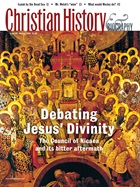
CHRISTIAN HISTORY & BIOGRAPHY: Why should we care about the early councils today—or even recite a creed? Aren't the gospel accounts in the New Testament enough for today's church?
ROBERT LOUIS WILKEN: One begins with the simple and inescapable fact that the Scriptures need to be interpreted. The Bible is not a doctrinal treatise. It's not a catechism. It's not a set of well-defined teachings. It's basically a narrative, a story about what God has done in the coming of Christ. So from the beginning, how to understand the various parts of the Scripture in relation one to another was an enormous challenge for Christians.
Take, side by side, two portions of Scripture: First, the great passage in Colossians 1 about Christ being the image of the invisible God in whom all things consist. Second, the narrative in Mark of Christ as a preacher, prophet, and healer. In one passage, all things come into being through Christ. In the other, you've got someone who looks very much like a preacher in the style of John the Baptist. The conviction of the early church was that the Bible was one book. It had one story. So one had to try to find a way to bring what was read in Paul into relation to what was read in Mark. And this was not a simple matter of quoting biblical verses; there were honest differences of opinion as to how they were to be understood.
The basic problem was that Christians began, as Jews, with the belief that God is one. On the basis of his teachings and miracles, the kind of person Jesus was, and because he rose from the dead, Christians said, "This man is not like any other man"—he is in some sense divine, or God. But how do you say that God is one when you've got two identifiable realities God the Father and God the Son—and claim they're God? That's the problem. And it's not an easy problem to solve.
Before the Council of Nicaea, there were plenty of local baptismal "creeds" that agreed in essentials while varying in details. Why coerce the whole church into accepting a single, rigidly defined creed promulgated by a single council? Was this really necessary?
Christians are reflective people. They think about what they believe. In my recent book The Spirit of Early Christian Thought, I quote a passage from Augustine. He says, "No one believes anything unless one first thought it believable.… Not everyone who thinks believes, since many think in order not to believe; but everyone who believes thinks, thinks in believing and believes in thinking."
The church very early on attracted well-educated people, and they began to think about what they confessed, what they believed, and to say, "Well, what does this mean?" or "How can this be, in light of what is said elsewhere in Scripture?" And eventually the problem emerged that I just outlined, namely, "How can we believe in one God and claim that Jesus, a human being, is also God?" That led to the controversy.
The Nicene Creed is different from the Apostle's Creed. The Nicene Creed is a creed that tries to define, to use more precise language for the church's faith, to set boundaries. It even introduces a word that is not in the Bible, homoousios, of one substance or being, because the bishops felt that it helped explain how God could be one yet twofold (the debate about the Holy Spirit will follow two generations later). With that term the council fathers wished to say that in whatever way God is God, Christ also is God. The term "begotten" (which is biblical) means that he comes into being eternally from the Father—he is not made like human beings.
What are bishops doing at the Council of Nicaea? Who were these bishops, and why should they have anything to say to the church?
It's very clear that from the beginning the church is not simply a collection of individuals. It's a community. And a community needs leadership, persons in authority to whom people could look for direction, someone to teach and to preside at worship.
We know that from early on in the church's history, these figures were called bishops. Bishop simply means "overseer." They were charged to teach what they had received from the apostles. And so by the end of the first century, anywhere you would look in the church, the primary leader was the bishop, and he was the focal point of the community. Ignatius of Antioch says, "Where the bishop is, there the church is."
Twice in 1 Corinthians, Saint Paul says, "That which I have received I have handed on to you." The leaders of the churches understood themselves as teachers who had received something from those who had preceded. This is in contrast to the way we think as Americans. When we have an issue before us, we gather different opinions, we con sul this and we consult that, and try to come to an agreement. But the early church always asked the question, "What have we received?" Then it asked, "How can we understand what we have received in light of this new situation?" Many had a say in the deliberations, but in the end someone finally had to be responsible and that was the bishop.
By the time you get to the third century, then, it is understood that the bishop is the guarantor of the apostolic tradition and is charged to teach what has been received. So it's natural, then, that the bishops are going to be the decision-makers at the council. It was a gathering of those who were most responsible for the church's teaching.
Wasn't the idea that Jesus is in some way subordinate to God the Father a pretty standard view in the church before Nicaea? Why pick on Arius?
Arius was representing what many of the bishops believed. They had relatively inchoate, unformed ideas about Christ's relation to the Father. Because they believed that the church's central teaching was belief in one God, they were reluctant to make the claim that Christ was fully God. It seemed to compromise what Christians believed—that God is one. In the early centuries most Christians, even bishops, were in some vague sense subordinationists—that is, they believed that Christ was divine but not quite in the same way that God the Father was divine.
What was finally affirmed at Nicaea after much debate was based on the Scriptures, but the precise formulations are not found in the apostolic writings. As the church deliberated it came to a deeper understanding of what was believed. In other words, the fullness of the revelation and the depth of its meaning were not as clear to the earlier generations as to later believers.
Ousia, hypostasis, persona. … Don't we have, in this conciliar process, a situation in which philosophy with its terms and rationales begins to overshadow the simple, powerful gospel?
These terms are attempts to express what the gospel means. To appreciate them you have to study the biblical passages the early Christians were trying to understand and how the language that they eventually agreed on (two natures and one person, for example, at the Council of Chalcedon in 451) helped them to make sense out of very, very deep matters.
Look at one of the texts that caused difficulties: Luke 2:52. "Jesus advanced in wisdom and stature." Everyone was willing to say Christ advanced in stature. But if he's a human being, then he's got to be someone who grows in knowledge. Few were willing to say that because it meant that Jesus was "ignorant" of certain things. Hence the difficulty of explaining what Luke meant.
Or take another one: Proverbs 8:22. Because Christ is identified as Wisdom in the New Testament, it referred to Christ. But Proverbs says, "He created me [wisdom] at the beginning of his work." Well, what does it means to say that Christ is created? Does that mean that he came into being like humans and that there was a time when he did not exist? That's a very, very big issue in the fourth centur )
Or take the great hymn in Philippians 2:6-11. The passage talks at first about Christ being in the form of God, and it says in the central section that he has taken on human form and was obedient unto death, even death on a cross. And then Paul sticks, right in the middle of the text, a great big "therefore": "Therefore God has highly exalted him." This makes it sound as though Christ's exaltation is because of what he has done. Critics of Nicaea appealed to this "therefore" to say that Christ had become divine, and was not always divine.
The thing that many people don't realize is that everything in the early church, in all of these debates, the issue always centered on how one was to interpret specific passages from the Bible. They were not soaring to lofty theological and philosophical heights; they were trying to understand the book they heard read each Sunday in church and recited in their prayers.
There is a sobering level of politicking involved in the whole process of the Council of Nicaea—before, during, and after—and quite apart from Constantine's role. There is "blood on the floor," so to speak. What are faithful Christians to make of this politically "dirty" process? Doesn't this taint the council and its resulting creed?
I doubt whether anybody involved in leadership in the churches today would claim that the debates they're involved in are not political. Politics has to do with people living together in a community. dealing with people who have different ideas and different agendas. It has to do with persuasion and compromise. The church is a human community which means it's a political community.
Even the apostles disagreed with each other. In Antioch, for example, there was a clash between Paul and Peter [Galatians 2:11-21]. I think we should be very grateful that we've got a record of the differences between the two foundational apostles in the New Testament, that they had a face-off with each other, and one said to the other, "You're wrong." We should notice that this clash had consequences that seem now to have been Spirit-guided: the flourishing of the Gentile mission.
In the council, the bishops cooperated with—some would say, were co-opted by—the state. Was the die cast at the council for the state church model that would dominate the church for 1200 years and more?
The simple answer is this: what does the church do when it winds up convincing most of the society to become Christian? That's what was happening by the fourth century. I don't think the church was co-opted by the state. It was the other way around: It's Constantine who changes. And once that happens, it means that the church assumes responsibility for forming the society—a task it didn't have before.
At the Council of Nicaea, called by the emperor Constantine, the bishops confessed the triune God, the God of the Bible, the Creator who sent Christ into the world to save sinners, in a very public forum. It meant that the biblical God displaced the gods of Rome. Constantine built churches, not temples to the Roman gods. So at the end of the fourth century, when the emperor Theodosius proclaims that the empire is now going to be officially under God, it's the God of Nicaea, it's the God of the Bible, it's the Trinitarian God he affirms.
The Nicene Creed is a way of proclaiming that the God of Abraham, Isaac, Jacob, and Jesus, that is, the biblical God, is the God to whom we as a society are now beholden. Now we will give this God our worship and adoration
Robert Louis Wilken is the William R. Kenan Jr. Professor of Early Christian History at the University of Virginia and the author of The Spirit of Early Christian Thought: Seeking the Face of God (Yale University Press, 2003).
Copyright © 2005 by the author or Christianity Today/Christian History magazine.
Click here for reprint information on Christian History.

Support Our Work
Subscribe to CT for less than $4.25/month