







The Wise Imagination


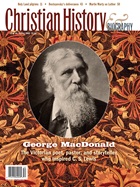
As a novelist and a poet George MacDonald was certainly blessed with a fertile imagination. But he was also a critic who thought long and hard about the nature of human imagination and its uses. And, as a Christian, he wanted to be able to give some account of just why it was that God made us imaginative as well as intelligent and moral beings.
MacDonald's distinctive ideas about these things are certainly woven into the fabric of his novels and poems. But they are expressed most succinctly and carefully in two essays, "The Imagination: its functions and its culture" (1867) and "The Fantastic Imagination" (1893), both published in a collection called A Dish of Orts.
Created in God's likeness
The first and most important thing MacDonald tells us is that imagination is something we have in common with God. Imagination is that in man, he writes, "which is likest to the prime operation of God." As human beings, therefore, we may say that we are "made in the image of the imagination of God."
This is striking in what it tells us both about ourselves and about God. Biblical talk of human creation "in the image and likeness of God" has generally been linked to our ability to think intelligently and to discern right from wrong. But here MacDonald links it unashamedly to that part of us which writes poetry and tells stories, sees patterns in the clouds and hears the music produced by a bubbling brook, and which is too busy wondering what might be the case to be constrained by whatever appears to be. Significantly, he reminds us that imagination does not have to do with such playful, creative and artistic impulses alone—but these are central to it. And God, he suggests, is like this. Our yearning for the poetic, therefore, is nothing other than a direct reflection of God's own creativity.
The God who created us made us poets and artists, and in doing so granted us a unique likeness to himself. This idea has some ancient roots, though it is one that theologians have often shied away from. But MacDonald grasps the nettle and insists that it must be so. And he sees poetry as essential to a truly human existence in God's world.
Finding God's poetry
As a Christian, MacDonald obviously believes that there is much more to the world than meets the eye. One of the key tasks of the imagination, he tells us, is to clothe invisible spiritual realities with material forms, enabling us to grasp them more securely. This is what the poet does, for instance, when he refers to love as "quick-e'yd," (George Herbert), to resentment "keeping its wrath warm" (Robert Burns), or to the Spirit of God brooding over the world with "warm breast and … bright wings" (Gerard ManleyHopkins). When ideas take flesh in this way, MacDonald suggests, words are duly born anew of the spirit.
Such poetic links themselves are not born of human invention, however. "Everything of man," he insists, "must have been of God first." So what the poet "creates" he really only "finds." The patterns are already present in the mind of God, awaiting our discovery. Indeed, we, too, are the products of God's own imagination, and whenever we have a genuinely "creative" insight, there is an important sense in which we are "rather being thought than thinking." The ideas are God's first, and ours only by grace. It's as though God has hidden a rich store of secrets in the world he has made, and leaves us to find them out. "The man, then, who, in harmony with nature, attempts the discovery of more of her meanings, is just searching out the things of God." And it is our imaginative capacity that enables us to do this.
Spiritual nourishment through the arts
Of course, not every product of the human imagination is "of God" in this direct way. Like all of our created capacities, imagination is fallen, and MacDonald knows that it can be the source of great evil. But imagination is not just a tool whereby we enter more fully into the meaning of God's world. It is also that bit of us which God lays hold of, so to speak, in drawing us ever more fully and closely to himself. Therefore, MacDonald concludes, "infinitely worse evils would be the result of its absence."
The response to base imagining should not be to suppress it (as Christians have sometimes sought to do), but precisely to cultivate and develop it, to make it "wise." For a wise or "right" imagination is equivalent to the presence of God in us, and it is the secret of a harmonious and joyous existence in God's world. If we try to crush it, imagination will find an outlet just the same, almost certainly for evil rather than for good. So we shouldn't seek to avoid dreaming dreams but pray that those we dream may be born of God's Spirit rather than some other.
MacDonald suggests that, as well as praying, there are other things we can do to encourage this. Like the body, the imagination needs food and regular exercise in order to develop in a healthy way. Far from avoiding the arts, Christians should put themselves regularly in the way of "the finest products of the imagination." For here is not just "entertainment" (let alone the "wiles of Satan") but spiritual food and drink.
Of course we must be discerning (there is much dross, and some positively unhealthy material which we should avoid). But how shall we ever learn to discern, MacDonald asks, unless we become familiar with what is best? Literature, music, painting, drama—these have a vital part to play in the shaping of our souls. As Christians in particular, therefore, we have a mandate to engage with them responsibly.
No higher calling
MacDonald is best known among Christian readers, of course, for his own fiction and especially his fantasy. In such work, he muses, it may be that the artist comes closest to God's own mode of creativity as he too makes a world and then works and struggles and suffers with it. It is here that MacDonald's influence on later writers (Chesterton, Lewis, Sayers, Tolkien) is most explicitly apparent. Those who know Tolkien's essay "On Fairy Stories" will find much that is familiar, not least MacDonald's indignant insistence that "for my part, I do not write for children, but for the childlike, whether of five, or fifty, or seventy-five." Devotees of Dorothy Sayers, meanwhile, will readily trace links between MacDonald's argument concerning artistic creation and "law" and that developed in Sayers' The Mind of the Maker.
It is not in specifics, however, that MacDonald's contribution as the "baptizer" of more than one great literary imagination should be traced, but in his wider recognition and rehabilitation of imagination itself as that God-given place in our humanity where depths are plumbed and lives shaped and reshaped. There can be no higher calling, he believed, than to be an instrument of God's continual redemptive engagements with the imagination, and through it the world.
Trevor Hart is professor of divinity and director of the Institute for Theology, Imagination and the Arts at the University of St. Andrews, Scotland.
Copyright © 2005 by the author or Christianity Today/Christian History & Biography magazine.
Click here for reprint information on Christian History & Biography.

Support Our Work
Subscribe to CT for less than $4.25/month