A Pen in God's Hand


The Prototypical Evangelical? Historians David Bebbington, Mark Noll, and George Rawlyk have identified four characteristic marks of "evangelicalism": a stress on conversion, a focus on Christ's redeeming work as the core of biblical Christianity, an acknowledgment of the Bible as the supreme authority, and an energetic and personal approach to social engagement and evangelism. According to Paul Lim, the life and ministry of Richard Baxter reveal all four of these qualities. Read more about this remarkable man.
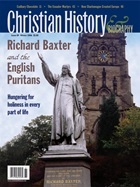
On July 28, 1875, the town of Kidderminster in the English Midlands witnessed a rare moment of Christian unity. After over 200 years of deep Protestant divisions, clergy from all denominations came together for the unveiling and dedication of the statue of a Puritan preacher.
The inscription at the base of the statue read, "Between the years 1641 and 1660 this town was the scene of the labors of Richard Baxter, renowned equally for his Christian learning and his pastoral fidelity. In a stormy and divided age he advocated unity and comprehension, pointing the way to everlasting rest."
Baxter himself would have been pleased by the ecumenical spirit of the event. Refusing to be boxed into any party or sect, he called himself a "mere Christian"—a phrase that would influence C. S. Lewis centuries later—and spent his life trying to persuade his fellow Protestants to reconcile their doctrinal and political differences and work together towards holiness. "In necessary things, unity; in doubtful things, liberty; in all things, charity" was his motto.
By age 44, he was the most famous clergyman in England, known for completely transforming the town of Kidderminster and fostering cooperation between clergy. By his death in 1691 he had written over 130 books selling more copies than any other English writer of the time. This voluminous outpouring of pastoral and theological commentary earned him the nickname "scribbling Dick." Preaching and writing to awaken dulled consciences, comfort the afflicted, and point people to the rest found only in Christ, he was a hero for many Puritans.
When George Whitefield visited Kidderminster 50 years after Baxter's death, he commented, "I was greatly refreshed to find what a sweet savour of good Mr. Baxter's doctrine, works and discipline remained unto this day." And the legacy continues. Baxter's bestseller The Saints' Everlasting Rest is a classic in devotional literature. His autobiography remains one of the most trusted historical sources for understanding the religious and political culture of 17th-century England. His handbook for pastoral ministry, The Reformed Pastor, influenced preachers like Charles and John Wesley and Charles Haddon Spurgeon—who had his wife read it aloud on Sunday evenings to "quicken my sluggish heart."
A Shropshire lad
Richard Baxter was born on November 12, 1616, the only child of a landowner in Shropshire, England. His hometown of Rowton was spiritually sleepy and in need of what Patrick Collinson calls "a hotter sort of Protestants." The 80-year-old pastor never preached. Baxter was confirmed at age 15 without ever being asked to recite the Apostles' Creed, the Lord's Prayer, or the Ten Commandments. Already winds of discontent were stirring that would provide the stormy religious background to the English Civil War. James I had just decreed that popular games could be played on Sundays, and Baxter recalled how after church the sounds of uproarious dancing around a maypole and the loud music of the tabor and pipe outside the window disrupted the family's devotions.
"Many times my mind was inclined to be among them," he wrote, "and sometimes I broke loose from conscience and joined with them; and the more I did it the more I was inclined to it. But when I heard them call my father Puritan it did much to cure me and alienate me from them; for I considered that my father's exercise of reading the Scripture was better than theirs, and would surely be better thought on by all men at the last; and I considered what it was for that he and others were thus derided."
Richard Baxter, Sr., had been converted through reading the Bible and tried to pass his love for Scripture on to his son. When the young Baxter realized that it was for practices such as "reading Scripture" when the rest of the town "were dancing on the Lord's Day" that people like his father were reviled, he became convinced that "godly people were the best, and those that despised them and lived in sin and pleasure were a malignant, unhappy sort of people."
As a teenager he read several Puritan devotional books that opened his eyes to the love of God and taught him how to live by faith in Christ. Though his formal education was poor and he was persuaded not to attend university, he acquired a massive amount of learning through his own reading. "And the use that God made of Books, above Ministers, to the benefit of my Soul, made me somewhat excessively in love with good Books"—an apt comment for someone whose personal library numbered 1,400 volumes by the time he died, an impressive collection that included first editions of many Latin and Greek Fathers, as well as medieval Scholastics and Jesuit theologies.
The true meaning of reformation
Already beset by the illnesses that would plague him for the rest of his life, Baxter decided to make the best of what he thought was his short time left on earth. He was ordained at age 23, and after a short stint as a schoolmaster and a year as pastoral assistant in Bridgnorth, Baxter accepted a call to be "lecturer" in the parish of St. Mary's in the small weaving town of Kidderminster.
Shortly after Baxter arrived in Kidderminster, the English Civil War erupted, and he spent five years as a chaplain in Oliver Cromwell's army, hoping to bring a voice of moderation into the struggle. But he was troubled by what he saw. Like his fellow Puritans, Baxter believed that the church in England was in desperate need of reform in order to make it more like Calvin's Geneva, which the Scottish reformer John Knox called "the most perfect school of Christ that ever was on the earth since the days of the Apostles." But he could not agree with those who would tear apart the unity of the church by separating from it, or who ignored the fact that reformed faith also meant holiness of life.
When he returned to Kidderminster in 1647—this time as vicar—he brought a new understanding of reformation, later expressed in The Reformed Pastor: "Alas! Can we think that the reformation is wrought, when we cast out a few ceremonies, and changed some vestures, and gestures, and forms! Oh no, sirs! It is the converting and saving of souls that is our business. That is the chiefest part of reformation, that doth most good, and tendeth most to the salvation of the people."
Conversion is the key
The Reformed Pastor, published in 1656, was the culmination of Baxter's thinking about the ministerial role and the product of an enormously successful ministry in Kidderminster. Baxter believed that a true church was not composed of a mostly absent bishop and thousands of parishioners who preferred to pursue trivial pleasures rather than following the "plain man's pathway to heaven." Nor was it made up of a "society of friends" like the Quakers, who eliminated the office of pastor. A true church was both a hospital and a school, and healing and learning could only come through truth rightly taught and embodied. In that regard, the pastor, both as a role model for others and also as a shepherd and teacher, was absolutely crucial.
The pastor must be "awakened" and reformed himself—thoroughly converted, humble, and obedient—before he could awaken others. The goal of preaching was to exalt Christ by confirming, convicting, and comforting the faithful and by converting the rest. Baxter urged his fellow pastors to preach "with clear demonstrations of love to their souls, and make them feel through the whole, that you aim at nothing but their salvation," so that "the increase of the purity and the unity of his churches" could be manifested.
Baxter himself preached twice a week, for an hour on Sunday and another hour on Thursday, and his preaching was characterized by enormous energy and urgency. "What!" he wrote, "Speak coldly for God and for men's salvation! … such a work as preaching … should be done with all our might, that the people can feel us preach when they hear us."
The personal touch
But preaching was not enough—a more hands-on strategy was needed to awaken sleeping souls. As a pastor, Baxter believed that conversion could happen at any age, and that the most effective way of finding out whether a person needed to be converted was not by public preaching but by private conversation. He would spend an hour with each family, using the Westminster Shorter Catechism, the Apostles' Creed, the Lord's Prayer, and the Ten Commandments to instruct each person and gauge his or her spiritual condition. Every Monday and Thursday Baxter would start at one end of town, his assistant would start at the other, and together they managed to interview 15 or 16 families a week—a total of 800 families (the whole parish) each year.
Baxter discovered that some people learned more in an hour's conversation than in ten years of preaching. He became convinced that personal instruction, or catechizing, was essential to insure the salvation of parishioners and thus the reformation of the parish. It also helped people better understand his sermons and enabled him to know who was ready to take the sacraments and where loving discipline was needed.
As a result of Baxter's one-on-one catechizing, he got to know his parishioners so well that he adapted his pastoral care to their widely varying spiritual states and needs. Rather than simply dividing people into "godly" and "ungodly," he claimed that there were 12 different categories of people in his parish—including those who merely conformed to the externals of church membership, those who desired to live godly lives but did not yet understand the fundamentals of faith, those with skeptical tendencies, those who rebelled against their pastor, and those whose wrong-headed theology was leading them into lawlessness.
Thanks to his intimate knowledge of his flock, most of Kidderminster's 2,000 adult inhabitants were converted under Baxter's ministry, and this town formerly infamous for its ignorance and debauchery became a model Christian community.
His program for reform and unity did not stop with Kidderminster. From his weekly fellowship with neighboring clergy grew the Worcestershire Association, an interdenominational alliance of Anglican, Presbyterians, Congregationalist, and Baptist ministers dedicated to Baxter's ideals of evangelistic preaching and catechizing families. The fervor spread to other counties as well.
Baxter also wrote 47 books during his Kidderminster years, including a compilation of his sermons titled A Call to the Unconverted. It sold over 30,000 copies in its first printing, went through 23 editions before 1700, and was translated into French, Swedish, German, and Dutch—as well as into Algonquian by John Eliot, the pioneer missionary to the Native Americans whose ministry Baxter praised highly.
Richard Baxter was soon a role model for Puritan pastors everywhere.
A wider parish
After the Restoration of the monarchy in 1660, Baxter emerged as the leader among conservative Puritans and with them was ejected from his pulpit (see p. 38). But for Baxter this was an opportunity to embrace all of England as his "parish," since by then he was one of the most sought-after writers of the day. Living in or near London, he published another 87 books, ranging from a defense of nonconformity to pleas for church unity, from a highly complex systematic theology to a huge compendium of Christian ethics. He was one of the first Protestants to produce a paraphrase of the New Testament, which aimed for "plainness and brevity" and included both doctrinal notes for younger scholars and ministers and practical notes for use at the "family altar."
Because books had played a key role in his own Christian growth, he promoted the kind of reading that instructs and nurtures. He donated a number of books to the fledgling Harvard College, although in a letter to a colleague, Baxter wrote that he would rather his books be "carried on peddler's backpacks" than kept in "learned men's libraries." He knew that while the poor were the very ones who could reap the most spiritual benefit from his writings, they could not afford the cost of books. So he arranged with his publisher that he would receive every tenth copy printed in lieu of royalties—copies he then distributed free. He also spent a good portion of his income buying Bibles for the poor.
Heavenly minded for earthly good
Despite his success as a pastor, a writer, and a leader, Baxter's life was not without its share of afflictions and setbacks. Ironically, his personality was not as suited to peacemaking as his convictions were. The same passion and straight-talking honesty that made him such an effective pastor often ended up causing insult and division in other spheres. A teacher by nature, Baxter could never seem to take off his schoolmaster's hat when relating to his peers. His long speeches before the bishops at the Savoy Conference—a failed attempt to revise the Prayer Book according to Puritan standards—only served to bore his listeners.
His lifelong striving for a peaceful middle ground meant that he was often misunderstood by people at both ends of the spectrum. He endured two prison sentences and caught flak from some Puritans for advocating "occasional conformity"—attending weekly service at the local Anglican church and sometimes celebrating the Eucharist, sometimes not. He also fumbled theologically by coming up with his own doctrine of justification which he believed avoided the extremes of Calvinism and Arminianism. His contemporaries observed, however, that it came dangerously close to "justification by works." For his high-church persecutors, he was too Puritan. For some of his fellow nonconformists, he was not Puritan enough.
Frequently believing himself at death's door because of his many illnesses, Baxter overcame disappointing circumstances by meditating on the heavenly reality to come. In The Saints' Everlasting Rest, he showed how reflecting upon the "excellency and certainty" of heaven could anchor and shape one's earthly sojourn. One particular paragraph from his Dying Thoughts on Philippians 1:23 captures Baxter's philosophy:
My Lord, I have nothing to do in this World, but to seek and serve thee; I have nothing to do with a Heart and its affections, but to breathe after thee. I have nothing to do with my Tongue and Pen, but to speak to thee, and for thee, and to publish thy Glory and thy Will. What have I to do with all my Reputation, and Interest in my Friends, but to increase thy Church, and propagate thy holy Truth and Service? What have I to do with my remaining Time, even these last and languishing hours, but to look up unto thee, and wait for thy Grace, and thy Salvation?
Baxter lived until age 76, considerably longer than he had expected. He died December 8, 1691, two years after the Act of Toleration put an end to persecution and guaranteed freedom of worship for Puritans. The huge funeral procession, attended by people of all ranks and including Anglicans as well as nonconformists, foreshadowed another ecumenical gathering nearly 200 years later at the unveiling of the Baxter statue in Kidderminster.
But such public accolades would not have been to Baxter's taste. In his funeral sermon, William Bates recalled the famous Puritan leader's characteristic humility: When a friend was "comforting him with the remembrance of the good many had received by his preaching and Writings, he said, I was but a Pen in God's hand, and what praise is due to a Pen?"
Paul C. H. Lim is associate professor of historical and systematic theology at Gordon-Conwell Theological Seminary.
Reaching the Kidderminster Kids
by Craig A. SmithIn the preface of his book Compassionate Counsel to All Young Men, Baxter confessed that "in the place where God most blessed my labours at Kidderminster, my first and greatest success was upon the youth." Baxter had a threefold strategy for reaching the young people.
First, Baxter started the equivalent of a youth group. No social events! Just three hours together once a week on Saturday evening in various homes to pray and to prepare themselves for the following Lord's Day.
Second, he taught the kids through weekly family conferences. He spoke first to the children, whom he then sent out of the room while he addressed the adults. His approach was direct, discussing matters of their salvation. His method, which he outlined in his book The Catechising of Families, was prescriptive, believing that everyone needs to be taught what they are, from where they are, for what purpose they have been made, and what means must be used to attain this goal. Baxter focused on the family because he saw its role as a school or church, to train up a succession of people to follow God's calling for their good and the good of the community.
Third, he dedicated one of his Thursday lectures every month to speak to the youth and those who educated them because he judged that "the work of educating youth aright [was] one half of the great business of man's life."
So important was reaching the young people to Baxter that he concluded: "There is no man that ever understood the interest of mankind, of families, cities, kingdoms, churches, and of Jesus Christ the King and Saviour, but he must needs know that the right instruction, education, and sanctification of youth, is of unspeakable consequence to them all."
Craig A. Smith, lecturer in New Testament at Trinity College, Bristol
Sunday Morning with the Puritans
by Michael LawrenceDevised by the Westminster Assembly in 1643, "The Directory for the Publick Worship of God" was the Puritans' attempt to reform the Prayer Book liturgy, and many pastors followed its guidelines. Had the Puritans printed church bulletins, one might have looked something like this.
Call to Worship
Many churchgoers used Sunday not only to worship, but to chat with friends and neighbors, conduct business, or catch up on sleep. Thus the Directory exhorts the people "wholly to attend upon [the publick worship] … forbearing to read [other things] … and abstaining from all private whisperings, conferences … as also from all gazing, sleeping and other indecent behavior."
Prayer of Invocation, Praise and Illumination
Old Testament Reading: Haggai 2
Singing of a Psalm
New Testament Reading: Hebrews 12
Ignorance of the Bible was a deep concern of the Puritans. "[T]hat the people may be better acquainted with the whole body of the scriptures" they read "one chapter of each Testament … at every meeting."
Prayer of Confession and Petition
Sermon: "Christ above Moses" (Heb. 12:25-29)
This was the centerpiece of Puritan worship. Puritan pastors were typically given one or even two turns of the hourglass. And as today, a good preacher could draw large crowds, not only from his own village but from distant towns.
Prayer of Thanksgiving and Application
Unlike the Book of Common Prayer, which provided set forms that the priest and people recited, the Directory simply indicated the subjects to be addressed in prayer. The minister could then either write his own prayers or pray extemporaneously.
The Lord's Prayer
Singing of a Psalm
Puritans sang only Psalms—no hymns—and without instrumental accompaniment. But don't imagine a boring monotone. It was said you could hear a Puritan church before you saw it, both because of the singing and the vocal agreement in prayer.
Benediction
Announcements:
Catechism class will meet this afternoon at 2 p.m. at the pastor's house.
The church dogwhipper requests that you please assist him in his duties by keeping the churchyard gate shut, as curs, sows, and geese are unseemly in the publick worship.
Michael Lawrence, Associate Pastor of Capital Hill Baptist Church in Washington, D.C.
Copyright © 2006 by the author or Christianity Today/Christian History & Biography magazine.
Click here for reprint information on Christian History & Biography.

Support Our Work
Subscribe to CT for less than $4.25/month