Adoniram & Ann Judson: Did You Know?


Larger than life
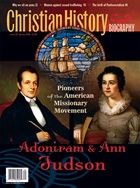
Missionary memoirs and biographies (often full of illustrations like the one to the left) gained huge popularity during the 19th century, inspiring young people to become missionaries and motivating Christians at home to pray for and give money to the missions cause. One biography of Adoniram Judson, published in 1853 by Francis Wayland, sold 26,000 copies in the first year alone. The most famous biography of Ann Judson appeared in a new edition almost every year from 1830 to 1856. Unitarian Lydia Maria Child described it as "a book so universally known that it scarcely need be mentioned." To the present, there have been at least 56 biographies of Adoniram published and at least 16 of Ann, including biographies for children. Though over the years the facts grew more and more embellished, the stories surrounding the Judsons' lives became as much a part of the landscape of American missions as the Judsons' own accomplishments.
Being like Brainerd
He made only a handful of converts in five years of evangelizing among the Native Americans. He died of tuberculosis at age 29. But for 19th-century Christians, David Brainerd (1718-1747) was the ideal missionary and a model of "disinterested benevolence," the sacrificing of self for the sake of others. Jonathan Edwards's 1749 biography, The Life and Diary of David Brainerd, became a spiritual classic motivating countless young Americans to become missionaries themselves. Levi Parsons, a missionary in Palestine, wrote, "Much refreshed this day by perusing the life of Brainerd. How completely devoted to God, how ardent his affections. What thirst after holiness, what love for souls. His life was short but brilliant and useful. … Counting pain and distress and every bodily infirmity dross, he patiently encountered difficulties and dangers, and at last sweetly resigned his all to his savior."
"Single missionary candidate seeks adventurous female"
By the 1830s, the American Board of Commissioners for Foreign Missions (ABCFM) prohibited unmarried persons from entering the mission field. The Board believed that married missionaries could cope better with hardships and resist sexual temptations. Thus they required young men to be engaged at least two months before entering the mission field. To help the would-be missionaries find wives, the ABCFM had an ongoing list of "missionary-minded" women who were considered "young, pious, educated, fit and reasonably good-looking." Often these missionary couples would leave for foreign lands within a week after their marriage.
It's a small world, after all
From 1820 to 1840, an estimated 590 American missionaries scattered throughout the world—reaching such widespread fields as India, Burma, the Sandwich Islands (Hawaii), China, Siam (Thailand), Borneo, Singapore, Ceylon, Persia, Turkey, Palestine, Greece, Southern and Western Africa, Brazil, and more.
Divinely matched
Though the Judsons barely knew each other when they got engaged, their marriage was extraordinarily loving and committed. Ann wrote to her sister while en route to India: "I find Mr. Judson one of the kindest, most faithful, and affectionate of husbands. His conversation frequently dissipates the gloomy clouds of spiritual darkness which hang over my mind, and brightens my hope of a happy eternity." After Ann finally succumbed to disease, Adoniram wrote, "There lies, enclosed in a coffin, the form of her I so much loved—the wife of my youth, the source and centre of my domestic happiness." Her death, he said, "deprived me of one of the first of women, the best of wives."
Schooled for ministry
During the 19th century, Andover Seminary (founded in 1808) and its sister school, Mount Holyoke College (founded in 1837), churned out scores of well-educated missionaries with a passion for sharing the gospel with men and women in foreign lands. Andover men often searched among the Mount Holyoke women for lifetime companions. In fact, Mount Holyoke gained a reputation as a "rib factory." By the end of the 19th century, 248 Andover alumni had entered the mission field. Mount Holyoke boasted more than 60 missionary alumnae by 1859, and by 1887 one fifth of all women serving as missionaries for the American Board were from Mount Holyoke.
Dr. Judson, I presume?
In 1823, Brown University granted Adoniram Judson the honorary degree of "Doctor of Divinity." Judson was in Burma at the time and so was unaware of his new title. Five years later, however, he publicly declined the honor: "I beg to be allowed the privilege of requesting my correspondents and friends through the medium of your magazine, no longer to apply to my name the title which was conferred on me in the 1823 by the corporation of Brown University, and which, with all deference and respect for that honorable body, I hereby resign. … I am now convinced that the commands of Christ and the general spirit of the gospel are paramount to all prudential considerations." Apparently, his desire to be called "Mister" instead of "Doctor" went unheeded.
Before you depart …
"I want to be a missionary. Now what?" Here, in paraphrase, is the advice Adoniram Judson gave to a missionary association in New York:
1. Be a missionary for life, not for a limited term.
2. Select a healthy and good-natured spouse.
3. Don't be overzealous to do good on board ship and thereby get in the way.
4. Take care that you are not weakened by the hardships you will face during the preparation and travel to your destination.
5. Don't judge the local Christians in your field of labor before you know their language and understand their culture. You will undoubtedly be disappointed when you first arrive and may regret that you came, but don't let first impressions dishearten or embitter you.
6. Don't let fatigue and frustration tempt you into seeking retreat or focusing on tasks that distract from real missionary work.
7. Beware of pride arising from your good reputation and guard against it by openly confessing your shortcomings.
8. Trust God in all things; don't lay up money for yourselves.
9. Exercise to maintain your health.
10. Avoid excessive socializing with other Westerners and don't try to keep up a fashionable lifestyle that will separate you from the people you are there to serve.
Copyright 2006 by the author or Christianity Today/Christian History & Biography magazine.
Click here for reprint information on Christian History & Biography.

Support Our Work
Subscribe to CT for less than $4.25/month