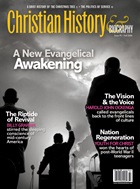
A New Evangelical Awakening: Did You Know?


"Mr. Evangelical"
One of the most important 20th-century shapers of modern evangelicalism was a man whose name is unknown to most evangelicals today: Harold John Ockenga (AH-ken-gay). During his lifetime Ockenga served as founder and first president of the National Association of Evangelicals; president of the American Board of the World Evangelical Fellowship; president, co—founder, and later Chairman of the Board of Fuller Theological Seminary; Chairman of the Board of CHRISTIANITY TODAY magazine; a member of the board of the Billy Graham Evangelistic Association; pastor of historic Park Street Church in Boston for more than three decades; and the founding president of Gordon-Conwell Theological Seminary. His remarkable oratorical skills and visionary speeches made him evangelicalism's most trusted voice for decades. Billy Graham, whose fame has now eclipsed his mentor, claimed that he never made a major decision in his life without first consulting Ockenga. [See America's Hour Has Struck for more about Ockenga.]
—contributed by Garth Rosell
Election redirection
The New Evangelicals were determined to infuse the public square—including the political arena‐with the truths of Christianity. In the midst of the 1952 presidential campaign, a group of Christians led by former Youth for Christ president Torrey Johnson held their own "campaign" on the heels of the Democratic National Convention in Chicago in an attempt to spark discussion of spiritual issues. "We feel the time has come when the entire nation should pray for guidance in the coming elections," Johnson said. "We want every politician to know the real hope of America is Jesus Christ." This converted bus with its provocative question was used to promote the campaign.
Becoming mere Christians
American evangelicals searching for an intellectually robust faith found a patron saint in the Anglican Oxford don C. S. Lewis. Lewis attracted national attention in the U.S. when the Atlantic Monthly published a profile of him by Chad Walsh in 1946 and Time featured him on their cover in 1947. His works were introduced to American students by InterVarsity Christian Fellowship workers and promoted by Billy Graham. Wheaton College professor Clyde Kilby corresponded with Lewis and did much to popularize him among evangelicals. CHRISTIANITY TODAY's first editor Carl Henry even invited Lewis to contribute to the magazine (Lewis declined). CHRISTIANITY TODAY recently named Lewis's Mere Christianity as one of the top three books that shaped 20th-century evangelicalism.
What's the difference between an evangelical and a fundamentalist?
No, there is no punchline. This is a question many Americans can't answer. "Evangelical" is the more general term, referring to a movement within Protestantism that emerged during the 18th-century revivals that swept across Britain, Ireland, parts of Europe, and America.
According to historian Garth Rosell, for the last 300 years evangelicals have put the cross at the center of their faith and have shared a commitment to the authority of the Bible, the importance of conversion, the atoning work of Christ, and the call to worldwide mission.
In the early 20th century, as Douglas Sweeney explains on page 15, evangelicals who were concerned about defending the "fundamentals" of orthodox Christian doctrine against the onslaught of liberal theology were called "fundamentalists."
But as the decades wore on, some of these evangelical-fundamentalists wanted to distance themselves from the anti- intellectual, militant, culture-shunning traits that had begun to characterize much of fundamentalism. So they recovered the use of the historic term "evangelical," calling themselves the "New Evangelicals."
This modern form of evangelicalism began, therefore, as a kind of reform movement within fundamentalism. In the beginning years (the period much of this issue covers) the terms "fundamentalist" and "evangelical" were interchangeable. But eventually, the lines of division hardened.
Today, the terms usually refer to two different groups, ultra-conservative Christians (fundamentalists) and those who take a more engaged approach to modern culture (evangelicals). Both, however, share the same family tree.
The first "Urbana"
Mid-century evangelicals set their sights on much more than national revival. After World War II ended, a world of evangelistic opportunities opened up. One significant catalyst of missionary interest among young people was InterVarsity Christian Fellowship. A missions-minded organization since its founding in Great Britain, IVCF caught on quickly at American universities after 1939 and in 1945 merged with the American-born Student Foreign Mission Fellowship, appointing J. Christy Wil so Jr. as its missionary secretary. Against opposition from both mainline denominations and fundamentalist groups, Wilson launched the first InterVarsity student missions convention at the University of Toronto a year later. The event drew 567 students and featured such prominent speakers as Harold John Ockenga. In 1948 a second convention was held at the University of Illinois at Champaign-Urbana. Ever since then, the triennial conference has become known simply as "Urbana" and now attracts some 20,000 students.
Broadcasting faith
Long before the 1980s televangelists gave media preachers a bad name, evangelicals had latched on to the latest forms of mass communication and popular entertainment to attract a wide audience. In the 1920s and '30s, fundamentalists invaded the airwaves, employing the cutting-edge medium of radio to broadcast their message. The New Evangelicals followed suit in the '40s and '50s. Harold John Ockenga refused to become pastor of Park Street Church in Boston without assurance that the congregation would remain committed to its radio ministry. Billy Graham's Sunday afternoon radio show "The Hour of Decision" was not only successful to an unprecedented degree, it paved the way for his debut in the new medium of television when ABC televised Graham's New York crusade services in 1957.
Put your money where your heart is
The mid-century evangelical movement could not have accomplished what it did without the financial support and public clout of Christians in the marketplace. Christian Business Men's Committees and Christian Business Women's Councils began proliferating during the 1930s and sponsored evangelistic rallies and radio programs. Much of the monetary resources for evangelicalism's burgeoning parachurch movement came from wealthy individual Christians like aluminum company president Herbert Taylor, who supported evangelistic organizations like Youth for Christ, and J. Howard Pew, whose oil fortune helped finance Fuller Seminary, CHRISTIANITY TODAY, Billy Graham's first television appearances, and numerous other organizations and evangelical endeavors.
Copyright © 2006 by the author or Christianity Today/Christian History magazine.
Click here for reprint information on Christian History.

Support Our Work
Subscribe to CT for less than $4.25/month