A History of Muslim-Christian Relations
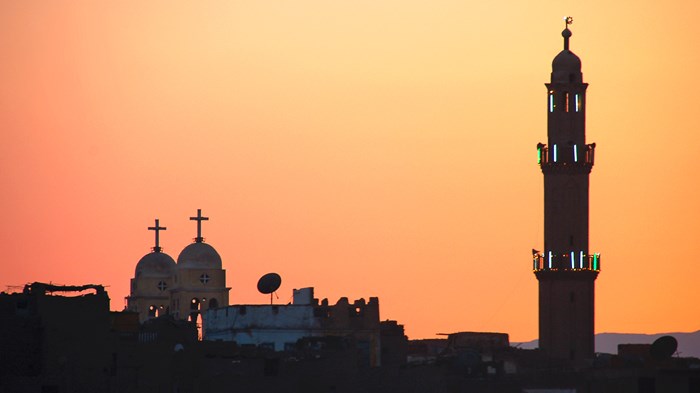


Relations between the Muslim world and the West dominate the international news. The events of 9/11, ongoing war in Iraq, developments in Afghanistan, the Israeli/Palestinian conflict, the Danish cartoon crisis, Pope Benedict's remarks on Islam, countless other lower-profile events—all reflect the fact that Muslim-Christian and Muslim-Western relations stand among the defining issues of our age. This situation compels serious followers of Jesus to consider precisely what Christ is calling us to concerning our Muslim neighbors—and our Muslim enemies.
Christians today are not the first to face this challenge. Since the sudden emergence of a vigorous and growing Muslim community in the Arabian Peninsula in the early seventh century, Christians and Muslims have been forced to negotiate the realities of face-to-face interactions in everyday life, in political relations between Christian and Muslim nations, and in all-too-common violent conflicts.
Unfortunately, violence has shaped Muslims' and Christians' views of each other and generated shame and anger on both sides. Marching under the banner of the cross, medieval Crusaders slaughtered thousands of Muslims, justifying their behavior in part as a response to Islamic aggression against Christians in the East. During the 14th and 15th centuries, Mongol warlord Tamerlane and his armies left great heaps of skulls across Asia as a symbol of their grisly ventures in the cause of holy war. More recently, European colonial powers have pilfered Muslim lands and subjugated their peoples in Africa, Asia, the Middle East, and beyond. And today, murmurings of an impending "clash of civilizations" mingle with the din of violent confrontations involving Muslims and Christians on several continents.
While these painful realities must be reckoned with, there are brighter points in our shared history as well. Among the many past Christians who engaged Muslims in more constructive ways, three stand out: Christian apologist John of Damascus, Nestorian Patriarch Timothy I, and Protestant missionary to Arabia, Samuel Zwemer. These three men inhabited different times and places and had different callings, but they display to varying degrees certain critical features of constructive Christian-Muslim engagement: a commitment to Christian orthodoxy, to intentional, non-violent engagement of Muslims, and to the respectful accommodation of their words and deeds to Muslim experience.
John of Damascus: Defender of Orthodoxy
Born to a prominent Arab Christian family in 655, John of Damascus (Yahya al-Dimashqi in Arabic) spent the first years of his career as the chief financial officer to the Muslim caliph Abd al-Malik. He was later elevated to the position of chief councilor of Damascus. John was well educated, gifted in rhetorical skills, and fluent in Arabic, Syriac, and Greek. With his thoroughly multicultural upbringing he undoubtedly moved among Syriac-speaking Christians, Arabic-speaking Muslims, and other local groups with ease.
John was apparently not always in favor with his Muslim employers or with the broader Christian community. He found himself on the wrong side of an increasingly acrimonious political and theological divide when he challenged the iconoclastic edicts of Byzantine Emperor Leo III, defending instead the role of images in Christian worship.
Leo III retaliated by sabotaging John's reputation among his Muslim patrons: He arranged for someone to forge a letter in John's handwriting offering to deliver the city of Damascus into Byzantine hands. John left the service of the caliph and spent the remainder of his life in the monastery of St. Sabas, less than 20 miles from Jerusalem.
At St. Sabas, John devoted his time to anti-heretical writing. Given his firsthand knowledge of Islam, it is not surprising that he turned his attention to defending the Christian faith against Muslim teaching, which he considered to be a kind of Christian heresy. His polemical work for Christians, "Against the Ishmaelite Heresy," was, in keeping with the genre, intentionally derogatory in tone—a sort of "anti-creed" that explained, "This is what we do not believe, and here's why … "
John's familiarity with Islam is evident throughout the work; he cites numerous details of Muslim faith and practice and quotes ten different Qur'anic verses. But his tone is not conciliatory, and he makes statements such as "Mohammed wrote many ridiculous books" and "Mohammed said: 'Oh by the way, God has commanded me to take your wife'"—clearly not an approach that promotes constructive engagement with Muslims.
But John was a product of his times, and he reflects a noble, if not always nuanced, commitment to Christian orthodoxy. His words represent the first substantive Christian engagement with the Muslim community in writing. In both good and bad ways, he set the tone for future Christian-Muslim interactions.
Patriarch Timothy I: Respectful Debater
Like John of Damascus, Patriarch Timothy I grew up as a Christian under Muslim rule. Born 50 years after John and 500 miles from Damascus, he came of age under the second great Muslim dynasty, the Abbasids of Baghdad. Timothy succeeded his uncle as bishop of the Assyrian Church, sometimes referred to as the Nestorian Church. In this role, he oversaw churches and missionaries as far away as China. (The rest of Christendom considered the Assyrian Christians heretical at that time, though this may have had more to do with politics than theology.)
As a Syriac-speaking Christian leader educated in the Greek classics and living among Arab Muslims, Timothy was ideally situated to be a bridge between the cultures and ideas of the classical West, the Assyrian Church, and the Muslim community. He developed the intellectual and diplomatic skills that would later distinguish him as the most nuanced of the early Christian leaders in his interactions with Muslims.
In 781, Timothy participated in a celebrated debate with the third Abbasid caliph, al-Mahdi. Given the respectful tone of both men, it is perhaps more appropriate to call the exchange a dialogue. Timothy's words are a model of how to maintain Christian orthodoxy while accommodating the message to Muslim perspectives and experiences.
Timothy later wrote of their exchange: "After I had paid to him my usual respects as King of Kings [the appropriate title of address to the caliph at the time] he began to address me and converse with me not in a harsh and haughty tone, since harshness and haughtiness are remote from his soul, but in a sweet and benevolent way." The caliph inquired about the Trinity, "If He is one, He is not three; and if He is three, He is not one; what is this contradiction?"
Speaking of the king as "his exalted Majesty," and addressing him with affection and respect, Timothy replied: "The sun is also one, O our victorious King, in its spheric globe, its light and its heat, and the very same sun is also three, one sun in three powers. In the same way the soul has the powers of reason and intelligence, and the very same soul is one in one thing and three in another thing. In the same way also a piece of three gold denarii, is called one and three, one in its gold that is to say in its nature, and three in its persons that is to say in the number of denarii. The fact that the above objects are one does not contradict and annul the other fact—that they are also three, and the fact that they are three does not contradict and annul the fact that they are also one."
The dialogue, in the form of a question and answer session between the caliph and Timothy, extended over two days and covered a broad range of practical and theological concerns. The conversation was always cordial, as seen in their closing remarks: "And our victorious King said: 'We have hope in God that we are the possessors of this pearl (the pearl of true faith), and that we hold it in our hands.' —And I replied: 'Amen, O King. But may God grant us that we too may share it with you, and rejoice in the shining and beaming lustre of the pearl! God has placed the pearl of His faith before all of us like the shining rays of the sun, and every one who wishes can enjoy the light of the sun.'"
More than 1200 years after his famous discussions with Caliph al-Mahdi, Patriarch Timothy I still stands as a shining example of a man deeply committed not only to Christian orthodoxy, but also to reflecting the mercy of his Lord in the way he related to the Muslims among whom he lived.
Samuel Zwemer: Apostle to Islam
In 1867, nearly 1100 years after Timothy's dialogue with Caliph al-Mahdi, Samuel Marinus Zwemer was born in the small Dutch community of Vriesland, Michigan. Sensing a call to Christian mission during his studies at Hope College, Samuel was swept up by the momentum of the Student Volunteer Movement. He continued his theological education at a Reformed seminary and went on to receive practical medical training under a physician in New York. After deciding with a classmate to "get something definite underway," Samuel departed for Arabia in June 1890. The motto of his new Arabian Mission was Abraham's prayer for his son in Genesis 17:18: "Oh, that Ishmael might live before thee."
Little did he know then that this prayer would absorb the rest of his life—nearly 62 years. Zwemer saw his life's work not as a struggle "against the Ishmaelites" (a term often used in the past to refer to the Muslim community), but as a struggle for them. Like Patriarch Timothy I, Zwemer viewed his call to engage Muslims not as an adversarial enterprise, but as an undertaking whose goal was to secure the blessings of God upon Muslims wherever they may be found.
Zwemer's approach focused on language, literature, and scholarship. Taught early on that "the learning of Arabic is a seven-day-a-week job," Zwemer devoted himself to the task, and he was later called upon to lecture and preach not only in his native English and Dutch, but also in the language of the Muslims to whom he was called. He founded the respected journal The Muslim World (still published today), wrote and distributed numerous books and articles aimed at bridging gaps of understanding between Christians and Muslims, and labored tirelessly to mobilize a generation of Christians to engage Muslims peacefully.
Living and traveling throughout the Arabian Peninsula and the entire Muslim world for decades, often under the worst of circumstances, Zwemer modeled the qualities of persistence and personal sacrifice (he buried three of his children in Arabia) that led eminent historian Kenneth Scott Latourette to state, "No one through all the centuries of Christian mission to Muslims has deserved better than Dr. Zwemer the designation of Apostle to Islam."
Though Samuel Zwemer was separated from John of Damascus and Timothy I by more than a millennium, he shared with them a deep commitment to orthodoxy and to intentional, peaceful engagement with Muslims. All three men possessed the cultural and linguistic skills as well as the willingness to engage in intelligent dialogue with Muslims. In the case of John and Timothy, these Muslims were their immediate neighbors; in the case of Zwemer, they lived on the other side of the world. Timothy and Zwemer accommodated their unwaveringly orthodox message to Muslims in ways that were both relevant and respectful, and their example calls us to do the same as we engage Muslims today in our own and distant lands.
Andrew Saperstein is associate director of the Reconciliation Program at Yale Divinity School's Center for Faith and Culture.
Copyright © 2007 by the author or Christianity Today/Christian History & Biography magazine.
Click here for reprint information on Christian History & Biography.

Support Our Work
Subscribe to CT for less than $4.25/month