Sermons that Sing
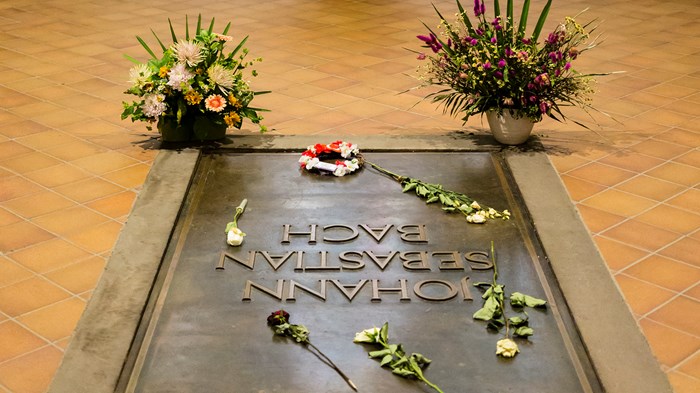


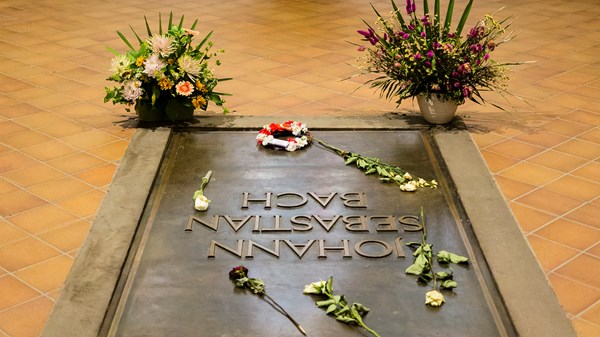
Johann Sebastian Bach served as Cantor of the St. Thomas Church, Leipzig, for the major part of his life. His last resting place is in the chancel of the church, marked by a bronze plaque that simply bears his name.
But when you visit the church today, local guides will usually point out two other things. One is the pillar against which the pulpit used to stand, the place where in 1539 Martin Luther preached to introduce the Reformation into the city and the surrounding area. The other is the gallery in the west end of the church, the site of the earlier gallery from which, two centuries after Luther, Bach directed the music of worship.
Earlier in this issue, Mark Noll has recounted how Luther, an extraordinary preacher, was also an accomplished musician. Now, this essay tells how Bach, the superlative musician, was also an effective preacher. But Bach did not preach from a pulpit as Luther did; his musical "sermons" came from the gallery at the back of the church. There stood the principal organ, and there the instrumentalists and singers played and sang what Bach created and directed.
Music for proclamation
Bach never called these pieces "sermons in sound," though that is what they are. He did not often call them "cantatas," the term modern musicians most commonly use to refer to them. He labeled them instead as church "motets" or "concertos," or more simply as "pieces"—Stücken, the term commonly heard today in connection with pieces of cake!
Most people today misunderstand these pieces. Because they are usually presented in concerts, the common view is that they are small-scale oratorios, independent works like Handel's Messiah or Mendelssohn's Elijah. And they are usually presented three or four at a time.
But Bach did not see them as independent musical works. Instead, Bach composed his cantatas for the two principal Leipzig churches, St. Thomas and St. Nicolaus. On alternate Sundays, these two churches heard Bach's cantatas as a significant part of the service of worship (usually the Eucharist). These services were long—lasting up to four hours—with a complex liturgical order based on Luther's evangelical reinterpretation of the traditional Mass.
In that service, the cantata was closely connected with both the reading of the Gospel and the sermon. The simple sequence was this:
Gospel, Nicene Creed, Cantata, Hymn, Sermon.
The portion from one of the Gospels appointed for that day was read. The choir responded to the Gospel, affirming the faith by singing the Nicene Creed in Latin. Then the choir and instrumentalists performed the cantata. The whole congregation responded by singing in German the hymn Wir glauben all' an einen Gott ("We all believe in one true God"), Luther's rhyming, metrical version of the Creed. After this second affirmation of faith came the sermon, a detailed exposition and application of the day's Gospel reading. The cantata therefore stood in the middle of a sequence that began with the Gospel reading and ended with the sermon. Like the sermon, the cantata was also an exposition and application of the Gospel of the day.
The human problem and God's answer
Like other composers, Bach needed someone to script the text he would use from the Bible, familiar hymns, and original material. The writers would structure the cantatas' libretti (as such texts were called) in much the same way as the sermons of the time. Indeed, some of the authors, such as Erdmann Neumeister of Hamburg, were pastors, and their poetic cantata texts grew out of their preaching.
Many cantatas begin with a biblical text, either from the Gospel of the day, or closely related to it. In Bach's libretti, this is frequently a statement about human sinfulness and the demands of God's Law. Then follows a series of movements (sections) in which the problem is expounded. Some of these movements are brief musical statements sung in the rhythms of ordinary speech (recitatives), focusing on the specific spiritual need announced in the opening movement. This then becomes the central theme of the more elaborate song (aria) that follows, a poetic text full of biblical imagery.
Midway through these movements, often in a recitative, the cantata answers the spiritual question raised in the previous movements—often by referring to the Gospel of grace and forgiveness. The remaining movements rejoice in the implications of this aspect of the Gospel. The libretto usually ends, as did many sermons of that time, with a stanza of an appropriate hymn that underscores the Gospel answer to the Law question, or whatever was the primary theme of the libretto.
An example of this is the cantata "My Heart Swims in Blood" (BWV 199). It begins with a recitative that states the problem: "My heart is bathed in blood, / For now my sins' great brood / Within God's holy vision /A monster makes of me." But in the third movement, the Gospel promise is announced: "But God shall be gracious to me." The following movements acknowledge sin and claim Christ's sacrifice: "I lay myself into these wounds now / … They shall be now my resting place. / Upon them will I firm in faith be soaring, / In them content and happy singing." The final movement rejoices in the reality of reconciliation: "How joyful is my heart / for God is reconciled … "
A musical Trinity
Thus as a literary form, the cantata is closely related to preaching. But when Bach adds music to these texts, he adds further levels of meaning and application.
In some movements of his cantatas and other vocal works, Bach expresses theological concepts in his choice of the musical form. Many elements of his Mass in F (BWV 233) come in threes, evoking the Trinity. Three prayers for mercy are sung: The bass sings the "Lord Have Mercy" section of Luther's Latin Mass, while the soprano sings Luther's German version of the "Lamb of God" section of the Mass. Sandwiched in the middle is a three-voice fugue in three parts for the three-fold liturgical prayer, "Lord, have mercy; Christ, have mercy; Lord, have mercy."
Traditionally, each part of this prayer is addressed to each Person of the Trinity in turn. The first theme of Bach's fugue is addressed to God the Father. The second part honors God the Son, so Bach inverts the first theme so that the second becomes a mirror image of the first, because the Son is the image of the Father. Then for the final part, addressed to God the Holy Spirit, Bach weaves together both the original theme and its inversion. This embodies in musical form the Nicene Creed's statement that the Holy Spirit "proceeds from the Father and the Son." The movement is a tour de force of musical and theological counterpoint.
Would every member of the congregation have picked up all these associations? Probably not. But in the same way, a congregation may not recognize all of a preacher's rhetorical techniques—alliteration, repetition, reiteration, metaphor, allegory, and the like—and yet these techniques working together can produce an effective sermon.
The freedom of grace
Other examples of Bach's musical interpretation of Scripture would have been readily understood by the congregation. Cantata 106 is a funeral cantata with a libretto mostly made up of biblical quotations and one from the Apocrypha. Two in particular are juxtaposed: "It is an old decree/law that you, O man, should die" (Ecclesiasticus 14:17) and "Yes, come, Lord Jesus" (Rev. 22:20). The lower voice parts (alto, tenor, bass) sing of the demands of Law in strict "legalistic" counterpoint. Set against this is the soprano who sings with great freedom the words from Revelation. Here in musical terms is the fundamental nature of Luther's theology: the distinction between the Law (strict counterpoint) and the Gospel (unfettered melody).
Another example is found in Cantata 9, a cantata based on a hymn about the distinction between the Law and Gospel. The fourth movement is a bass recitative that says the Law is to be obeyed, but sinners fail to do so, and thus Christ fulfills these demands on their behalf. The next movement, a soprano and alto duet, states that good works are ineffective since one is justified only by faith. If you look at the score on paper, you can see an incredibly dense texture of overlapping canons. But the sound you hear is a lively and airy message of grace. The texture is Law, but the sound is Gospel. Here is Bach the preacher conveying theological themes in musical form that cannot be described as either "intellectual" or "dry."
All the good tunes
The melodies of the Lutheran chorales (as their hymns were called) were deeply embedded in the memories of the congregations that Bach served. He could therefore add further dimensions of meaning by using these melodies. Of course, when the people heard these melodies, their normal texts immediately came to mind, and another layer of meaning became apparent.
The movement from Cantata 106 referred to above is a good example. In the middle of the three-voice counterpoint of Law, against which is contrasted the freedom of the Gospel, the listener suddenly hears a familiar chorale melody played by violas da gamba. Bach's congregation would have thought of the hymn's words: "I have committed my things to God, / he does with me what pleases him; / should I no longer live here, / I do not contest, / to his will I submit myself completely."
Cantata 12 is also full of superlative examples of theological hermeneutics, such as the second movement, part of which became the Crucifixus of the B Minor Mass. The sixth movement, a tenor aria, is an exposition of the command "Be faithful," although the text never explicitly says to what or to whom we should be faithful. The ambiguity is dispelled when a trumpet begins to play a chorale melody that Bach's original listeners would have recognized immediately: "Jesus, My Joy." Thus the trumpet explains the command: We are to be faithful to Jesus.
There is a similar example in Cantata 48. In the first movement, the choir poses the question: "O wretched man that I am, who will redeem me from this body of death?" (Rom. 7:24). Again an instrument supplies the unmistakable answer by playing a familiar chorale melody: "Lord Jesus Christ, Thou Highest Good."
The Gospel reading for the Sunday before Lent is Luke 18:31-43. It has three elements: First, Jesus tells the disciples that they are going to Jerusalem where he will suffer, die, and rise again; second, they set out for Jerusalem; third, they pass by a blind man in the crowd who cries out to Jesus for mercy.
In the orchestral introduction to Cantata 127, written for this Sunday, Bach expresses all three themes in musical form. First, he creates the sound of a procession by a steady rhythm in common time. Second, Jesus' message to the disciples is underscored in the bass part, which quotes the first line of the melody of the Passion chorale "O Sacred Head Now Wounded." Third, the melody of Luther's German version of the "Lamb of God," a liturgical prayer for mercy, is played first by the stringed instruments and later by oboes. Thus it echoes the blind man in the Gospel reading. Bach presents all this to the congregation before they hear any text sung by the choir.
In step and out of step
Composers often use the device of imitation, in which voices and/or instruments repeat the same melodic phrase at different pitches and at different times (e.g., a round, canon, or fugue). Discipleship is also imitation, following the Master. So Bach uses imitation to represent discipleship. This "following the leader" can be heard in a number of arias, notably Cantata 12 (movement 5), "I Follow After Christ," and the St. John Passion (movement 9), "I Follow Thee [Jesus] Also."
But Bach could also convey imperfect discipleship in musical form. In the St. John's Passion (movement 12b), Peter is challenged with the question: "Are you not one of his disciples?" Here the discipleship of Peter is less than perfect, and so Bach makes the imitation irregular: The voices are "out of step," being displaced first by one beat and then by two, creating a sense of uneasiness in listeners and performers alike.
Bach was not a preacher in his vocal music alone; similar attention to theological detail is found in his other works, such as those for organ. For example, his ClavierÜbung (Keyboard Practice) Part III includes two sets of chorale settings of the melodies of Luther's catechism hymns—one for each of the six main sections: Ten Commandments, Creed, Lord's Prayer, Baptism, Repentance, and Lord's Supper. These chorale preludes express the theology of Luther's catechisms without words. Bach treats each melody twice, one for a small organ without pedals and one for a larger organ with pedals, thus reflecting Luther's two expositions of the catechism, the Large Catechism for preachers to use in church and the Small Catechism for use in the home.
The music Bach composed for worship was as powerful as any sermon, perhaps even more so! Like all good sermons, his church cantatas are biblically based and theologically structured. Like all good sermons, they are intellectually challenging and emotionally persuasive. Like all good sermons, they are well crafted, aesthetically mature, and supremely memorable. Like his Lutheran predecessors, Bach understood the role of music in worship as the living voice of the Gospel that touches both heart and mind.
Robin A. Leaver is professor of sacred music at Westminster Choir College of Rider University, Princeton, New Jersey.
Copyright © by the author or Christianity Today/Christian History & Biography magazine.
Click here for reprint information on Christian History & Biography.

Support Our Work
Subscribe to CT for less than $4.25/month