





Defining the Faith


A Christian walking the streets of Ephesus in the mid-second century would have seen signs of material splendor and prosperity—the recently built Library of Celsus at the entrance to the commercial agora, the temples and other building projects initiated under the emperor Hadrian, the Roman remodeling of the great theater, the new Vedius Gymnasium and baths, and other amenities of a flourishing urban life. He could have conversed about current philosophical interests—Middle Platonic metaphysics, Stoic ethics, Aristotelian science. He may have been aware of flourishing literary activity from authors such as the clever satirist Lucian of Samosata.
The religious, political, economic, and cultural life of Ephesus was dominated by the cult of Artemis, whose magnificent temple was one of the Seven Wonders of the World, though other cults flourished as well. The association of the imperial cult with Artemis testified to the pervasive presence of the Roman Empire.
During the second century, the empire reached its height geographically (under Emperor Trajan) and economically (under Hadrian and the Antonines). Underneath this success, however, were reasons for uneasiness. Emperor Marcus Aurelius struggled mightily against barbarians on the frontiers. Books about history by Pausanias, Plutarch, Athenaeus, and others reflected a general feeling that the older customs were better and that something had been lost in the new Roman age. Movements such as the Neopythagoreans and Christian Encratites took a negative view of the material world. The question of the origin of evil troubled many, especially Jews and Christians who believed in a good Creator. Undercurrents pulled toward another, spiritual world.
Christians shared in this vibrant, troubled culture. They wrestled with how to relate to the overarching Roman political, economic, and religious authority. They moved up the economic ladder. They engaged the philosophical issues of the time, produced their own abundant literature, and clarified doctrines. Above all, now that the last of the apostles had died, Christians wrestled with their own identity: Who are we? What does it really mean to be a "Christian"?
A persecuted race
Christians faced this question within the context of uneasy relations with the Roman state. Religious acts permeated all aspects of society—athletics, dramatic entertainments, commercial activities, civil oaths, and political functions. The Roman government co-opted local cults as part of the state religion. The ultimate test of political loyalty was sacrifice to the "divine spirit" of the emperor, represented by his statues and pictures.
Some Christians reasoned that bodily actions are irrelevant to spirituality and therefore going through the motions of sacrifice does not matter morally. Most Christians, however, rejected pagan religions as idolatrous and refused to participate in acts of sacrifice, even in civil and social contexts. This refusal led to sporadic outbursts of persecution. Those who steadfastly resisted any temptation to compromise were considered the heroes of the church. Some who volunteered for martyrdom yielded under pressure, so the church discouraged voluntary martyrdom and held up the example of Polycarp of Smyrna as martyrdom "according to the Gospel." Polycarp withdrew to a country house until the authorities arrested him. His confession is classic: "For 86 years I have served Christ; how can I blaspheme my King who saved me?"
Persecutions underlined the communal aspect of Christian faith. Narratives of the martyrs' trials recorded that, when commanded to sacrifice to the gods in obedience to the emperor, the martyrs repeatedly confessed, "I am a Christian." Christians were condemned "for the name," that is, for being members of the group that was considered subversive. The apologist Justin Martyr argued that this legal practice was unfair: People should be punished for their own crimes, not for those suspected of an entire group.
But such experiences strengthened the consciousness of a special identity. In their written defenses of their faith, Christians spoke of themselves as a "third [or fourth] race." The Epistle to Diognetus says of Christians, "They neither esteem those to be gods that are reckoned such by the Greeks [Romans included] nor hold to the superstition of the Jews." And Aristides' Apology states, "There are four classes of people in this world: Barbarians, Greeks, Jews, and Christians."
Jesus and Moses
Rome recognized Jews as an ancient people, and as long as Christians were considered a branch of Judaism they enjoyed a certain protection. But this situation was ambiguous, for there was popular animosity against Jews, especially after the Jewish revolts against Rome (the latest in the 130s during the reign of Hadrian). Also, Jews removed the legal cover provided by Judaism by excluding Christians from their communities.
Relations between Jews and Christians were ambivalent. Jesus and his earliest disciples were Jews, but by the second century the churches were composed mostly of Gentiles. The question of Christianity's relation to Judaism and the Old Testament was a very important part of Christians' efforts to define their identity.
The longest surviving second-century work illustrating this Christian-Jewish discussion is Justin Martyr's Dialogue with Trypho. Trypho, a Jew, was puzzled that Christians "professing to be pious" did not "alter [their] mode of living from that of the Gentiles" or observe "festivals or sabbaths and do not have the rite of circumcision" required in the Law of Moses. Justin distinguished between the Old and the New Covenants. The Old Covenant given to Moses was valid for Jews, but the prophets predicted a "new law" and "eternal covenant" in Christ that is for all peoples.
Others expressed different answers to the question of Christianity's relation to Judaism. Some (for example the Epistle of Barnabas) allegorized the Law, so that its "spiritual" meaning belonged to Christians. Some, like the heretic Marcion, wanted to sever Christians' association with Judaism and rejected the Old Testament altogether (an approach his opponent Tertullian said "gnawed the Gospels to pieces"). The Gnostic teacher Ptolemy made distinctions in the Law between what was fulfilled by Christ, what was abrogated by him, and what was transformed by him.
But most Christians held fast to their Jewish heritage. It showed that Christianity was not something novel (a major pagan criticism against Christians) but had ancient historic roots—an important fact in a culture that valued the oldest as the best and the truest. Jewish Christians maintained various aspects of Judaism along with their faith in Jesus as the Messiah. Gentile Christians, although they did not observe the ceremonial aspects of the Law, continued to consider the Jewish Bible in its Greek translation as their Scripture.
Christians' use of some Jewish books not found in the Hebrew Bible (still included in Roman Catholic editions today) made the limits of the Old Testament canon a concern already in the second century. Melito, the bishop of Sardis, journeyed to Palestine to learn the exact contents of the "Old Covenant" from Jews there, and he recorded a list agreeing with the Jewish and Protestant Bibles except for the absence of Esther.
Doctrinal dilemmas
An essential aspect of the question "Who are we?" was the related question "What do we believe?" As Christians prayed, sang, taught the gospel message to converts, and confessed their faith in baptism, they were forced to think deeply about how Jesus related to God and what the limits of true doctrine were.
For one thing, there was considerable pressure within the culture to modify or compromise monotheism. Christians shared with Judaism the belief in the one Creator God, and the philosophers of that age were moving towards an affirmation of one Supreme Principle. But the currents of thought also found a place for multiple subordinate divine beings, much like multiple governors under one supreme emperor. Even some forms of Judaism reflected this trend.
Also, those who affirmed Jesus as Savior interpreted the nature of salvation differently. Was he a teacher who brought enlightenment or a healer who brought wholeness? A spirit who brought eternal life or a real human being who brought a resurrection of the body? A conqueror who brought deliverance from fate or demons, or a redeemer who brought forgiveness of sins?
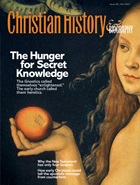
Those we now call "Gnostics," who combined elements of Greek philosophy, Jewish speculation, and Christian belief, had various perspectives on these and other options—as did the Gnostics' orthodox opponents. Moreover, the church's proclamations about Jesus—his virgin birth, ministry of teaching and healing, crucifixion, bodily resurrection, and future coming as a judge—were questioned by those who discounted the historicity of these events.
A diversity of viewpoints emerged, expressed in various forms of Christianity. Common to nearly all Christian groups, as far as we can tell, was baptism in the name of Jesus Christ as the central act of initiation and a weekly communion on the first day of the week.
Holding on to the apostles
In the midst of all of these challenges from within and without, Christians tried to maintain a sense of unity and theological clarity by strengthening the organization of local communities and keeping up constant communication between these communities. As the second century went on, there were fewer and fewer "apostles, prophets, and teachers"—as well as fewer evangelists who circulated among the churches and carried the gospel to new areas—and more bishops (or pastors) who emerged out of the council of elders as the main leaders of the Christians in each city. "Let the congregation be wherever the bishop is," wrote Ignatius of Antioch, concerned that doctrinal divisions would tear apart local churches.
Not all Christians liked the growing organizational structures. The Montanist movement revived the practice of prophecy in reaction against what they perceived to be the church's weakening separation from the surrounding world and against the greater authority exercised by bishops. Teachers continued to function, sometimes only loosely connected with the local leadership. Some, like Justin Martyr, were orthodox, while others, like the Gnostics, promoted their own esoteric speculations and formed independent schools of thought.
At the core of all these developments was one central concern: Where can we find the apostolic message? Christians clung to the apostles' teaching about Jesus as the standard for determining what was true and what was not. Those who taught a different message from what the local bishop and elders taught appealed to a secret tradition going back to one of the apostles. Over against this claim to "secret teaching," their opponents pointed to the public succession of leaders and teaching in the established churches. The theologian Tertullian summarized this argument: Truth is what "the churches received from the apostles, the apostles from Christ, Christ from God," and all other doctrine is false. Such concerns led to a "canon" of accepted apostolic writings (the New Testament), a summary of the message these writings contained (the Rule of Faith), a confession of faith (the Apostles' Creed), and an apostolic succession of bishops and elders.
At the intersection of Greek philosophy, Jewish interpretation of Scripture, and Christian affirmations of a divine Redeemer who appeared on earth, various teachers formulated their views of material and spiritual reality and sought a firm place to stand. Except for physical persecution, the situation of Christianity in the West today has a lot in common with the second century. And on the worldwide scene, the question "What is a Christian?" remains a central issue.
Everett Ferguson is professor of church history emeritus at Abilene Christian University.
Copyright © 2007 by the author or Christianity Today/Christian History & Biography magazine.
Click here for reprint information on Christian History & Biography.

Support Our Work
Subscribe to CT for less than $4.25/month