Building a Holy City


IN A.D. 325, JUST NINE MONTHS after Constantine became sole ruler of the whole Roman empire, Christian leaders came together for their first ever "global summit" – the Council of Nicaea. Their purpose was to debate and state more clearly their understanding of Jesus' identity. Of all the regions represented at that meeting, one province was set to be transformed by the onset of the Constantinian era more than any other—Palestine, the land of Jesus' birth.
Everything changed overnight. Christians in previous centuries had expressed some interest in Jesus' homeland, and a few had even traveled there to see the sites described in the Gospels. Yet the land itself, still under pagan rulers, scarcely reflected the significance that Christians ascribed to it. After all, this was the land that had witnessed the Incarnation! Yet Christians were a small minority there, and the province remained something of a "backwater" within the wider empire.
Now, with a new emperor, there was an opportunity for a "new day. Within just two generations, Palestine was transformed. Christian visitors started arriving in vast numbers, and many stayed and established Christian communities in or around Jerusalem. They built numerous churches and developed a "pilgrimage trail" for those who wished to visit all the Gospel sites. They developed creative forms of worship that were adapted both to the place and to the season, something that would color the nature of Christian worship around the world to this day. Palestine was no longer (from an imperial point of view) a buffer–zone on the eastern border, but a vital—even central—part of the new empire. So began the "Byzantine" era in the Holy Land (so called because Constantine moved the capital of the Roman Empire to Byzantium, renamed Constantinople). It was a 300–year period of economic flourishing, population explosion, and relatively undisturbed harmony.
Bishops, monks, and pilgrims
It is a fascinating page in Christian history filled with colorful characters. There were residents of Palestine like the scholarly Eusebius of Caesarea, whose Church History is our indispensable guide to all things prior to A.D. 300. Eusebius was the elderly "Archbishop" of Palestine in that crucial year of the Council of Nicaea. There was Cyril, the energetic bishop of Jerusalem from 348–387, who almost single–handedly developed the rich new liturgy. And there was Jerome, the slightly angular and awkward "Doctor" of the Latin Church who established a monastery in Bethlehem, where he spent his time translating the Hebrew Bible and other important commentaries into Latin (from 384 until his death in 420).
Then there were those who made brief visits but who left their mark on the land or bequeathed to us a written account of their visit. Queen Helena (Constantine's British mother) made a "royal visit" in 326. The "Bordeaux Pilgrim" visited in 333 and kept a travel diary. Gregory, bishop of Nyssa, returned to Asia Minor frankly unimpressed with aspects of the pilgrimage trade and the lack of "holiness" in the supposed "holy sites" after his visit in the 380s. And the indomitable Egeria, a nun from Spain, spent three years in the East (384–387) and kept a very detailed account of her travels (including trekking on a mule around the Sinai desert!). From her account we get the "inside story" of what it might have been like to travel around Palestine 60 years after Constantine became emperor.
Archaeological epiphany
Some 30 years before Constantine's victory Eusebius had been compiling his Onomastikon (an alphabetical "gazetteer" to sites mentioned in the Old and New Testaments), but when he came to Golgotha all he could write was this: "Golgotha: this is pointed out to the north of Mount Zion." Local Christians evidently knew the general vicinity of where the crucifixion had taken place, but it could only be "pointed out" from a distance. This was because a pagan temple dedicated to Aphrodite had covered the place since the time of Hadrian (A.D. 135).
Like Eusebius himself, the bishop of Jerusalem, Macanus, attended the Council of Nicaea. No doubt he took this golden opportunity to discuss the awkward situation with Constantine during the intervals between other business. Macanus returned from Nicaea with just what he wanted: the emperor's command to destroy the pagan temple and build a church in its stead. We have a copy of an imperial letter sent a little later to Macanus (preserved by Eusebius in his Life of Constantine) in which the emperor makes clear his intentions: "My concern is that that sacred place, which at God's command I have now relieved of the hideous burden of an idol which lay on it like a dead weight,… should be adorned by us with beautiful buildings."
Constantine clearly had caught the vision: What better way to mark the new day of his reign than to destroy a pagan temple and to honor Christ at the site of his crucifixion and resurrection? Though buried in shame and disgrace, Christ could now be honored as the King of Kings.
But what would the excavators find? Would this local Christian tradition be revealed as a pious fraud? Would there be any evidence of the place as it appeared in the first century? The stakes were high—for all concerned. So one can almost sense the sigh of relief, indeed the exhilaration and rejoicing, in Eusebius' account of what happened next:
The Emperor gave further orders that all the rubble of stones and timbers from the demolition should be taken and dumped a long way from the site … and that the site should be excavated to a great depth…As stage by stage the underground site was exposed, at last against all expectation the revered and all—hallowed Testimony (inartyrium) of the Savior';s resurrection was itself revealed, and the cave, the holy of holies, took on the appearance of a representation of the Savior's return to life. Thus after its descent into darkness it came forth again to the light, and it enabled those who came as visitors to see plainly the story of the wonders wrought there, testifying by facts louder than any voice to the resurrection of the Savior.
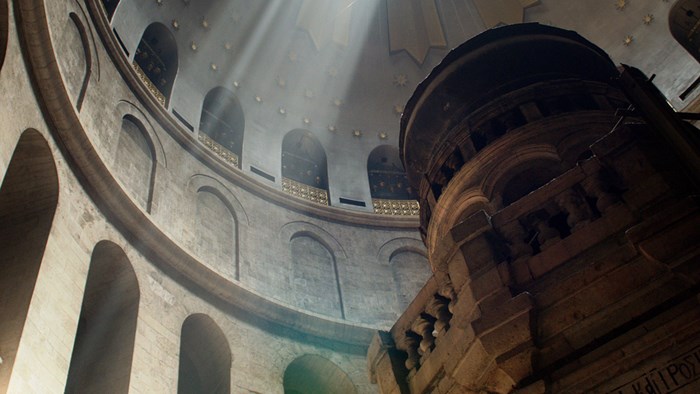
This, one of the few archaeological excavations known to us from ancient times, proved to be more of a success than anyone could have dared hope for. There, for all to see, was a long–buried tomb. In fact we know Constantine';s builders found several tombs. (Some oven–like burial openings, through which they later had to build their walls when constructing the dome, are visible to this day.) Yet one tomb was evidently singled out as being the tomb of Jesus—presumably because it matched the Gospel accounts in some way. From this many scholars conclude that it is perfectly possible that the excavators identified the right tomb (though, of course, we cannot discount the possibility that, even if the excavators were in the correct general vicinity, the actual tomb lay somewhere nearby).
But was anything else from the first century discovered? It all depends on whom you asked. Bishop Cyril, when conducting his baptism classes on the site 20 years later, was adamant that there was indeed another amazing discovery: the wood of the "True Cross." Some fragments of this precious item, he claimed, had already been dispersed "throughout the known world." The main portion was brought out on display for those visiting Jerusalem on Good Friday.
Traditionally, this discovery of the True Cross is associated with Queen Helena. By the end of the fourth century some elaborate stories developed which linked the wood';s discovery to the time of her visit back in 326. Yet Cyril and Eusebius, the first recorded witnesses to the excavations, never explicitly made this link to Helena. Eusebius links Helena';s visit more closely with the commissioning of two quite different churches (see below) and does not mention her being involved with this first Constantinian project over the crucifixion site. Indeed, Eusebius never mentions the True Cross at all and may have been skeptical about its historical authenticity. There were probably some lively disputes associated with this project—which would be repeated many centuries later in many archaeological excavations and the building of several churches!
The Holy Sepulchre
So began the building of what is now usually known as the Church of the Holy Sepulchre (see Battles over Christ's Tomb). Called the Church of the Resurrection by the Eastern Orthodox church to this day, this was in fact a complex of buildings that took nearly 30 years to complete (though dedicated for active worship in 335).
Running from east to west, there was first a basilica– shaped church (known as the Martyrium or "Witness"), then an open courtyard, and then a vast dome over the tomb of Jesus (known as the Anastasis or "Resurrection"). We can see this arrangement reasonably clearly in the floor mosaic known as the Madaba map. The impressive complex of buildings would stand undisturbed for nearly 700 years. Eusebius waxes lyrical in his description and even ventures the rather farfetched thought that these buildings might be seen as a fulfillment of the prophecy in Isaiah 65:17–19 about the "new Jerusalem."
What prompted this remark was the strong contrast between this site and the opposite hill to the east—the Temple Mount (destroyed in A.D. 70). Christians of Eusebius' day (and throughout the next few centuries) decided it was best for that hill to be left abandoned and deserted—not least as a visible reminder of Jesus' prophecies predicting the Temple's destruction. Now a new Jerusalem was being established—one that focused on the worship of Christ, the person who had been rejected in the "old" Jerusalem 300 years before. As Cyril would say, rather pointedly, "that Jerusalem crucified him; this Jerusalem worships him."
Transtorming Palestine
But Constantine had not finished. Some speak of his "Holy Land Plan." This may be too grandiose (suggesting a carefully orchestrated strategy with specific goals), but clearly this project began to attract both his energies and those of the local Christians.
Soon two more churches were being built near Jerusalem: the Church of the Nativity in Bethlehem and a church on the Mount of Olives (known as the Eleona or "olive church"). Eusebius saw these buildings, together with the Holy Sepulchre, as forming a significant triad: Each represented one of the three main clauses of the Christian creed (namely, Jesus' birth, his crucifixion and resurrection, and his ascension). He also linked them together as being focused on three "caves"—the cave where Jesus was born (the tradition of Jesus being born in a cave goes back to the first half of the second century); the cave/tomb of Jesus' burial; and the cave on the Mount of Olives, which Christians had previously identified as the place where Jesus spoke privately to his disciples about the Temple's destruction (Mark 13 and parallels).
These were the churches that Egeria enjoyed.during her visit in the 380s. Indeed, by her day there were others near Jerusalem: for example, the Lazarium (over Lazarus's tomb in Bethany), a church in Cethsemane, and a church on Mount Zion that commemorated Pentecost. The face of Jerusalem was being transformed.
Constantine's interest spread beyond Jerusalem. He ordered the construction of a church at the site of Mamre (near Hebron), associated in biblical thought with the three strange visitors to.Abraham (Gen. 18:1– 22). Eusebius and others understood this event as an instance of a theophany, a visible manifestation of God.
Constantine may have seen the worldwide Christian church as the fulfillment of Cod's promise that Abraham would be the "father of many nations"—or he may have modeled his own life on Abraham, sharing a sense of destiny.
A man called Count Joseph also asked Constantine to consider funding the construction of some churches in Galilee—probably the ones in Nazareth and Capernaum. Theoretically Galilee was, for obvious reasons, very much on the Christian map, but by the fourth century it had become the center of Rabbinic Judaism. The construction of these church buildings seems to have sparked some local opposition. Yet Christian tourists (such as Egeria herself and Jerome's friend Paula) still ventured north.
Popular stopping–points included the lakeside area just to the west of Capernaum (Heptapegon, now known as Tabgha), the village of Cana, and Mount Tabor (the supposed site of the transfiguration). Byzantine Christians clearly wanted to "map out" the scenes of the Gospel and show visitors the sites. Yet in each of these last three instances, it is highly likely that they chose the wrong site. This raises the perennial question of authenticity: Did Byzantine Christians have any secure basis for selecting the sites for their churches?
Each case needs to be judged on its own merits, but the overall pattern is that where there was some local tradition prior to Constantine, the Byzantine identification may be regarded as fairly reliable (this includes most of the Jerusalem sites mentioned above). In many instances, however, such local tradition and memory had sadly been lost; so they were operating in the dark, choosing sites as best they could on the basis of their own reading of the Gospels—and convenience. Judging from the Bordeaux Pilgrim, over–eager pilgrims were often pretty gullible. Today, any visitor to the Holy hand has to deal with this same tension between pilgrimage "certainties" and historical authenticity.
The Holy City?
The New Testament writers don't normally talk of particular places as "holy" or spiritually significant. "True worship" is not connected to particular places but is instead a matter of "spirit and truth" (see John 1:14; Col. 3:1–2; John 4:21–24). If anything, Jesus himself is the true "holy place" (for example, in John 2:19–21 he embodies the significance of the Temple, the "holy place" of the Old Testament). Jesus' coming has shifted God's purposes into a new era. Thus, in these days of the New Covenant, the physical Jerusalem is in "slavery with her children," and instead believers are to focus on the "new" or "heavenly" Jerusalem (for a full discussion, see my book Jesus and the Holy City, Eerdmans, 1996).
This attitude seems to have been the dominant view in the first three centuries. Early Christians like Justin Martyr saw the catastrophic destruction of the city in 70 and again in 135 as evidence that God's purposes had left Jerusalem behind. Eusebius was indebted to the Alexandrian school of thought (represented by theologians such as Origen), which emphasized the spiritual nature of the Christian faith—often contrasted with the so–called "physicality" of Jewish faith. So most of his writings are littered with references to the heavenly Jerusalem and fairly dismissive remarks about the Jerusalem below.
It is only when Eusebius, at age 65, had to find words to describe the discovery of Jesus' tomb that he suddenly started using the language of "holy places." Thereafter, such terminology became commonplace— as seen constantly in the writings of Cyril and Egeria. The Incarnation had made this place sacred. After all, Palestine was the one place in the world that could be described as God's "footstool" (Psalm 132:7), understood by Christians of that era to mean the very "place where his feet had trod." The new attention being given to the places associated with Jesus caused a seismic shift in Christian attitudes toward the land itself.
Cyril saw the physical Jerusalem as having an undeniable pre–eminence in God's saving purposes. (Such a this—worldly focus is hardly surprising, given that he was the up—and—coming bishop of Jerusalem!) He interpreted the reference to the holy city in Matthew 27:53 as "this Jerusalem, in which I am now standing." He constructed a theology, based on the bedrock of the Incarnation, that emphasized the enduring spiritual importance and "holiness" of both Jerusalem and the sites visited by Jesus.
In so doing, Cyril may unwittingly have committed the church to a theology that culminated in the Crusades (the quest to rid "holy places" of supposedly "unholy" people). Much Protestant thought ever since has tended to be cautious about using "sacred" language too freely and to be wary of pilgrimage. Yet the physical rootedness of our Christian faith will not go away, and the existence of the "Holy Land" reminds us of this. An overly spiritual approach can be unhelpful in itself, or perhaps provoke an unhelpful opposite reaction.
Despite its obvious dangers, the flowering of Christian interest in the Holy Land in the fourth century may be a challenge to us all to treasure aright our common Christian history. Some would see the Byzantine period as the golden era of the church in this land, and it certainly is a stark contrast to the situation in modem Israel. We have seen how the Byzantines expressed their faith in the land of Christ's birth. This inevitably raises the question of how we should bear witness appropriately to that same faith and also support those who have that delicate task in the (much more complex) Holy Land of today.
Peter Walker teaches New Testament at Wycliffe Hall in the University of Oxford.
Copyright © 2008 by the author or Christianity Today/Christian History magazine.
Click here for reprint information on Christian History.

Support Our Work
Subscribe to CT for less than $4.25/month