The Land Belongs to God
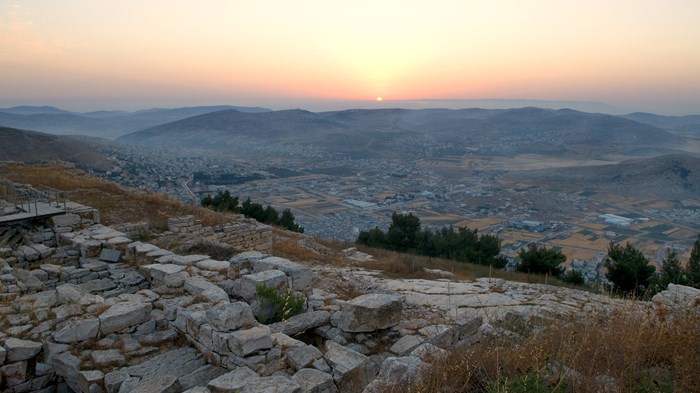


Through the centuries, Romans, Persians, Arabs, Turks, Jews, and even European Christians have conquered, colonized, or invaded the Holy Land, making life difficult for Christian communities. Nevertheless, these followers of Jesus have survived. In this article Archbishop Elias Chacour tells of growing up in the aftermath of the establishment of a Jewish state — and dealing with the anger that came from being displaced from home and village. Not all native Christians have learned to forgive and work for peace as has Fr. Chacour. But he has modeled the Christian life in ways that have won the admiration of Jews, Christians, and Muslims alike. He received the World Methodist Peace Award in 1994 and the Japanese Niwano Peace Prize in 2001.
I GREW UP IN THE SMALL VILLAGE of Biram, amidst the Galilean hills. Mother nurtured my faith by relating the parables and teachings of Jesus. I pictured Jesus walking the rocky hills beside me and talked to him as a friend. Father radiated the love of Jesus by praying for the Zionist soldiers who deceived us, confiscated our home and village, and denied their promise that we would return. After years of study abroad, I was ordained to the priesthood of the Melkite (Greek Catholic) Church in Nazareth in 1960.
Learning to read the parables in Aramaic, the "heart language" of my Lord, helped me to understand them better. I interpret the Beatitudes as the Lord's appeal to his followers to get up and get their hands dirty as they work for peace and justice, and not to be satisfied with passively admiring peace and justice.
Prayer became the inspiration for my words and actions. As I acknowledged the suffering of my people, I also recognized the suffering of my Jewish brothers and sisters. We both trace our ancestry to Father Abraham; therefore, we are "blood brothers." As God's blessed children, we all cherish the land on which we live, but we are sojourners. The land belongs to God (Lev. 25:23).
My early ministry in Ibillin was filled with challenges, and by far the greatest anger between neighbors, church members, and even brothers. Only when I confronted my own anger, which had built up over years of humiliation, blind prejudice ("dirty Palestinian"), and a boyhood beating by an Israeli policeman, could I see that I too was capable of acting in revenge. Through my tears, I asked and received the forgiveness of my Lord, just as he had forgiven his crucifiers. In prayer, God showed me a way to lead my congregation out of hate's darkness and into reconciliation's light.
That Palm Sunday, our church was full of stony- faced, hostile people. Instead of pronouncing the benediction, I walked down the aisle and locked the doors. Returning to the front, I said, "Sitting in a church doesn't make you a Christian. Your words say you love God, yet you hate your brother. I have tried to unite you but could not, as I am only a man. It is only through Jesus Christ that forgiveness and reconciliation is born. I will be silent so he can give you that power." Fearfully we waited. Then, one by one, a hate-filled brother or neighbor stood and pleaded for forgiveness. Soon families were sitting together and former enemies sat side by side. Worship began again — a liturgy of love and reconciliation.
The healing born on Palm Sunday began to spread throughout the community. Villagers offered to repair the church and parish house. Food was brought from farms or kitchens. Muslims as well as Christians wanted to help whenever needed, and together we built a community center, a library, and school buildings. Today, we offer education to Christians, Jews, Muslims, and Druze. There are over 4,000 students attending Mar Elias Educational Institutions (MEEI), with classes from kindergarten through university.
Peace with justice is possible, but only when Palestinians and Israelis, Christians, Jews, and Muslims put aside distrust and hatred and begin to work together in the spirit of reconciliation and love.
Copyright © 2008 by the author or Christianity Today/Christian History magazine.
Click here for reprint information on Christian History.

Support Our Work
Subscribe to CT for less than $4.25/month