George Washington: The ‘American Moses’
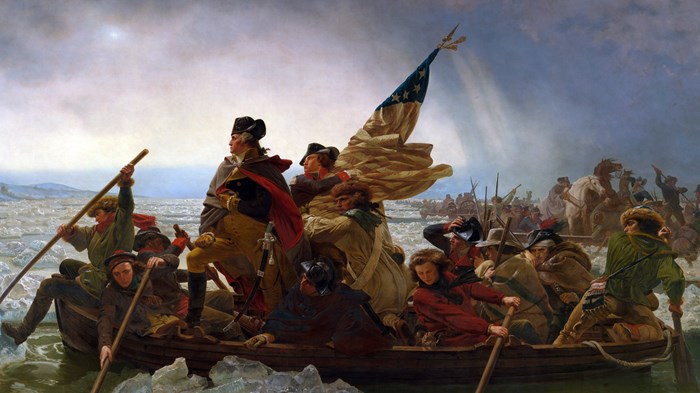


As commander-in-chief of the Continental Army and the first president of the United States, George Washington played an indispensable role in achieving American independence and safeguarding the infant republic. Risking his reputation, wealth, and life, he commanded an undermanned and poorly supplied army to a victory over the world's leading economic and military power. As president, he kept the new nation from crashing on the shoals of anarchy, monarchy, or revolution.
But he longed to return to his beloved Mount Vernon. In September 1796 he published his "Farewell Address" in a Philadelphia newspaper to make clear he would not consider a third term and to offer his prescription for how best to preserve the fragile republic. To prevent their nation from unraveling or being conquered by England, France, or Spain (which still laid claim to land in North America), he warned, Americans must avoid political factions and entangling alliances.
Moreover, the nascent republic could flourish only if it were grounded on religion and morality. These were the "indispensable supports" of "political prosperity" and human happiness. "Virtue or morality," he maintained, "is a necessary spring of popular government."
Under the Constitution framed in Philadelphia in 1787, Americans had embarked on what Thomas Jefferson labeled "the fair experiment": Was freedom of religion "compatible with order in government and obedience to the laws"? The First Amendment mandated that the United States could not establish a national church. Could such a nation endure? If the government did not provide financial and political support for Christianity, as had been done in the West since Theodosius made Christianity the official religion of the Roman Empire in 391, would it still be a vital force in public life? If religion was voluntary, would citizens still act in the morally upright ways that were crucial to a republic's success?
Washington argued that popular government depended on virtuous citizens and that only religion, which in the American context meant Christianity, could inspire such selfless behavior. He frequently asserted that religion helped promote virtue, order, and social stability, and praised the efforts of churches to make people "sober, honest, and good Citizens, and the obedient subjects of a lawful government." He maintained that "general prevalence of piety, philanthropy, honesty, industry and economy" were necessary to America's happiness and success. God had so designed the universe that there was "an indissoluble union between virtue and happiness." Religion and morality "are the essential pillars of Civil society."
In his Farewell Address, Washington urged his countrymen to "observe good faith and justice toward all nations." "Religion and morality enjoin this conduct, and can it be that good policy does not equally enjoin it?" The president sought to promote harmony and positive exchanges with all nations, which prudent policy, American self-interest, and concern for humanity all recommended. In voicing these arguments, Washington spoke for many founders and for almost all his successors as president.
Enigmatic saint
To a certain extent during his life and even more after his death, Washington was elevated to sainthood. An American civil religion arose that revered him as God's instrument and a larger-than-life mythological hero. He has been seen as "the deliverer of America," the savior of his people, the American Moses, and even a demigod. For more than 200 years, Washington's faith has been closely scrutinized, distorted by folklore, endlessly debated, and used by various groups to support their own positions. Many of the hundreds of books, articles, sermons, and essays published about his faith since 1800 have advanced ideological agendas and recounted pious fables about Washington that have little basis in historical fact. Unlike some other founders, Washington was very private about his faith, so unearthing what he believed is very challenging.
Many have extolled the first president as "a Christian hero and statesman," "the founder of a Christian republic," "Christ's faithful soldier and servant," and a "man of abiding faith." Mason Locke "Parson" Weems, the pastor of the Pohick Church near Mount Vernon which Washington sometimes attended, as well as other enthusiasts insist that he regularly attended church services, said grace before all meals, actively participated in church work, and filled his public and private statements with religious exhortations.
These authors argue that Washington served diligently as a vestryman, contributed liberally to churches, had private devotions habitually, strictly followed biblical moral principles, and relied strongly on God's providence. They emphasize his exemplary prayer life, extensive knowledge of Scripture, and repeated calls for public and private piety. They add that Washington served as a godfather for eight children and often led projects to improve the church.
Others counter that Washington's faith was not very deep or meaningful. They label his interest in religion as perfunctory and insist that his practice of Christianity "was limited and superficial because he himself was not a Christian." They stress that he refused to take Communion during the last 25 years of his life, frequently used deistic terms for God such as "the Grand Architect," and seldom referred in his public addresses or private correspondence to Christianity and almost never to Jesus. They argue that Washington never mentioned that Christ was his savior or redeemer and did not even call Jesus a great moral teacher.
Although Washington offered substantial advice to his stepchildren and nephews on moral subjects, he said nothing about religion. Moreover, the Virginian expressed no hope of eternal life and on his deathbed did not call for a minister to pray. Scholars also disagree sharply about the level and nature of his involvement with Freemasonry.
An all-powerful Providence
Washington was raised in the Anglican Church (Episcopal Church after 1783) and maintained a lifelong relationship with this denomination. He recruited chaplains for his troops in the Continental Army, required his soldiers to attend Sunday worship, and held thanksgiving services after victories. Washington attended worship services sporadically before becoming president, due in part to distance and pressing military obligations, but as president he attended church almost every Sunday. He frequently cited biblical passages in his letters to friends and acquaintances and asked religious bodies to pray for him. For example, he thanked Methodist bishops in 1789 for their promise to present prayers "at the Throne of Grace for me" and pledged to pray for them as well.
Washington firmly believed that God controlled events. In both his public and private writings, he constantly praised God for helping the United States win its independence against incredible odds, create a unified country out of diverse and competing interests, establish a remarkable Constitution, and avoid war with European powers that still had territorial ambitions in North America. Throughout his life, Washington appealed to "an all-powerful Providence" to protect and guide him and the nation, especially in times of crisis. During the War for Independence, he asked for and acknowledged God's providential guidance and assistance hundreds of times.
He told Reverend William Gordon in 1776 that no one had "a more perfect Reliance on the all wise and powerful dispensations of the Supreme Being than I have nor thinks his aid more necessary." Because God had fashioned and actively ruled the universe, Washington insisted, people must revere, worship, and obey him. He also repeatedly rejoiced that God was infinitely wise, just, and benevolent.
Washington's faith is difficult to classify. Some scholars label him a deist. However, deists deny three tenets that Washington affirmed: God's active involvement in the world, the value of prayer, and the Bible as God's revelation. Washington may have been a Unitarian, but he never clearly delineated what he believed about Jesus. His faith became unmistakably deeper as a result of his trying and sometimes traumatic experiences as commander-in-chief and as the nation's first president, and it significantly affected his understanding of life and his duties in both roles.
Liberty of conscience
Washington used his enormous prestige and influence to promote freedom of worship and to cultivate positive relations among America's various religious bodies. Along with Jefferson and Madison, who led efforts to establish religious liberty in Virginia and frame the First Amendment, he helped ensure that religious freedom prevailed in the United States. Washington played a leading role in America's shift from state-established religion to the prohibition of a national church.
As commander-in-chief, he refused to tolerate religious prejudice among his soldiers. "While we are contending for our own Liberty," the general declared as his troops prepared to invade Canada in 1775, "we should be very cautious of violating the Rights of Conscience in others," because "God alone is the Judge of the Hearts of Men." In 1782, he argued that Americans had fought for independence because "our Religious Liberties were as essential as our Civil."
As president, Washington promised that he would strive to preserve "the civil and religious liberties of the American People" and to be "a faithful and impartial Patron of genuine, vital religion." He frequently insisted that freedom of conscience was a right, not a privilege. He rejoiced "to see Christians of different denominations dwell together in more charity, and conduct themselves in respect to each other with a more christian-like spirit than ever they have done … in any other nation." The liberty Americans enjoyed to worship "Almighty God agreeable to their consciences," Washington told Quakers in 1789, "is not only among the choicest of their blessings, but also of their rights."
Washington sought to protect the religious rights of America's Catholics and Jews. He countered arguments that the federal government should give Protestants special consideration because of their role in founding the republic and urged citizens not to "forget the patriotic part" Catholics had played in winning the Revolutionary War and in establishing the new government. Washington assured the Jews in Newport, Rhode Island, that in the United States all citizens possessed "liberty of conscience."
Piety and patriotism
Washington was the first major spokesperson and practitioner of American civil religion, and after his death he became a principal figure in its development. In his first inaugural address, the president thanked God for his past guidance and sought his favor for the nation's future. He offered his "fervent supplication to that Almighty Being who rules over the universe, who presides in the council of nations, and whose providential aids can supply every human defect, that His benediction may consecrate to the liberties and happiness of the people of the United States."
Throughout his presidency, Washington's public pronouncements continued to link piety with patriotism and God's benevolence with the welfare of the nation. In his annual message to Congress in 1794, he asserted, "Let us unite … in imploring the supreme Ruler of nations" to protect the United States. He urged Americans to confess their corporate sins. He also set aside days for national thanksgiving, a custom almost all his successors followed.
Moreover, Washington helped develop the creed and moral code of American civil religion, along with its forms and objects of devotion. The creed asserted that God had chosen the United States to incarnate and promote republican government throughout the world. The code demanded that all Americans, especially their political leaders, act virtuously to help accomplish this mission. This civic faith created national saints and shrines, sacred objects, ritual practices, and patriotic holy days.
Not only did Washington help mold and popularize the nation's civil religion, but he also became a significant part of it. Having no established church, the new nation needed a common faith that transcended political and religious differences to direct its public life. Because of his colossal contributions to American independence and his exalted reputation, Washington provided a unifying center and symbol for the new nation.
Almost overnight, Washington became a "'blessed object," "a sacramental center" who pointed to and personified the spiritual power of the fledgling country and exemplified its moral values. After the British surrendered at Yorktown in 1781, Washington was saluted as a demigod and the nation's savior. Worship services, community bonfires, songs, addresses, and cannon fire commemorated his exploits.
Contemporaries frequently compared the general to both biblical and Roman heroes. Like Moses, he liberated his people from bondage; like Joshua, he led them into the Promised Land. Appealing to the biblical archetypes of Moses and David, Washington's eulogists pictured him "as a model republican prophet and king." Like Moses, Washington was depicted as a great lawgiver, an outstanding civil leader, and a virtuous man. He became an ideal type, "a standard of republican leadership" by which his successors could be judged. For many, Washington's life and death helped verify that Americans were God's chosen people who must faithfully follow his laws and serve as an example of true religion and liberty for the world.
The role of religion
Washington's life and convictions illustrate many of the main religious themes in American presidential history: concern about the character and religious commitments of chief executives, the relationship between religion and civic virtue, the meaning of the separation of church and state, the United States as a chosen nation, the nature and importance of religious liberty, and the contours of civil religion. The faith of Washington and many of his successors influenced their philosophy of governing, their relationship with religious constituents, their electoral strategies, and their approach to public policies.
As the United States has become more religiously and ideologically diverse, Washington's conviction that religion is indispensable to both morality and the republic's success has been increasingly challenged. Reexamining the views of the nation's founders and presidents can shed light on the heated debate over what role religion should play in American public life.
Gary Scott Smith is professor of history at Grove City College in Pennsylvania and author of Faith and the Presidency (Oxford, 2006).
Copyright © 2008 by the author or Christianity Today/Christian History & Biography magazine.
Click here for reprint information on Christian History & Biography.

Support Our Work
Subscribe to CT for less than $4.25/month