Fire, Water, and a Risen Savior
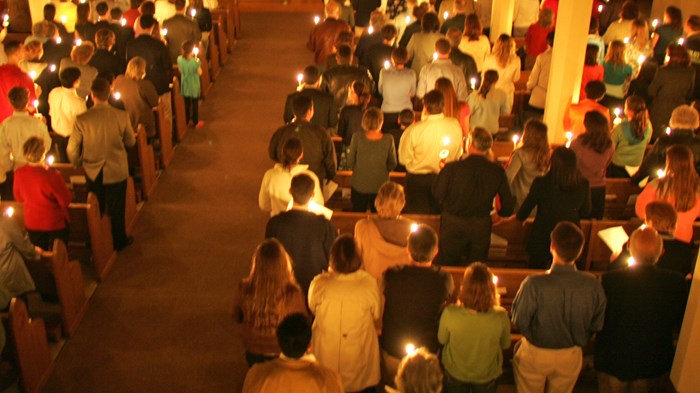


After the long darkness of Lent, the brief exultation of Palm Sunday, and the sorrow of Maundy Thursday and Good Friday, Easter morning dawns. While the secular world sleeps, or reads its New York Times, or hands out bunnies, eggs, and jelly beans to its eager children, the Christian community gathers around a different set of symbols: lilies, trumpets, spring clothes, Easter cantatas, the "Hallelujah Chorus," darkness, fire, water, oil, bread, wine … Wait—what?
Of all Christian celebrations of the events of Christ's life, our modern Easter traditions have perhaps strayed farthest from the ways the early church marked the day—or rather, the days, for they saw Holy Week, and especially its holiest hours from Thursday night to Sunday morning, as an indivisible unit. The New Testament makes clear that early Christians began to meet on the first day of the week (Acts 20:7,11) to "break bread" and celebrate Jesus' resurrection. But though every Sunday was thus a "little Easter," the early church also drew attention to the events of Jesus' last days through what they called the Pascha (taken from the Hebrew word for Passover, and held at the same time of the year). They read Scripture and celebrated the Eucharist to commemorate Jesus' triumphal entry, Last Supper, betrayal, crucifixion, burial, and resurrection. 1 Corinthians 5:7-8 may be a New Testament reference to this festival, and it was certainly being celebrated by the second century, when controversy arose as to whether it should be commemorated on a Sunday or on the date of Passover itself.
Because Paul had described baptism with the imagery of death and resurrection (Romans 6:4-5), the time surrounding Pascha became associated with the baptism of new converts. Tertullian's treatise on baptism (ca. 200) mentions Passover as the most appropriate time for this sacrament. The famous third-century liturgical document The Apostolic Tradition is one of our earliest descriptions of a period of fasting on the Friday and Saturday before Easter, culminating in an all-night vigil on Saturday evening. (In addition to emphasizing a symbolic movement from darkness to light, the vigil took over the idea from Judaism that the religious day begins at sundown.) That night, new Christians were baptized, anointed with oil, and received their first Communion with the community. The inscription on the Lateran baptistery in Rome, which dates from a century or two later, expresses the mood of this celebration: "Sinner, sink beneath this sacred surf that swallows age and spits up youth. Sinner, they know no enmity who are by one font, one Spirit, one faith made one. Sinner, shudder not at sin's kind and number, for those born here are holy."
The Vigil through the centuries
By the fourth century, the celebration of Pascha had expanded both backwards to give us our modern outline of Holy Week, and forward into the "Great Fifty Days" of rejoicing between Easter Day and Pentecost—when, Augustine tells us, "there is no fasting and we pray standing, which is a sign of resurrection." Egeria, a Christian pilgrim who journeyed to Jerusalem, observed that this expansion of the festival developed to accommodate the large number of pilgrims, who could not visit all the holy places at the same time.
The main features of the Easter Vigil service survived unchanged (though elaborated) in the Western church into the Middle Ages. These features included the kindling of "new fire," used to light a Paschal candle to burn throughout the Easter Season; a series of four to twelve readings telling the story of salvation history from the Old Testament (always including the stories of creation and the Exodus) plus Epistle and Gospel readings; the blessing of "new water" and the celebration of baptisms; and (after a great ringing of bells as the congregation sang the Gloria, not to mention a considerable number of alleluias sprinkled throughout the whole service) the Eucharistic meal. The new fire and new water, in particular, were symbolic of both Christ's resurrection and (through baptism) our own.
From cantatas to candy eggs
By the time of the Reformation, though, the Vigil had crept slowly "backward" onto Holy Saturday afternoon—a casualty of the desire in monastic communities to also celebrate the daily office during Holy Week. Thus it lost one of the chief features that had originally given it Scriptural resonance and emotional power—its movement from darkness to light, night to dawn. To varying degrees, Lutheran and Anglican reformers adopted the service in this truncated form. Meanwhile, many Reformed Christians rejected the entire enterprise as hopelessly tainted by Catholicism.
With the Vigil reduced in importance, the Easter Sunday service was left to bear the whole weight of the resurrection celebration. For some time in Catholic and most liturgical Protestant churches, Easter music and vestments had created a more festive version of the usual Sunday service. (Bach, for example, produced a cantata for every Sunday in the church year but a special oratorio for Easter Sunday.) Decorating the church with flowers, especially lilies, was a common custom. Various cultural practices took on increased liturgical prominence—wearing "Easter best," for example, as well as eggs, rabbits, lambs, and other symbols of springtime. By the mid-20th-century, most American Protestant denominations were publishing aids to worship recommending that Easter morning be filled with celebratory hymns, drama, instrumental music, visual aids, and Scripture readings.
Modern longing for liturgy
But some Christians were seeking a more countercultural approach to the holiday that would refocus attention on our own death and resurrection in Christ as well as our expectant longing for the coming of the Spirit at Pentecost. As a Methodist pastor commented in 1959, "It is hard enough to make Lent meaningful in the face of commercial bombardments about Easter clothes, candies, hats, and hams; it is even harder to proceed from Easter Sunday into the season of Eastertide without the support of a secular society which supposes that after the first Sunday Easter is over for another year and that the next biggest religious-commercial date will be Mother's Day." In the explosion of liturgical innovation and recovery in both Catholicism and Protestantism that followed Vatican II, many with such hopes found part of their answer in a revival of the Easter Vigil and a renewed emphasis on the "Great Fifty Days" of the Easter season.
The Vigil has once again become a standard celebration in Catholic, Anglican, and Lutheran churches. (Other mainline denominations recommend it in the liturgical books, though actual practice varies.) Congregants kindle new fire, hear the stories of creation, exodus, prophecy, and redemption, welcome new Christians in baptism, and gather around the Communion table. The service opens with the ancient Christian hymn called the Exultet: "This is the night when first you saved our fathers: you freed the people of Israel from their slavery and led them dry-shod through the sea. This is the night when the pillar of fire destroyed the darkness of sin! This is the night when Christians everywhere, washed clean of sin and freed from all defilement, are restored to grace and grow together in holiness. This is the night when Jesus Christ broke the chains of death and rose triumphant from the grave." And the church still proclaims, after two thousand years, the message of Jesus' resurrection and our redemption. Sinner, shudder not at sin's kind and number; for those born here are holy.
Jennifer Woodruff Tait is adjunct professor of church history at Asbury Theological Seminary.
Copyright © 2009 by the author or Christianity Today/Christian History & Biography magazine.
Click here for reprint information on Christian History & Biography.

Support Our Work
Subscribe to CT for less than $4.25/month