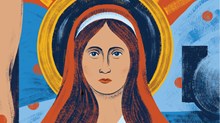
Truth in Stone and Marble


Our college recently built a large chapel designed in the style of a traditional New England church, with a tall white steeple. Inside are simple pews, white walls, large clear windows with a few smaller bits of medieval stained glass in the front preserved from the earlier chapel on campus. It is a beautiful building and one quite comfortable for many American Christians. Christians from the Middle Ages, the Byzantine Empire, or the Baroque period in Europe, however, might be startled by the austerity of the place. Where are the images of Christ and pictures of biblical narratives? There are no heavenly glimpses of angels with gilded wings or ornately carved furnishings.
While in our own time the visual arts are largely thought of as a sphere separate from Christian faith, this is an anomaly historically. For most of the last two millennia, Christian art was the norm. Painters and sculptors, like musicians, saw their work as bringing glory to God. Churches, private chapels, and tombs were adorned with explicitly Christian images that communicated the faith of artists, patrons, and their communities. We see bits of this art preserved in museums and European cathedrals, but we rarely see the art functioning in its original liturgical context, contributing to a worshipful environment. To better appreciate what is missing from our worship spaces today, it helps to explore Christians' first attempts to express their faith through images.
Images and Idols
Christian art got off to a slow beginning. The earliest Christians expected the imminent return of Christ, so they were slow to adopt a program of transforming culture! But there were other obstacles. Christians in the ancient world tended to be suspicious of art and images—for good reason. In the Greco-Roman world, art was inextricably linked with pagan religion (as were other aspects of culture, including education, the theater, and athletic games). Classical myths about the gods and goddess were the subject of much artwork, but the problem went deeper than that. Sculptors, painters, and even gold and silver smiths were employed in the manufacture of idols.
There is evidence for this in the New Testament when Paul's friends earn the wrath of the silver smiths of Ephesus who made idols of Artemis. The artisans feared that the preaching of the gospel might jeopardize their livelihood, and so they dragged the missionaries to the theater for judgment, chanting, "Great is Artemis of the Ephesians!" (Acts 19:23-30) At the beginning of the second century, Hippolytus gave this advice for screening candidates for baptism: "If a man be a sculptor or a painter, he shall be taught not to make idols. If he will not desist, let him be rejected …" So if an artist converted to Christianity, he stood to lose a big cut of his business.
The second commandment provided a Scriptural basis for ambivalence about image making: "Thou shalt not make unto thee any graven image, or any likeness of any thing that is in heaven above, or that is in the earth beneath, or that is in the water under the earth" (Exodus 20:4 KJV; more modern translations rightly clarify the problem as idolatry, not images themselves). The Hebrew God was spirit and could not be depicted with metal or stone; the creation was not to be worshiped in place of the Creator. There were, however, Scriptural commands to decorate the tabernacle and the liturgical items that filled it (Exodus 25). Jews in the Hellenistic and Roman eras did use art, sometimes even pagan symbols such as the zodiac or the sun god, to decorate their synagogues.
In addition to portraying the gods, images had another use in the Greco-Roman world: honoring the emperors. These were not only political images but also cult images. During periods of persecution Christians were required to sacrifice to the images of emperors, so this too gave art a negative connotation to early Christians.
Art in the Catacombs
No explicitly Christian artworks survive from the first and second centuries, whether because Christians did not have the material resources or because they lacked the artistic vision to manifest their faith visually. Christian art began in earnest in the third century. The art that survives from this period is funerary art in catacombs and sarcophagi well preserved underground. The catacombs were not places where Christians hid from persecution as is popularly imagined. In fact, these burial places were registered with the Roman government, which was very fastidious about the proper disposal of dead bodies. It is interesting that the first distinctively Christian art was funerary, since Christian beliefs about the afterlife were so distinct from the rest of Greco-Roman culture.
The Christian images in the catacombs are simple symbols, quickly rendered with a basic color palette on the white plaster walls of the burial chambers. The symbols are derived from the Greco-Roman visual vocabulary: a dove, ship, anchor, fisherman, peacock, grapevines, loaves and fishes. These symbols had traditional meanings that could be reinterpreted in a Christian context. Thus grapevines associated with harvest or the god Bacchus could come to refer to the Eucharistic wine used in Christian worship. The anchor, representing salvation, and the peacock, standing for eternal life, were easy to infuse with Christian meaning.
The earliest representation of Christ emerged in a similar manner. Derived from pagan images of the Greek hero Orpheus from Greek mythology or a Hellenistic representation of philanthropy, the image of a shepherd with a sheep draped across his shoulders brought to mind for Christians Jesus' parable of the Good Shepherd and his own self-identification with this potent image: "I am the good shepherd: the good shepherd giveth his life for the sheep" (John 10:11). The figure of the Good Shepherd represented Christ but was not a portrait of Jesus. Sometimes a cross-shaped halo added to the image highlighted the connection between Christ and the Good Shepherd, as in the fifth-century mosaic in the mausoleum of Galla Placidia, daughter of Emperor Theodosius the Great.
Other images in the catacombs come from Old Testament narratives: Noah's ark, the three Hebrew children in the fiery furnace, the sacrifice of Isaac, and scenes from the life of Jonah. We know from early biblical exegesis that Christians believed these passages to prefigure the coming Christ. The stories tell of salvation and redemption. New Testament narratives appear in the catacombs as well, including the adoration of the Magi and the raising of Lazarus. In the Catacomb of St. Priscilla in Rome, there is a third-century image of a woman holding an infant in front of a prophet, who is pointing to a star above their heads; scholars argue that this is the earliest representation of the Virgin and Child.
Christians gathered in the catacombs to worship and celebrate the Eucharist, not because they were hiding from Roman soldiers but because the proximity to the graves of their loved ones, including saints and clergy, held spiritual significance for them. The images that surrounded them spoke of God's promise of salvation. Another example of third-century Christian art that survives, this time far from Rome in Syria, also points to a liturgical focus. In the early house church at Dura-Europos, wall paintings in a room used for a baptistery depict Adam and Eve (recalling the Fall), Christ as the Good Shepherd, and David vanquishing Goliath, as well as scenes from the life of Christ. As new believers were initiated into the faith, the power of Christ to rescue them from death was proclaimed through the pictures around them.
The triumph of Christian art
With the legalization of Christianity in the fourth century, Christian art shifted because of imperial patronage. The newly converted emperor Constantine dispatched his mother Helena to Jerusalem, soon to become the center of a new Christian Holy Land. She oversaw the building of many churches, including the Church of the Holy Sepulchre over the site of Christ's death and resurrection and the Church of the Nativity in Bethlehem.
The triumph of Christian art is visible in the brilliant mosaics that decorate the fifth- and sixth-century churches of Ravenna, the seat of Byzantine imperial authority in Italy. Glittering pieces of glass that have not lost their color over the centuries adorn the interior of the churches and baptisteries, depicting Christ enthroned over the altar and rich narratives from the Old and New Testaments on the walls. Processions of male and female martyrs and even an emperor and empress are shown bringing their gifts to Christ. Colorful marble columns with ornately carved capitals support soaring domes above inlaid marble floors. The fully developed iconographic programs and architectural plans found in the worship spaces of Ravenna contrast with those first humble images in the catacombs in Rome. But both use the same language of visual images, sharing one vocabulary as they announce the saving message of the gospel to those who come to offer prayers and praise.
Christians in late antiquity worked out a way to infuse new meaning into the visual images they found in their own culture, even in a world that seemed to equate art with idolatry. In a similar manner today, Christians who have grown up in branches of Protestantism that have traditionally eschewed art in worship are now reconnecting in new ways with both the long tradition of Christian art and the sometimes off-putting world of contemporary fine art. As worshipers, artists, and patrons of art, they are engaging the surrounding culture and seeking a new visual vocabulary to express the truth of the gospel. To catch a glimpse of this new endeavor unfolding, I need only walk to the opposite end of our campus from the chapel, to the newly refurbished gymnasium-turned-Fine Arts Center, with open studios and galleries, to see the next generation of Christian artists busy with stone, clay, and pigment, working hard to glorify their Creator.
Jennifer Hevelone-Harper, associate professor and chair of history at Gordon College, teaches regularly in Gordon's study abroad program in Orvieto, Italy, where students from many institutions explore the connections between art, faith, and history.

Support Our Work
Subscribe to CT for less than $4.25/month