The Caged Bird Wrote
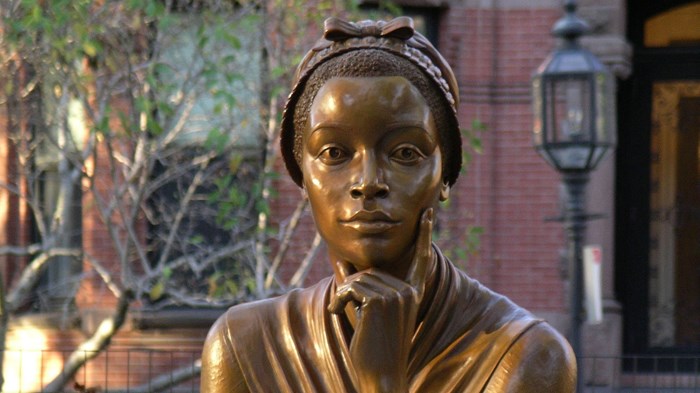


I can imagine the discussion in the CBS conference room: "February sweeps … Black History Month … Clinton allegations … let's do a miniseries on Thomas Jefferson and Sally Hemmings!" Not that there isn't a story to be told, or that the founding Fathers should be exempt from investigation. It's just that, as far as I can tell from the promotional spots, this miniseries jettisons what few historical accounts we have of Ms. Hemmings in favor of holding her up as a heroine who fluently speaks the language of feminism and civil rights. If only CBS had instead chosen to feature a true heroine of the colonial era: Phillis Wheatley.
Phillis, who was born in West Africa around 1753, was only 7 when slavers stole her from her parents and shipped her to America. She was purchased by John Wheatley, a prominent Boston tailor, as a personal servant for his wife. The Wheatleys brought Phillis to their church, where she was baptized at age 18. They also saw to her education (a benefit not usually bestowed on slaves), and she quickly learned to read and write in English. She also read Greek and Latin classics and passages from the Bible, all of which influenced the poetry she began writing at age 13.
Phillis published her first poem in 1767, but no American publisher would take a chance on a complete volume. Many people (including Thomas Jefferson) couldn't believe a woman, let alone a black woman, could have written such classically minded verses. The Wheatleys eventually found a British publisher for the 39-piece collection, Poems on Various Subjects Religious and Moral.
The volume began with this disclaimer: "We whose names are under-written, do assure the world, that the poems specified in the following page, were (as we verily believe) written by Phillis, a young Negro girl, who was but a few years since, brought an uncultivated Barbarian from Africa, and has ever since been, and now is, under the disadvantage of serving as a slave in a family in this town. She has been examined by some of the best judges, and is thought qualified to write them." Eighteen names followed, including those of the governor and lieutenant governor of Massachusetts, five judges, seven pastors, and John Wheatley.
Phillis's most popular poems celebrated George Whitefield and George Washington; she also wrote many elegies and pieces centered on religious themes. Though she wrote openly and exuberantly about Christianity, she was more circumspect when writing about race and slavery. She did liken her bondage to England's oppression of the states, which made her popular with revolutionaries. But she also found some good in her situation, which is probably why she's disqualified from ever appearing in a CBS miniseries. Note the sentiment in her well-known poem "On Being Brought from Africa to America":
'Twas mercy brought me from my pagan land, Taught my beknighted soul to understand That there's a God, that there's a Savior too: Once I redemption neither sought nor knew. Some view our sable race with scornful eye, "Their color is a diabolic dye." Remember Christians: Negroes, black as Cain, May be refin'd, and join th' angelic train.
Abolitionists esteemed Phillis and her work, and they featured her in tracts to show that blacks were not inferior. Unfortunately, her symbolic significance didn't translate into success during her lifetime. The Wheatleys freed her, but she had an unhappy marriage and buried all three of her children young. Phillis was only 31 when she died, penniless, on the outskirts of Boston. So, yes, her story would make a fairly depressing TV special. But the founder of African-American literature certainly deserves the attention.
* Read Phillis Wheatley's poems
Copyright © 2000 by the author or Christianity Today/Christian History magazine.
Click here for reprint information on Christian History.
Copyright © 2000 by the author or Christianity Today/Christian History magazine.
Click here for reprint information on Christian History.

Support Our Work
Subscribe to CT for less than $4.25/month